
Pore regulation determines AAC blocks’ compressive strength, uniform density and surface finish. Defoaming equipment stabilizes raw slurry and optimizes internal pore structure.
Manufacturers select matched devices according to raw materials, output and factory layout. Customized machinery enhances operational performance, line compatibility and overall production stability.
AAC Bubble Removing Device
Uniform internal pores decide AAC block strength. Uncontrolled bubbles in pre-curing cause irregular holes, uneven density and fragile zones inside blocks.
Defoaming stabilizes slurry before cutting, removing large unstable bubbles without sacrificing AAC’s intended lightweight performance.
| Control Factor | Effect on AAC Production | Bubble Removing Device Function |
| Bubble Size Distribution | Influences block density and strength consistency | Removes oversized and unstable bubbles |
| Slurry Uniformity | Affects cutting accuracy and finished quality | Improves slurry stability before curing |
| Surface Quality | Determines appearance of AAC blocks | Reduces surface defects caused by air accumulation |
| Production Stability | Impacts continuous casting operation | Supports consistent batch performance |
Main Factors for Selection
Production Capacity Matching
Defoaming capacity must match the throughput of AAC production lines. If device handling capacity lags behind slurry supply, residual unstable bubbles will compromise finished block quality.
Small and medium production lines adopt compact defoaming units, while large factories deploy high-output equipment compatible with automated casting lines.
Slurry Characteristics
Raw materials including cement, lime, fly ash, sand, and aluminum powder influence slurry viscosity and bubble formation behavior.
Different slurry formulas may require adjustments in:
- Bubble removal intensity
- Processing time
- Mixing and separation structure
- Control parameters
A Custom design allows manufacturers to optimize equipment performance according to specific raw material conditions.
Production Line Connection
AAC Bubble Removing Devices are usually connected before casting and pre-curing processes. The equipment layout should consider:
- Existing casting machine position
- Slurry transportation route
- Maintenance space
- Automatic control requirements
Proper integration helps avoid unnecessary transfer distance and keeps the production process continuous.
Types Based on Production Requirements
| Equipment Type | Main Characteristics | Suitable Application |
| Standard Bubble Removing Device | Simple structure, stable operation, easy maintenance | Small and medium AAC production lines |
| Automatic Bubble Removing System | Integrated control and continuous operation | Large AAC block factories |
| Customized Bubble Removing Equipment | Designed according to line layout and slurry conditions | Special production requirements |
Key Technical Parameters
The AAC Bubble Removing Device uses a lifting structure with 16 vibrating rods to homogenize slurry bubbles, improve block consistency, and support stable AAC production performance.
| Parameter | Specification |
| Equipment Type | AAC Bubble Removing Device |
| Lifting Power | 0.75 kW |
| Number of Vibrators | 16 pcs |
| Vibrating Rod Power | 0.5 kW × 16 |
| Equipment Weight | 416 kg |
| Main Function | Homogenizes air bubbles in freshly poured AAC slurry |
| Installation Position | Casting and pre-curing process |
| Supply Scope | Vibrating rods, brackets, lifting drive, sheave sets, wire ropes |
Configuration for Different Production Lines
For newly built AAC factories, the bubble removing device can be planned together with casting systems and material handling equipment. For existing production lines, the equipment structure may need to be adjusted according to available installation space and current slurry transportation conditions.
- Small and Medium AAC Plants
Compact bubble removing equipment, simple installation, stable operation, suitable for standard production requirements.
- Medium Capacity AAC Lines
Semi-automatic bubble removing systems, balanced processing capacity, flexible operation, and reliable production control.
- Large AAC Block Factories
Automatic bubble removing solutions, continuous operation, improved production consistency, and better process integration.
- Special Layout AAC Plants
Custom bubble removing equipment, optimized structure, dimensions, and connection design for specific production conditions.
Operation Features of Advanced AAC Bubble Removing Equipment
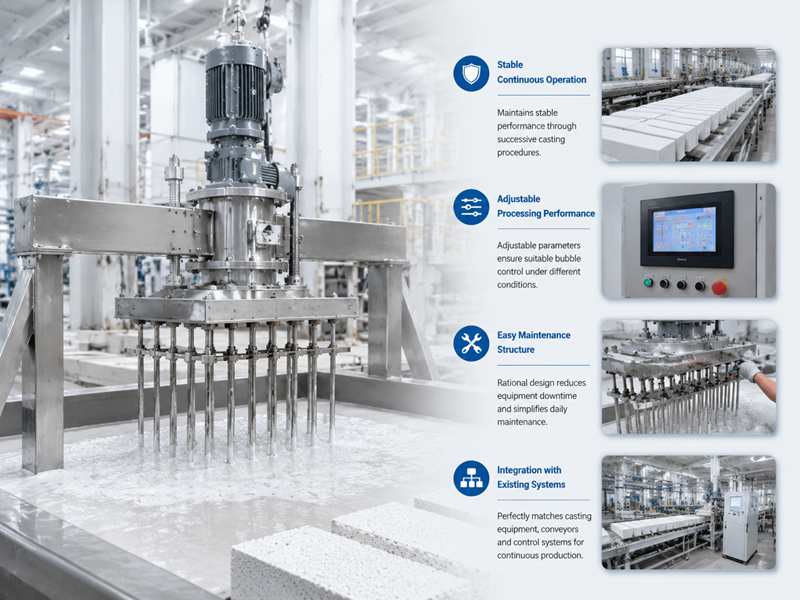
Modern AAC production demands equipment stable enough for prolonged operation. Defoaming units need effective bubble removal performance alongside simple operation and convenient servicing.
Stable Continuous Operation
To raise output efficiency, AAC workshops run uninterruptedly. Accordingly, bubble removal equipment must maintain stable performance through successive casting procedures.
Adjustable Processing Performance
Adjustable parameters help manufacturers maintain suitable bubble control when raw materials or production targets change.
Easy Maintenance Structure
All production machinery requires periodic inspection and maintenance. Rational structural design cuts equipment downtime and elevates daily operational efficiency.
Integration with Existing Systems
The unit shall match casting gear, conveyors and auto-control systems perfectly to realize continuous manufacturing procedures.
Relationship Between Bubble Removal and AAC Block Quality
Density alone cannot decide AAC block strength. Pore structure, even pore distribution and curing environment jointly affect mechanical properties.
Too many unstable bubbles formed during casting cause internal unevenness, worsening cutting quality, surface look and consistent strength after autoclave curing.
A properly selected AAC Bubble Removing Device helps improve:
- Uniform pore distribution inside AAC blocks
- Stability of slurry before pre-curing
- Consistency between different production batches
- Surface quality after cutting
Custom AAC Bubble Removing Device Solutions
Custom AAC Bubble Removing Device solutions can be developed according to:
- Required processing capacity
- Existing production line dimensions
- Slurry characteristics
- Automation requirements
- Installation space limitations
| Device Type | Capacity | Power | Removal Efficiency | Application |
| Vacuum Bubble Remover | 20 m³/h | 2.5 kW | 95% | Pre-curing Process |
| Centrifugal Bubble Remover | 30 m³/h | 3.0 kW | 90% | Slurry Preparation |
| Hydraulic Bubble Remover | 40 m³/h | 4.0 kW | 92% | Mold Filling |
| High-Frequency Bubble Remover | 25 m³/h | 3.5 kW | 94% | Casting Process |
| Ultrasonic Bubble Remover | 50 m³/h | 5.0 kW | 98% | Pre-curing and Final Finishing |
AAC production lines have different requirements for bubble control according to casting capacity, slurry characteristics, and process layout.
RunDing provides different AAC Bubble Removing Device types, including vacuum, centrifugal, hydraulic, high-frequency, and ultrasonic solutions, allowing manufacturers to select suitable equipment according to production conditions.
Maintenance Considerations
Defoaming devices primarily operate during casting preparation, yet routine maintenance is critical to consistent production. Standard upkeep sustains stable bubble regulation and minimizes unplanned production halts.
| Maintenance Area | Recommended Attention |
| Mechanical Components | Check rotating parts, transmission components, and wear conditions |
| Contact Parts | Clean slurry-contact surfaces regularly |
| Control System | Inspect sensors, electrical connections, and operating parameters |
| Equipment Structure | Check installation stability and connection conditions |
Dust, humidity and alkaline substances prevail in AAC production workshops, so equipment materials and structural designs must adapt to long-term harsh operating environments.
Periodic inspections prolong equipment service life and guarantee stable defoaming during uninterrupted manufacturing.
Choosing an AAC Bubble Removing Device requires evaluating capacity, slurry conditions, layout, and automation needs to ensure stable production quality.
Suitable solutions improve pore uniformity, surface quality, and manufacturing efficiency, from standard equipment selection to fully Custom designs.