
AAC expansion control relies on aluminum slurry quality. Consistent mixing guarantees even dispersion, precise concentration and stable gas evolution in production.
Optimized aluminum slurry preparation minimizes expansion variation, improves uniformity of block density, and enables stable, efficient AAC manufacturing for large-scale production lines.
Aluminum Slurry Mixing in AAC Expansion Control
Aluminum powder generates hydrogen gas in AAC mixtures, creating pores for lightweight blocks. Uniform slurry distribution ensures stable expansion and consistent internal structures.
Fluctuating aluminum slurry concentration causes uneven gas generation, affecting mold expansion, density control, and final AAC block quality.
A well-designed aluminum slurry mixing machine helps manufacturers control:
| Control Factor | Influence on AAC Production |
| Aluminum powder dispersion | Determines gas generation uniformity |
| Slurry concentration | Affects expansion consistency |
| Mixing time | Influences particle distribution stability |
| Feeding accuracy | Maintains repeatable batch quality |
Aluminum Slurry Mixing’s Impact on AAC Expansion
Uniform Aluminum Powder Dispersion
Adequate stirring is essential to evenly distribute aluminum powder. Well-dispersed ingredients form a homogeneous slurry suspension and stabilize the expansion performance of autoclaved aerated concrete.
Controlled mechanical agitation maintains uniform suspension of aluminum particles prior to pouring. This mitigates inconsistent chemical reactions and facilitates the formation of regular pore structures inside AAC blocks.
For continuous AAC production, this uniformity helps reduce:
- Expansion height deviation
- Density differences between blocks
- Internal pore structure variation
- Cutting process instability
Stable Aluminum Slurry Concentration
Precise dosing of aluminum slurry is critical in AAC manufacturing, as deviations in aluminum content will alter the foaming and expansion performance of the product.
A steady stirring system ensures a fixed mixing proportion of aluminum powder and water, eliminating discrepancies brought by manual batching operations.
| Parameter | Production Influence |
| High aluminum concentration | Faster gas generation and possible over-expansion |
| Low aluminum concentration | Insufficient expansion and higher density |
| Stable concentration | More predictable pore structure |
Slurry concentration control is particularly vital for manufacturers producing AAC blocks of varying densities, as different product specifications demand distinct expansion levels.
Optimized Slurry Mixing for Higher AAC Production Efficiency
Foaming defects impact not only the exterior of AAC blocks but also cutting precision, raw material utilization and overall production efficiency.
When aluminum slurry quality remains stable, AAC manufacturers can achieve:
- More consistent block density
- Reduced trimming waste
- Improved cutting stability
- More predictable production cycles
Minor improvements in expansion regulation bring remarkable economic gains to large AAC factories, given their daily high-volume block output.
Design Features of AAC Aluminum Slurry Mixing Machines
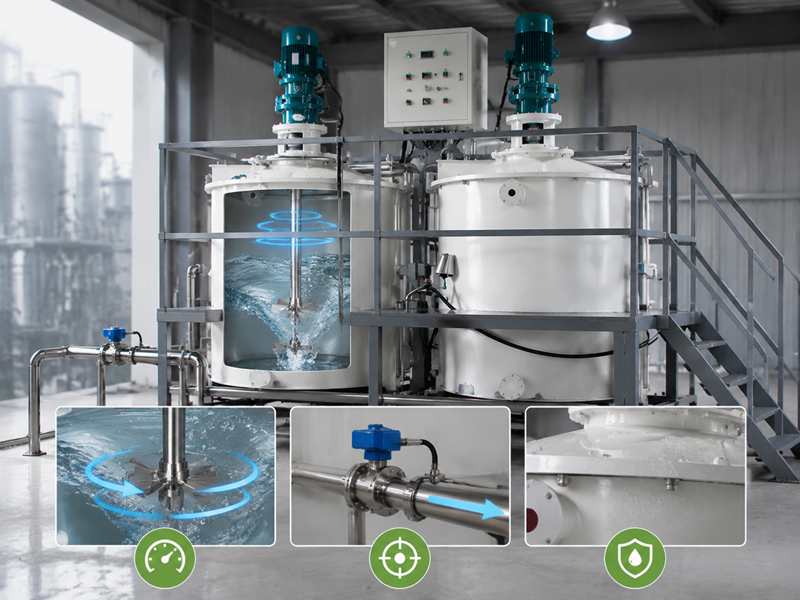
High-Speed Mixing Structure
The dispersion rate of aluminum powder in water is governed by mixer structure.
AAC aluminum slurry mixers commonly adopt high-speed rotating parts to enhance powder uniformity and cut mixing duration.
Optimal mixing rotating speed enables the following benefits:
- Faster slurry preparation
- Better aluminum particle dispersion
- Reduced sedimentation during transfer
- More stable feeding performance
Accurate Feeding Connection
Aluminum slurry is typically introduced at a designated stage prior to pouring. The linkage between mixing machinery and the batching system exerts a direct impact on expansion uniformity.
A properly designed aluminum slurry system should coordinate with:
- AAC mixer operation cycle
- Mold filling timing
- Slurry temperature condition
- Production speed
Corrosion-Resistant Equipment Structure
Aluminum slurry consists of water and reactive substances, so the mixer equipment must feature strong anti-corrosion properties.
Mixing tanks, pipelines and connectors are constantly exposed to humid and chemically reactive conditions during long-term continuous production.
A suitable machine structure helps maintain:
- Longer service life
- Stable mixing performance
- Lower maintenance frequency
- Cleaner slurry preparation conditions
AAC Production & Aluminum Slurry Mixing Parameters
AAC producers demand aluminum slurry mixing equipment compatible with their output scale and foaming regulation standards. RunDing Machine’s ASM aluminum slurry mixing units come in multiple specifications with distinct tank volumes, stirring power and homogenization performance, catering to diversified AAC production lines.
| Model | Volume (L) | Blending Power (kW) | Homogenizing Power (kW) |
| ASM-200 | 200 | 1.5 | 3 |
| ASM-500 | 500 | 2.2 | 4 |
| ASM-1000 | 1000 | 2.2–4 | 7.5 |
| ASM-1500 | 1500 | 4–5.5 | 11 |
| ASM-2000 | 2000 | 5.5 | 11 |
| ASM-3000 | 3000 | 7.5 | 15 |
| ASM-5000 | 5000 | 11 | 22 |
Proper ASM models are selected based on output, slurry usage and batching demands, with customized options for large factories.
Mixing Control for Stable AAC Expansion
Uniform expansion cannot be achieved merely by high-performance equipment. AAC producers must coordinate mixing parameters with actual production conditions.
Mixing Time Control
Inadequate mixing time leads to incomplete dispersion of aluminum powder, yet overmixing creates redundant preparation cycles.
Key factors determining ideal mixing duration include:
- Aluminum powder characteristics
- Water temperature
- Production capacity
- Mixing equipment design
Slurry Temperature Coordination
Temperature governs the reaction rate of aluminum powder within AAC slurry. Aluminum slurry preparation must align with the temperature of the AAC batching system during manufacturing. Stable temperature environments facilitate the following outcomes:
- Control hydrogen generation speed
- Improve expansion uniformity
- Reduce seasonal production differences
Manufacturers in varying climate zones can customize aluminum slurry systems to adapt to local production conditions.
Automatic Control Integration
Large-scale AAC factories pursue higher automation to avoid inconsistencies caused by manual tuning. The integrated aluminum slurry mixing system can link to:
- PLCcontrol systems
- Automatic dosing equipment
- Production management systems
- Batching control platforms
Solutions for Different AAC Production Lines
| Production Scale | Main Requirement | Recommended Model | Mixing Consideration |
| Small AAC Plant | Flexible operation | ASM-200 / ASM-500 | Compact capacity and easy maintenance |
| Medium AAC Line | Stable daily production | ASM-1000 / ASM-1500 | Balanced mixing capacity and production stability |
| Large AAC Factory | Continuous operation | ASM-2000 / ASM-3000 | Higher capacity and stronger slurry preparation ability |
| High-Capacity AAC Project | Large output demand | ASM-5000 | Continuous operation and customized production integration |
For example, factories with multiple casting lines may require higher-capacity aluminum slurry preparation systems, while smaller production plants may focus more on equipment flexibility and simple operation.
Custom Design
AAC production lines differ greatly in layout, throughput and automation; standard machines often fail to fit on-site conditions. Custom aluminum slurry mixing equipment allows manufacturers to adjust units based on:
- Production capacity requirements
- Installation space limitations
- Automatic feeding systems
- Existing AAC batching equipment
- Local operating conditions
Custom designs cover tank capacity modification, motor matching, electrical control upgrades and pipeline connection structures.
AAC plants expanding output can upgrade their aluminum slurry mixing units to stabilize foaming performance, without full production line replacement.
Maintenance Focus
| Component | Maintenance Focus |
| Mixing Tank | Check internal cleanliness and material accumulation |
| Mixing Blade | Inspect wear condition and rotation performance |
| Motor System | Monitor operation stability and temperature |
| Pipeline Connection | Prevent leakage and slurry blockage |
Routine maintenance preserves stable mixing performance and prevents unplanned downtime in AAC manufacturing.