
Regular upkeep of AAC ferry trolleys guarantees steady mold delivery, precise positioning and uninterrupted production. It cuts equipment downtime and enhances coordination between devices.
Maintenance schedules should be customized based on factory output, mold load, operation frequency and workshop layout to sustain consistent transport operation.
Key Maintenance Areas of AAC Ferry Cart
Each part influences different operating conditions. For example, insufficient lubrication may increase wheel resistance, while inaccurate positioning may interrupt mold transfer between production stations.
| Maintenance Area | Main Inspection Items | Maintenance Purpose |
| Travel System | Wheels, rails, bearings, alignment | Ensure stable movement and reduce vibration |
| Drive System | Motor, reducer, coupling, transmission parts | Maintain smooth transportation performance |
| Electrical System | Control cabinet, sensors, cables, limit switches | Improve operation reliability |
| Positioning System | Stop devices, sensors, positioning accuracy | Ensure accurate mold transfer |
| Structural Components | Frame, welding points, protective parts | Maintain long-term mechanical strength |
Travel System Maintenance
Maintenance of wheels, rails and bearings stabilizes the running mechanism of AAC ferry trolleys, cutting vibration and transport breakdowns.
Routine cleaning, alignment calibration and abrasion inspection guarantee precise mold conveyance, particularly for high-output AAC production lines running nonstop.
Drive System Inspection and Maintenance
Long-term operation under heavy loads may gradually increase mechanical wear. Checking lubrication conditions, connection tightness, and abnormal noise can help maintain reliable performance.
A suitable maintenance schedule should consider:
- Operating hours per day
- Mold transportation frequency
- Average transportation load
- Working environment conditions
For example, AAC production lines running continuously require more frequent inspection compared with small-capacity plants operating fewer hours.
Electrical Control System Maintenance
Modern AAC ferry carts usually integrate automatic control functions to improve transportation efficiency and positioning accuracy.
The electrical system commonly includes:
- Control cabinet
- Travel control system
- Sensors
- Limit switches
- Remote operation interface
Electrical maintenance should focus on connection stability, sensor sensitivity, and protection against dust or moisture.
Maintenance Schedule
Standardized maintenance schedules enable staff to efficiently monitor trolley conditions. Routine inspections maintain steady operation and avoid unexpected breakdowns.
| Maintenance Frequency | Recommended Inspection | Application Focus |
| Daily | Cleaning, abnormal noise checking, operation observation | Detect immediate operating problems |
| Weekly | Wheel condition, lubrication points, electrical connections | Maintain normal running performance |
| Monthly | Motor, reducer, sensors, positioning accuracy | Prevent component degradation |
| Annual | Full system inspection and component evaluation | Support long-term operation planning |
Maintenance Requirements Based on Ferry Cart Configuration
AAC ferry carts are often customized according to production line layout, mold dimensions, transportation distance, and capacity requirements.
For example, a ferry cart operating in a large AAC factory with multiple production stations may experience higher transportation frequency compared with a compact production line. In this case, attention should be given to travel components and positioning systems.
Parameters and Maintenance Considerations
The technical specifications of ferry carts directly influence maintenance requirements. Larger capacity models require stronger structural inspection, while longer travel distances require more attention to rail alignment and drive performance.
| Model Type | Typical Application | Main Parameters | Maintenance Focus |
| Standard AAC Ferry Cart | Medium AAC production lines | Stable mold transportation between sections | Wheel system and positioning accuracy |
| Heavy Duty Ferry Cart | Large-scale AAC plants | Higher loading capacity and continuous operation | Drive system and structural inspection |
| Customized Ferry Cart | Special plant layouts | Designed according to production requirements | Customized maintenance plan |
Maintenance of Wheel and Rail System
In AAC production plants, the working environment usually contains dust, moisture, and material particles, which may gradually influence wheel rotation and rail contact performance.
Regular maintenance should include checking rail cleanliness, wheel surface condition, bearing lubrication, and alignment accuracy. Small deviations in rail installation or wheel wear may increase resistance during movement, causing additional load on the drive motor.
| Inspection Item | Possible Influence on Operation | Recommended Maintenance Action |
| Rail Surface | Increased friction and unstable movement | Remove dust and production residues regularly |
| Wheel Wear | Reduced positioning accuracy | Check wheel condition and replace when necessary |
| Bearing Lubrication | Higher running resistance | Add suitable lubricant according to operation frequency |
| Rail Alignment | Cart deviation during travel | Verify track level and installation accuracy |
Maintenance Considerations for Different Operating Conditions
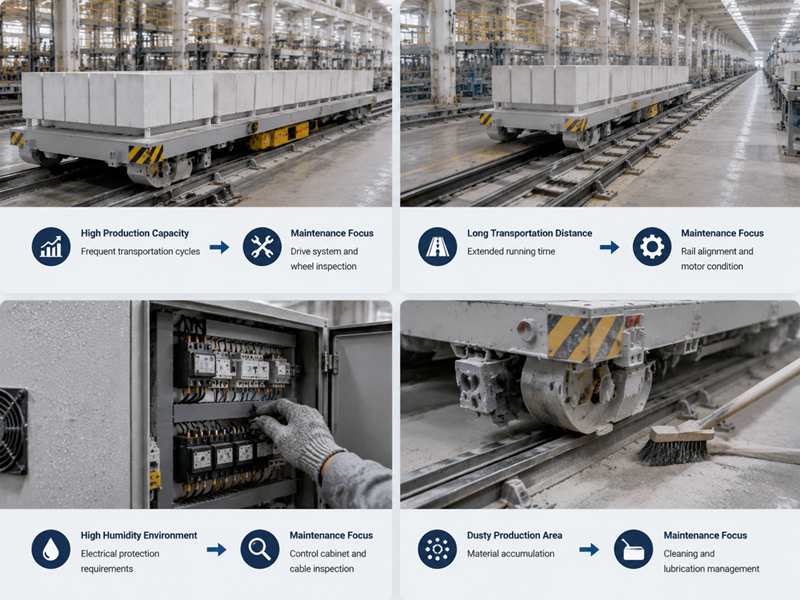
AAC factories feature diverse working environments shaped by output scale, workshop layout and local climate. Thus, ferry trolley maintenance standards need to adapt to on-site operational conditions.
For instance, facilities in humid regions demand more frequent electrical system checks, whereas high-volume production lines require intensified inspection of mechanical parts.
| Operating Condition | Main Challenge | Maintenance Focus |
| High Production Capacity | Frequent transportation cycles | Drive system and wheel inspection |
| Long Transportation Distance | Extended running time | Rail alignment and motor condition |
| High Humidity Environment | Electrical protection requirements | Control cabinet and cable inspection |
| Dusty Production Area | Material accumulation | Cleaning and lubrication management |
Spare Parts Management
For AAC production plants, keeping frequently used components available can shorten repair time and improve equipment availability.
Common maintenance spare parts include:
- Bearings
- Limit switches
- Sensors
- Electrical components
- Transmission parts
- Wheel components
Maintenance Strategy Based on AAC Ferry Cart Models
Customized trolley designs accommodate varying transport ranges, load ratings and control systems to perfectly fit established production workflows.
| Ferry Cart Configuration | Typical Features | Recommended Maintenance Priority |
| Standard Type | Suitable for regular mold transfer operations | Daily inspection and lubrication management |
| Heavy Load Type | Designed for higher transportation requirements | Drive system and structural inspection |
| Long Travel Type | Used for larger factory layouts | Rail alignment and positioning maintenance |
| Automated Type | Integrated with production control systems | Sensor and electrical system inspection |
Improving Production Stability Through Preventive Maintenance
Preventive maintenance is an effective method for maintaining AAC production continuity. Instead of repairing equipment after failure, factories can use scheduled inspections to identify potential issues earlier.
For AAC ferry carts, preventive maintenance focuses on maintaining transportation accuracy, reducing component wear, and ensuring coordination with the whole production line.
A stable ferry cart operation supports:
- Continuous mold transportation
- Reduced production waiting time
- Improved equipment utilization
- More predictable production scheduling
Recommended Maintenance Checklist
| Checklist Category | Inspection Content |
| Mechanical Check | Wheels, bearings, reducer, coupling, frame condition |
| Electrical Check | Sensors, cables, control cabinet, switches |
| Operation Check | Travel speed, positioning accuracy, abnormal noise |
| Safety Check | Emergency stop, protection devices, limit control |
Routine inspections of mechanical, electrical and positioning systems during AAC ferry trolley maintenance lift production efficiency, equipment dependability and operational stability.
Combining tailored trolley schemes with targeted maintenance schedules enables AAC factories to cut downtime, streamline mold transit and sustain round-the-clock manufacturing.