
Mold transit links casting, curing, cutting and recycling procedures in AAC production, directly impacting operational stability, process efficiency and overall output.
Custom rail-mounted ferry trolleys optimize mold turnover, cut manpower costs and sustain non-stop production.
AAC Mold Transportation Process in AAC Production
Traditional manual transportation mainly depends on workers or mobile equipment to complete mold movement. The transportation route is usually adjusted according to production conditions.
AAC ferry carts work differently. The cart runs on fixed rails and transports molds according to a planned production route. It can connect different areas of the factory and become part of the overall AAC production line.
| Transportation Method | Working Principle | Application Characteristics |
| Manual Mold Transportation | Workers move molds manually or with simple handling tools | Flexible for small-scale production |
| Forklift Transportation | Mobile equipment transfers molds between sections | Suitable for medium-distance movement |
| AAC Ferry Cart | Rail-guided electric transportation system | Suitable for continuous AAC production |
Manual Mold Transportation
Manual mold transportation offers flexible operation and lower investment for simple AAC production environments, allowing adjustments based on temporary production conditions.
However, efficiency depends heavily on labor coordination, making large-scale operations harder to standardize due to variable speed, timing, and accuracy.
AAC Ferry Cart
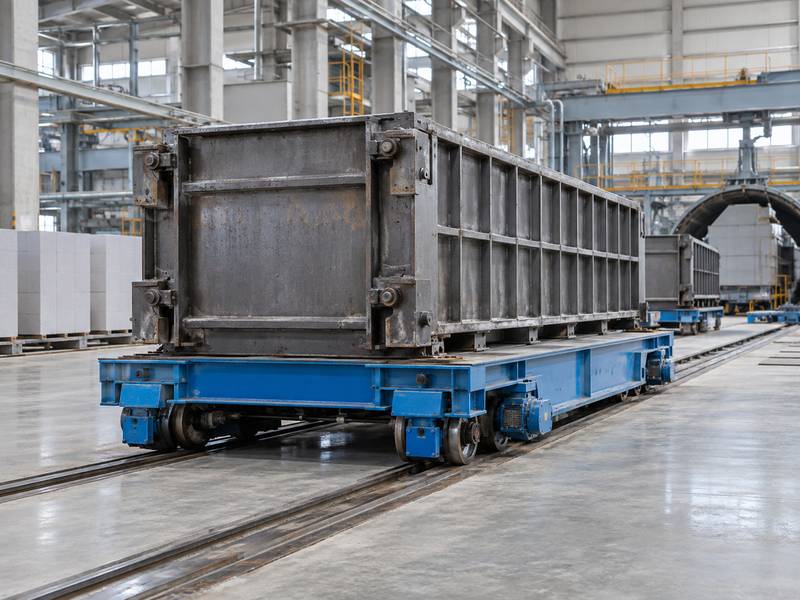
AAC ferry carts create controlled mold transportation through fixed rails and mechanical drives, ensuring consistent movement cycles, reducing unnecessary handling, and improving connections between AAC production sections.
Typical AAC ferry cart structures include:
- Steel frame platform
- Driving mechanism
- Rail wheels
- Electrical control system
- Positioning components
Efficiency Comparison
AAC ferry carts improve efficiency mainly through stable transportation cycles and better process connection.
For example, when molds need to move between casting areas and pre-curing areas continuously, a ferry cart can maintain a predictable transportation sequence. This reduces waiting periods between production stages.
Manual transportation may require workers to coordinate each movement individually. As production capacity grows, the number of transportation tasks increases, making stable scheduling more difficult.
| Comparison Item | Manual Mold Transportation | AAC Ferry Cart |
| Transportation Control | Depends on operators | Controlled by mechanical system |
| Movement Stability | Changes with operation conditions | Stable and repeatable |
| Production Rhythm | Easily affected by manual coordination | More suitable for continuous production |
| Process Connection | Separate transportation activity | Integrated production transportation |
Production Continuity
AAC production requires coordination between casting, pre-curing, cutting, and autoclaving sections. Stable transportation ensures smooth mold circulation, reduces waiting time, and maintains consistent production rhythm.
Manual transportation relies on worker coordination, while AAC ferry carts provide fixed routes and planned movement cycles. This improves production stability and supports long-term efficiency in AAC manufacturing.
Labor Efficiency and Production Management Improvement
Manual AAC mold transfer relies heavily on frequent manual labor, raising manpower reliance and complicating cross-process production coordination.
Ferry cart systems cut manual handling work, freeing staff to focus on equipment supervision, upkeep and production administration.
AAC Ferry Cart Application in Different Production Scenarios
Medium Capacity AAC Production Lines
Medium-scale AAC plants adopt ferry carts to link casting, curing and cutting preparation sections, achieving more reliable transportation than full manual conveyance.
Large AAC Production Plants
Large-scale AAC plants demand uninterrupted mold turnover. Stable conveyance is critical here, as transport disruptions will interfere with multiple production processes.
AAC ferry trolleys fit large production layouts and can be customized to match individual factory conditions.
Automated AAC Production Systems
For factories moving toward higher automation levels, transportation equipment needs to cooperate with other production systems.
Ferry carts can become an important connection point between different automated processes.
Long-Term Efficiency Comparison
The choice between manual mold handling and AAC ferry trolleys is determined by actual production demands. Manual transfer fits simple production scenarios with short haul distances and low output.
Yet with AAC manufacturing trending toward larger output and tighter process integration, conveying equipment must deliver more consistent operation.
| Evaluation Factor | Manual Mold Transportation | AAC Ferry Cart |
| Labor Dependence | Requires continuous operator involvement | Reduces repetitive transportation work |
| Production Stability | Influenced by manual operation | Provides consistent movement cycles |
| Factory Layout Integration | Limited by movement methods | Designed according to production layout |
| Future Expansion | Requires additional labor planning | Easier to integrate with automation upgrades |
Selecting the Right Mold Transportation Solution
Manual mold transit retains operational flexibility for small-scale AAC production lines. For medium and large manufacturing lines, AAC ferry trolleys excel in transport scheduling, consistent production running and factory layout optimization.
Optimal transport schemes must align with onsite production procedures. Instead of merely moving molds, a conveying system ought to serve the whole AAC manufacturing flow.
Custom AAC Ferry Cart Design Based on Production Requirements
A suitable AAC ferry cart needs to match the actual production conditions, including mold dimensions, transportation distance, transfer frequency, and connection between different process sections.
For example, some AAC plants require a ferry cart to connect multiple pre-curing areas, while others need the cart to transfer molds between cutting preparation zones and production circulation areas. The transportation route, platform size, and control system need to be considered together.
Through Custom design, AAC ferry carts can be developed according to:
- Existing workshop dimensions
- AAC mold size and loading requirements
- Production cycle requirements
- Rail layout conditions
- Automation level of the production line
It allows the transportation system to become a coordinated part of AAC manufacturing instead of a separate material movement device.
| Custom Factor | Available Specifications | Application Consideration |
| Load Capacity | 5–25 tons (FC-1 to FC-5) | Match different mold weights and production requirements |
| Cart Size | 4000×1500×1200 mm to 6500×2700×1600 mm | Adjust according to plant layout and mold dimensions |
| Travel Speed | 20–40 m/min | Select based on transportation distance and production cycle |
| Control System | PLC / Remote Control | Support stable operation and automated AAC production lines |
With steady operation, custom configurations and streamlined process docking, AAC ferry carts upgrade mold transport, enabling continuous manufacturing and boosting production efficiency.