
The production capacity of AAC blocks determines equipment selection, plant layout design, energy consumption, raw material preparation and automation standards for various production scales.
Production lines ranging from 200 to 1500 cubic meters daily demand differentiated engineering schemes in terms of equipment parameters, material conveying efficiency, material storage volume and cross-process production coordination.
Capacity Range and Line Positioning
| Daily Capacity | Production Positioning | Suitable Factory Type | Main Focus |
| 200–300 CBM/day | Small and regional production | New AAC plants, local suppliers | Stable operation and lower investment |
| 400–800 CBM/day | Medium-scale production | Growing block manufacturers | Production balance and efficiency |
| 1000–1200 CBM/day | Large commercial production | Industrial AAC factories | Automation and continuous operation |
| 1500 CBM/day | High-capacity production | Large construction material producers | Maximum efficiency and system integration |
Core Process Configuration
The main production process includes:
- Raw material crushing and grinding
- Slurry preparation
- Material batching and mixing
- Mold casting
- Pre-curing
- Wire cutting
- Autoclave curing
- Finished block packaging
The difference between capacity levels mainly appears in processing speed, equipment size, storage volume, and transportation efficiency.
Raw Material Preparation System Selection
Common raw materials include:
- Sand
- Fly ash
- Cement
- Lime
- Gypsum
- Aluminum powder
Among these materials, sand or fly ash usually requires grinding before mixing. The grinding capacity must match the daily AAC output.
| AAC Capacity | Grinding System Requirement | Typical Equipment Configuration |
| 200–300 CBM/day | Medium grinding capacity | Single ball mill system with storage tank |
| 400–800 CBM/day | Continuous material supply | Larger ball mill with automatic feeding |
| 1000–1500 CBM/day | High-volume preparation | Multiple grinding and storage systems |
Batching and Mixing System
AAC blocks require accurate material ratios because density, strength, and pore structure depend heavily on slurry consistency.
A batching system usually controls:
- Sand or fly ash quantity
- Cement amount
- Lime dosage
- Gypsum proportion
- Water ratio
- Aluminum powder addition
For 200–500 CBM/day plants, semi-automatic batching systems may satisfy production requirements. However, when output exceeds 800 CBM/day, automatic weighing and control systems become more important.
| Capacity Range | Batching Method | Production Requirement |
| 200–500 CBM/day | Semi-automatic or automatic batching | Stable formula control |
| 500–1000 CBM/day | Automatic weighing system | Continuous material supply |
| 1000–1500 CBM/day | Fully integrated batching control | High consistency production |
Casting and Pre-curing System
Casting quality determines the initial structure of AAC blocks before cutting.
After mixing, AAC slurry is poured into molds and transferred to the pre-curing area. The pre-curing time depends on raw material characteristics, temperature, and formula design.
A higher-capacity plant requires more molds and better transportation coordination because casting delays can affect the whole production cycle.
For example:
- A 200 CBM/day line may operate with a limited number of molds and manual transfer assistance.
- A 1000 CBM/day line requires automatic mold movement and coordinated production scheduling.
- A 1500 CBM/day line usually needs optimized mold circulation to maintain continuous casting.
The mold quantity should not be selected only according to daily output. It should also consider:
- Pre-curing time
- Cutting cycle
- Autoclave loading schedule
- Factory working hours
AAC Cutting Machine Configuration
After pre-curing, the cake is transported to the cutting machine, where horizontal and vertical wires cut the material into required block sizes.
| Capacity | Cutting Requirement | Suitable Configuration |
| 200–500 CBM/day | Stable cutting accuracy | Standard cutting machine |
| 500–1000 CBM/day | Higher cycle efficiency | Automatic cutting system |
| 1000–1500 CBM/day | Continuous high-speed operation | Fully automatic cutting line |
A reliable cutting system should focus on:
- Accurate wire positioning
- Stable cake transportation
- Reduced material loss
- Fast mold circulation
Autoclave Configuration
The autoclave provides final curing for AAC blocks, ensuring stable strength, dimensional accuracy, and reliable performance through controlled steam treatment.
Different capacities require matched autoclave quantity, size, and scheduling to coordinate cutting systems, material preparation, temperature, and pressure control.
A common production planning method is to calculate autoclave quantity according to:
- Daily AAC output
- Block size and loading quantity
- Curing cycle time
- Factory working schedule
- Future production expansion
| AAC Capacity | Autoclave Arrangement | Production Characteristics |
| 200–300 CBM/day | 2–3 autoclaves depending on cycle | Suitable for stable regional production |
| 500–800 CBM/day | Multiple autoclaves with coordinated loading | Supports continuous industrial operation |
| 1000–1500 CBM/day | Large autoclave system with optimized scheduling | Designed for high-volume production |
Autoclave specifications need to align with the processing capacities of cutting and raw material preparation. Mismatched process capacities in AAC production will lead to production stagnation, piled-up semi-finished blocks and excessive energy waste.
Automation Level Selection
A small AAC plant can operate with partial automation, while large factories require more integrated control systems.
| Automation Level | Application Capacity | Main Functions |
| Basic Automation | 200–500 CBM/day | Equipment control and operation assistance |
| Medium Automation | 500–1000 CBM/day | Automatic batching and transportation control |
| High Automation | 1000–1500 CBM/day | Integrated production monitoring and process management |
Automation can improve:
- Production consistency
- Equipment coordination
- Labor efficiency
- Data monitoring
However, automation selection should match actual production requirements. Excessive automation may increase investment and maintenance complexity if the production scale does not require it.
Complete AAC Equipment Configuration
For a 200–1500 CBM/day AAC project, the main equipment normally includes:
- Jaw crusher
- Ball mill
- Storage tanks
- Batching system
- Mixer
- Mold
- Mold ferry cart
- Cutting machine
- Waste material recycling system
- Autoclave
- Finished product handling system
The difference between capacity levels is mainly reflected in equipment size, quantity, automation degree, and transportation design.
| Equipment Section | 200–500 CBM/day Line | 800–1500 CBM/day Line |
| Crushing System | Standard crushing equipment | Higher-capacity crushing system |
| Grinding System | Single grinding unit | Larger or multiple grinding systems |
| Batching System | Semi/automatic batching | Fully automated regulation and control system |
| Cutting System | Standard automatic cutting | High-efficiency automatic cutting |
| Autoclave System | Small quantity arrangement | Multiple autoclave operation |
| Material Transfer | Basic transportation | Integrated automatic transfer |
For manufacturers planning long-term development, equipment selection should include future expansion possibilities. Assembly lines tailored solely for current productivity demand substantial renovations amid climbing market requirements.
Factory Layout Planning
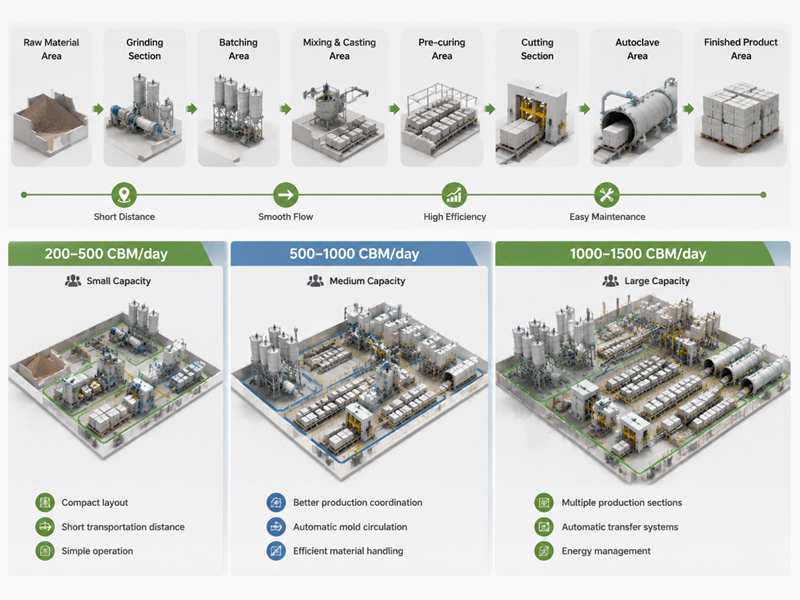
A reasonable layout should reduce unnecessary material movement distance and improve production connection.
The typical production flow includes:
Raw Material Area → Grinding Section → Batching Area → Mixing & Casting Area → Pre-curing Area → Cutting Section → Autoclave Area → Finished Product Area
Small Capacity AAC Plants (200–500 CBM/day)
Small-scale AAC manufacturers generally adopt space-saving compact layout designs.
Key considerations:
- Reduce transportation distance
- Simplify material flow
- Lower equipment installation difficulty
- Keep maintenance access available
Medium Capacity AAC Plants (500–1000 CBM/day)
Medium-scale production requires better coordination between equipment sections.
Important factors include:
- Continuous raw material supply
- Efficient mold circulation
- Automatic transportation
- Improved finished product handling
Large Capacity AAC Plants (1000–1500 CBM/day)
Large AAC factories require industrial-level planning.
The layout should consider:
- Multiple production sections
- Higher warehouse capacity
- Automatic transfer systems
- Maintenance channels
- Energy management
Energy Consumption Considerations
Main energy consumption sections include:
- Ball mill operation
- Mixer operation
- Cutting equipment operation
- Autoclave steam consumption
- Material transportation
For example, a 200 CBM/day plant usually focuses on equipment efficiency and simple operation, while a 1500 CBM/day factory needs systematic energy planning.
Large production lines can optimize energy usage through:
- Improved autoclave scheduling
- Steam circulation management
- Automatic production control
- Reduced idle running time
Custom AAC Block Manufacturing Line Solutions
RunDing Machine develops Custom AAC production line solutions according to:
- Required daily capacity
- Available factory space
- Raw material properties
- Block size requirements
- Automation expectations
- Future expansion plans
For example:
A customer requiring 300 CBM/day production may prioritize compact equipment arrangement and easy maintenance.
A factory planning 1200–1500 CBM/day production may require:
- Multiple autoclave systems
- Automatic material handling
- Higher-capacity grinding equipment
- Integrated production control
The customization process usually includes:
- Production capacity evaluation
- Equipment configuration design
- Factory layout planning
- Technical parameter confirmation
- Manufacturing and installation support
An AAC block manufacturing line with 200–1500 CBM/day capacity requires precise coordination between every production section. From raw material preparation and batching to cutting and autoclave curing, each equipment choice affects the final production performance.
The most suitable AAC solution is not always the largest capacity system, but the one that matches factory conditions, material characteristics, and long-term production goals.