
When comparing poured concrete and block walls, cost per square foot is only part of the picture.
Labor, equipment, reinforcement, waterproofing, scheduling, and project scale can significantly change total cost. The real comparison is not simply materials, but one construction workflow versus another.
Poured Concrete Walls and Block Walls Use Cost Differently
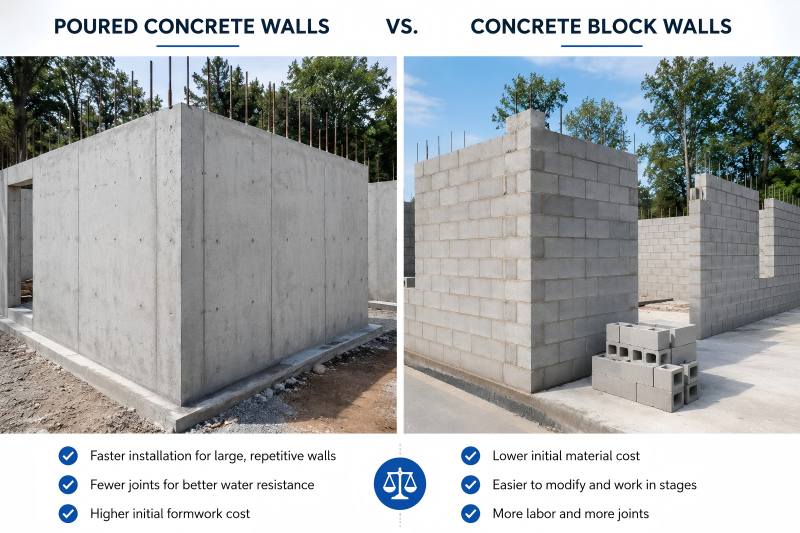
A poured concrete wall is built by assembling forms, installing reinforcement, placing concrete, consolidating it, allowing it to gain strength, and eventually stripping the forms.
Concrete masonry unit, or CMU, construction follows another sequence. Blocks are delivered as individual units and laid course by course with mortar. Reinforcement and grout may then be added according to structural requirements.
Consider a basic 8-inch-thick wall.
| Quantity for 100 sq. ft. of Wall | Poured Concrete | 8×8×16 CMU Block |
| Main wall material | Approx. 2.47 yd³ concrete | Approx. 113 blocks |
| Primary installation method | Bulk concrete placement | Individual unit laying |
| Temporary form surfaces | Approx. 200 sq. ft. | Normally not required |
| Major labor activity | Forming and placement | Repetitive masonry |
| Reinforcement | Rebar within wall | Rebar + possible cell grouting |
These numbers explain an important part of the cost difference.
Poured concrete moves a relatively large volume of material very quickly once the forms are ready. CMU reduces the need for large forming systems, but more than 100 individual blocks must be handled for every 100 square feet of standard wall.
Therefore, poured walls tend to concentrate cost in setup and equipment, while block walls distribute more cost into labor hours.
That distinction becomes increasingly important as projects get larger.
Material Price Alone Can Give the Wrong Answer
Suppose a contractor compares ready-mix concrete with pallets of concrete blocks and concludes that CMU is cheaper.
Although technically accurate, the computation may be deceptive from a business standpoint.
Mortar is still needed for blocks. Structural CMU may require horizontal reinforcement, vertical rebar, and grout. Fully grouted walls can consume significantly more cementitious material than buyers initially expect.
Poured walls have their own hidden material costs. Form ties, release agents, reinforcement, bracing materials, and form rental are easy to overlook when only the concrete price is considered.
A more realistic wall estimate should therefore separate the major cost groups.
The following example is an illustrative estimating model for an 8-inch structural wall, rather than a national price quotation.
| Cost Component | Poured Concrete | Reinforced CMU |
| Main materials | $7.50/sq. ft. | $6.00/sq. ft. |
| Reinforcement/grout | Included partly above | $4.00/sq. ft. |
| Formwork or setup | $7.00/sq. ft. | — |
| Placement/equipment | $3.00/sq. ft. | $2.00/sq. ft. |
| Direct labor | $8.00/sq. ft. | $12.00/sq. ft. |
| Waterproofing / basic finishing | $3.50/sq. ft. | $4.00/sq. ft. |
| Modeled total | $29.00/sq. ft. | $28.00/sq. ft. |
At first glance, the difference is almost insignificant.
But changing only one project condition can reverse the result.
That is why selecting a wall based on a generic “cost per square foot” number is risky.
Labor Rates Can Change the Winner
CMU construction is highly dependent on masonry productivity.
Imagine a 10,000-square-foot wall package. If masonry labor effectively costs $12 per square foot, labor represents $120,000. A 20% increase caused by local wage rates, difficult access, or lower productivity adds another $24,000.
Poured concrete also requires skilled labor, particularly during forming. However, once the forms are complete, hundreds of square feet of wall can be placed during one coordinated pour.
This produces an interesting regional effect.
In a market with affordable and available masonry crews, CMU can remain very competitive. In an area experiencing a shortage of experienced masons, the lower material cost of block may no longer matter.
Project Size Changes the Economics
Small projects generally favor flexibility.
A short equipment-room wall, building addition, or irregular foundation may not justify mobilizing a large forming system, concrete pump, and placement crew. CMU allows the contractor to start and stop construction more easily.
Large repetitive walls create different economics.
Suppose a project contains several thousand square feet of straight foundation wall with similar heights and thicknesses. Forms can be moved or reused repeatedly. Concrete deliveries can be planned efficiently, and pumping costs are distributed over much more wall area.
The effective formwork cost per square foot then starts falling.
CMU behaves differently. Increasing wall quantity does not eliminate the basic requirement to place thousands of individual blocks.
This means that poured concrete frequently benefits more strongly from scale, while CMU benefits from flexibility.
Neither advantage appears clearly in a simple material quotation.
Wall Geometry Is Another Hidden Cost Driver
Not every square foot of wall costs the same amount to build.
A 100-foot straight wall is very different from several short walls totaling the same area.
Corners, pilasters, steps, changes in thickness, door openings, and embedded components increase form complexity for poured concrete. Form carpentry becomes slower, and standard form panels may require additional adjustment.
CMU can sometimes accommodate irregular layouts more naturally because individual units can be cut and arranged incrementally.
But complicated masonry is not free either. Numerous corners, bond beams, openings, and reinforced cells slow laying productivity.
The correct comparison should therefore consider wall complexity per square foot, not simply wall area.
Waterproofing Can Erase a Small Initial Saving
Below-grade walls introduce another budget variable: water.
Poured concrete contains fewer construction joints across the wall surface than conventional block masonry. CMU walls contain mortar joints and numerous individual units, so moisture control may require careful parging, coatings, membranes, drainage systems, and workmanship.
This does not mean poured concrete is automatically waterproof. Concrete cracks, penetrations leak, cold joints require attention, and poorly detailed drainage can cause problems regardless of wall type.
The financial issue is different.
If two wall systems differ by only $1 or $2 per square foot initially, an additional waterproofing treatment or future moisture repair can easily become more important than the original wall-price difference.
For basements, retaining structures, and other moisture-sensitive applications, waterproofing should therefore be included in the wall-system comparison, rather than treated as an unrelated subcontract.
Schedule Has a Financial Value
Construction estimates often treat time as though it were free.
It is not.
Imagine that choosing one wall system shortens the structural schedule by five working days. The material saving from the alternative system may disappear if those five days create additional costs for:
- Site supervision
- Equipment rental
- Temporary facilities
- Financing
- General conditions
- Delayed follow-on trades
A $10,000 direct wall saving is not necessarily a saving if it indirectly adds $15,000 elsewhere in the project.
The opposite is also possible.
Poured concrete requires coordinated formwork, concrete delivery, and sometimes pump access. On a remote site where ready-mix trucks must travel long distances, mobilization can become expensive. CMU may allow materials to be delivered in advance and installation to progress without depending on a large single placement event.
The cheapest wall is therefore often the system that fits the site’s logistics, not the one with the cheapest raw material.
A Sensitivity Analysis Is More Useful Than One Price
Before choosing between wall systems, estimators can test several possible site conditions.
Using the earlier $29 versus $28 per-square-foot example:
| Project Condition | Poured Concrete | Reinforced CMU | Likely Advantage |
| Baseline estimate | $29 | $28 | Nearly equal |
| Higher masonry labor | $29 | $31 | Poured |
| Repetitive walls / reusable forms | $27 | $28 | Poured |
| Remote site with difficult concrete pumping | $33 | $29 | CMU |
| Small irregular wall package | $32 | $30 | CMU |
| Large simple wall package | $26–28 | $28–30 | Often poured |
The exact values will change by project, but the exercise reveals something important: the preferred system can change without any change in wall thickness or structural performance.
Only the construction conditions changed.
This is a much better way to think about poured concrete walls vs block cost than searching for one universal square-foot price.
Consider the Cost of Future Changes
Another factor is how certain the design really is.
Once a reinforced poured concrete wall is complete, adding large openings or rerouting penetrations can require concrete cutting, scanning, structural review, and additional reinforcement.
CMU can sometimes be modified more easily, particularly before all reinforced cells are grouted. That can provide value on projects where mechanical layouts are still evolving.
However, excessive field modification should never be considered normal construction practice. Structural walls should follow engineered drawings regardless of material.
The budget lesson is that design uncertainty has a price.
If drawings are incomplete, a system that appears cheapest under the original plan may expose the contractor to expensive changes later.
The lowest wall cost isn’t always the lowest bid.
Imagine two bids for a 5,000-square-foot foundation:
- Poured concrete: $145,000
- CMU: $135,000
The apparent saving is $10,000.
Now assume CMU requires additional waterproofing worth $4,000 and extends the schedule enough to create $7,000 of additional general-condition costs.
The economic comparison becomes:
Poured concrete: $145,000
CMU effective project cost: $146,000
CMU did not suddenly become a bad construction method. The problem was simply that the first comparison excluded costs created elsewhere in the project.
This leads to a more useful estimating formula:
Effective Wall Cost = Direct Installation Cost + Schedule Cost + Supporting Work + Risk Allowance
That equation is far more valuable than asking which material has the lower unit price.
When Does Poured Concrete Make More Financial Sense?
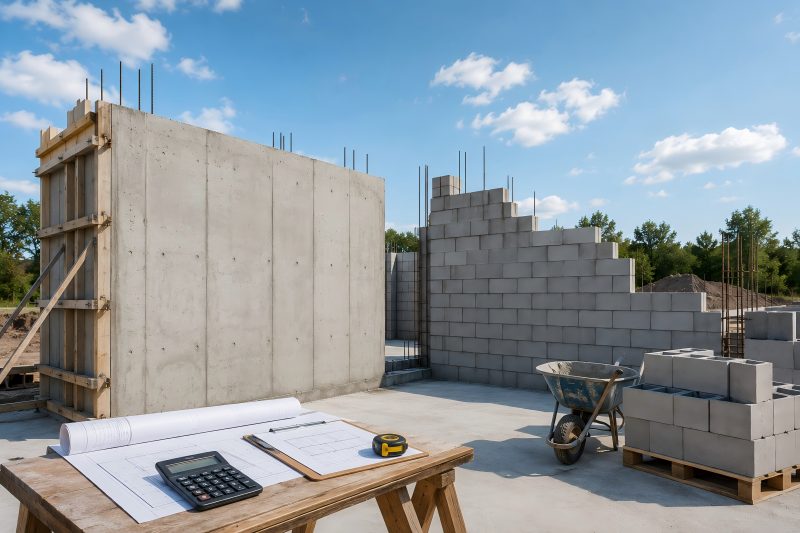
Poured concrete becomes particularly attractive when the project has large quantities of relatively repetitive walls, expensive masonry labor, good concrete-truck or pump access, substantial lateral loads, or demanding below-grade moisture conditions.
The ability to reuse forms across repeated wall sections can also improve economics considerably.
Its biggest financial weakness appears when the wall package is small or complicated. Mobilizing forming equipment and placement crews for limited quantities may produce a high cost per square foot.
When Can Block Construction Be the Better Value?
CMU often makes financial sense for smaller wall packages, irregular configurations, and projects where masonry labor is readily available.
It can also be valuable when construction must proceed incrementally. Contractors do not need to organize every wall section around a major concrete placement.
Site logistics matter as well. In locations where pump access is difficult or ready-mix transportation is expensive, block construction may reduce dependence on time-sensitive concrete deliveries.
Its weakness appears when wall area becomes very large and repetitive. At that point, thousands of individual unit placements can make labor productivity the dominant budget issue.
Final Thoughts
The cost of poured concrete walls vs block depends on more than price per square foot. CMU may suit small, irregular projects, while poured concrete can be more economical for large, repetitive foundations.
Labor productivity, project scale, access, waterproofing, and schedule often have a greater impact than material prices. Comparing the full construction sequence provides a more accurate project-level financial decision.