
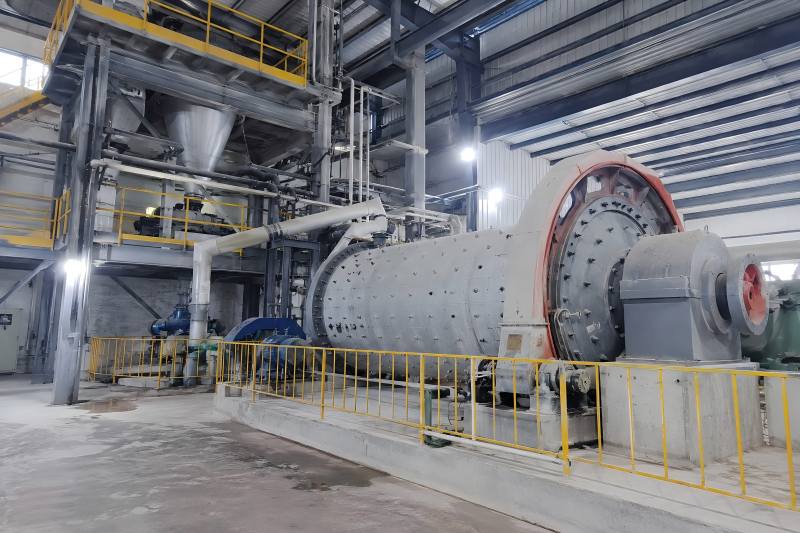
In an AAC plant, the ball mill grinds silica-rich materials before slurry preparation, directly affecting production stability. Its capacity should be based on actual grinding demand, raw materials, operating hours, and production schedules, with a reasonable reserve.
Why Ball Mill Capacity Matters in AAC Production
The ball mill mainly controls two things: how much ground material is available and how consistently it reaches the required fineness.
If the mill is too small, the batching section may frequently wait for slurry. Operators may compensate by extending mill operating hours, increasing grinding load, or reducing production speed.
An oversized mill creates a different problem. It increases equipment cost, installed power, foundation requirements, and no-load or partial-load energy consumption without necessarily increasing AAC output.
The correct capacity therefore sits between these two extremes.
| Ball Mill Situation | Possible Effect on AAC Production |
| Capacity too low | Slurry shortage and casting delays |
| Capacity close to maximum continuously | Little room for production fluctuation |
| Properly sized | Stable slurry supply and easier scheduling |
| Excessively oversized | Higher capital cost and lower equipment utilization |
The goal is not to select the largest mill affordable. It is to select the smallest mill that can reliably support the required production rhythm.
Start with AAC Plant Output
Annual AAC production capacity is the first figure normally available.
For example, assume an AAC block plant is designed for:
200,000 m³ of finished AAC blocks per year
If the plant operates 300 days annually:
200,000 ÷ 300 = 667 m³/day
This number still cannot directly determine ball mill capacity because the mill only processes part of the raw material.
AAC dry density, recipe composition, and material moisture must also be considered.
Suppose the average dry material requirement is approximately:
500 kg per m³ of finished AAC
Daily dry-material consumption would be:
667 × 0.50 = 333.5 tons/day
However, the ball mill does not grind cement, lime, gypsum, aluminum powder, and every other ingredient. It normally processes the silica source, especially sand.
If sand represents 65% of the dry mix:
333.5 × 65% = 216.8 tons/day of sand
Now the ball mill requirement becomes much clearer.
Convert Daily Demand into Hourly Grinding Capacity
A common mistake is dividing daily demand by 24 hours.
The mill rarely operates at full production for every hour of the day. Maintenance, loading, slurry tank conditions, cleaning, power interruptions, and operational gaps reduce effective grinding time.
Assume the mill operates effectively for 18 hours per day:
216.8 ÷ 18 = 12.0 t/h
The calculated theoretical grinding capacity is therefore approximately 12 tons per hour.
A capacity margin should then be added.
Using a 15% margin:
12.0 × 1.15 = 13.8 t/h
In this example, a ball mill with approximately 14–15 t/h practical grinding capacity would be more reasonable than selecting a nominal 12 t/h machine operating near its limit every day.
Example Capacity Calculation
| Parameter | Example Value |
| AAC annual production | 200,000 m³/year |
| Operating days | 300 days/year |
| Daily AAC production | 667 m³/day |
| Dry material consumption | 500 kg/m³ |
| Total dry materials | 333.5 t/day |
| Sand proportion | 65% |
| Sand grinding demand | 216.8 t/day |
| Effective grinding time | 18 h/day |
| Basic mill requirement | 12.0 t/h |
| Design margin | 15% |
| Recommended working target | About 14 t/h |
These figures are planning examples rather than universal AAC formulas. Actual consumption should always be recalculated according to the local raw material recipe.
Raw Material Hardness Can Change Real Capacity
Ball mill capacity printed on a specification sheet should not be treated as a fixed output under every condition.
Grinding harder quartz sand generally requires more energy and retention time than processing softer or previously crushed material.
Two AAC factories using the same ball mill model may therefore obtain different hourly production.
| Raw Material Condition | Relative Grinding Difficulty | Possible Effect on Output |
| Fine, well-prepared sand | Low | Higher throughput |
| Normal silica sand | Medium | Baseline throughput |
| Coarse quartz-rich sand | High | Lower throughput |
| Material with unstable feed size | Variable | Unstable output |
| Excessively wet feed | Variable | May affect grinding efficiency |
This is why raw material analysis should come before final equipment selection.
A manufacturer stating that a mill produces 15 t/h may be referring to a particular feed size, hardness, moisture level, and required discharge fineness. If your raw material is more difficult to grind, the real production capacity may be lower.
It’s Important to Consider Feed Size
It is unrealistic to expect the ball mill to make up for inadequate crushing preparation.
If large particles enter the mill, more energy is spent on coarse size reduction instead of fine grinding. This reduces throughput and can increase wear.
For this reason, crusher selection and ball mill capacity should be considered together.
Suppose one plant feeds material averaging below 5 mm while another regularly sends particles above 15 mm into the same type of mill. The second plant may experience longer grinding cycles even though both use chemically similar sand.
Improving pre-crushing can sometimes be more economical than purchasing a significantly larger ball mill.
Required Fineness Changes the Capacity Calculation
AAC performance depends partly on how quickly silica reacts during hydrothermal curing. The silica-bearing material’s accessible surface area is increased by grinding.
However, finer is not automatically better.
Producing unnecessarily fine material increases grinding time and electricity consumption.
For illustration:
| Grinding Target | Relative Mill Throughput | Relative Energy Demand |
| Coarser target | 110–120% | Lower |
| Standard AAC target | 100% | Baseline |
| Moderately finer | 85–95% | Higher |
| Very fine grinding | 70–85% | Significantly higher |
These values illustrate the relationship rather than define a fixed industrial standard.
When comparing ball mills, the important question is therefore not:
How many tons per hour can this machine grind?
It should be:
How many tons per hour can it grind to our required fineness?
That distinction prevents many capacity-selection errors.
Wet Grinding and Slurry Demand Must Be Connected
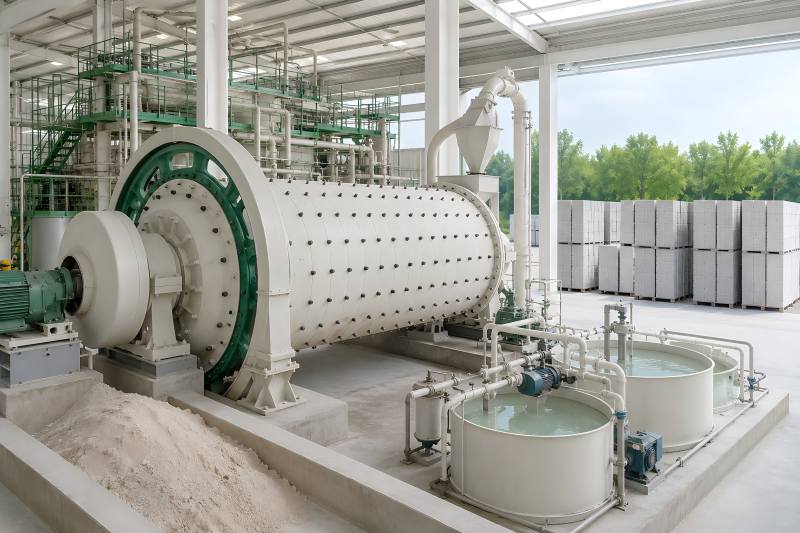
Many AAC plants use wet ball milling, where sand is mixed with water to produce slurry.
In this arrangement, ball mill capacity should also be matched with slurry storage volume.
Imagine a mill capable of producing enough slurry for one casting cycle every 40 minutes, but the slurry storage system can only buffer one batch. Any downstream interruption quickly forces the mill to stop.
A larger slurry tank can act as a buffer between grinding and batching.
This means plant engineers should evaluate three capacities together:
ball mill capacity + slurry storage capacity + casting consumption rate
Selecting each machine independently can create hidden bottlenecks.
Consider Peak Demand, Not Only Average Demand
Average production is useful for initial calculations, but AAC plants do not always operate at perfectly uniform rates.
For example, a plant may normally produce 650 m³/day but increase output to 750 m³/day during high-demand periods.
If the grinding section was sized exactly for 650 m³/day, the plant may struggle to increase casting frequency.
Assume sand demand increases proportionally:
| Plant Output | Approx. Sand Demand* |
| 500 m³/day | 162.5 t/day |
| 600 m³/day | 195.0 t/day |
| 700 m³/day | 227.5 t/day |
| 800 m³/day | 260.0 t/day |
| 1,000 m³/day | 325.0 t/day |
*Example based on 500 kg total dry material per m³ and 65% sand.
This table shows why a modest spare capacity is valuable.
For many projects, designing the mill around approximately 110–120% of normal expected grinding demand provides more operational flexibility than sizing it exactly at average consumption.
Extreme oversizing, however, is rarely necessary.
Account for Maintenance Time
Grinding equipment experiences continuous wear.
Grinding media, liners, bearings, transmission systems, feeding equipment, and slurry pumps require regular inspection and maintenance.
Therefore, capacity planning should include expected downtime.
Consider a plant requiring 220 tons of ground sand per day.
If effective grinding time is:
20 hours/day
Required production is:
220 ÷ 20 = 11 t/h
But if practical availability drops to 16 hours during some operating periods:
220 ÷ 16 = 13.75 t/h
The same factory suddenly requires approximately 25% more hourly capacity.
This does not mean the mill should always be oversized by 25%. It means the production team should understand whether maintenance can be scheduled during plant shutdown periods or whether grinding must recover production during fewer operating hours.
One Large Mill or Two Smaller Mills?
For larger AAC plants, another decision appears: use one large ball mill or multiple smaller mills.
One large mill usually offers simpler plant layout and potentially lower equipment cost per ton of grinding capacity.
Multiple mills provide redundancy and greater production flexibility.
| Configuration | Advantages | Limitations |
| One large mill | Simpler operation, fewer auxiliary systems | Production is strongly affected during mill shutdown |
| Two medium mills | Better redundancy, flexible production | Higher equipment and maintenance complexity |
| One working + one standby | High reliability | Higher capital investment |
For a small AAC block factory, installing redundant mills may not be economical.
For a large plant operating continuously, however, the financial loss caused by several hours without sand slurry may justify additional grinding redundancy.
This is an important distinction: capacity selection is also a reliability decision.
Do Not Select Capacity Only from Annual Plant Size
It is tempting to create rules such as:
“100,000 m³ AAC plant needs X-sized ball mill.”
Such shortcuts are useful during preliminary planning, but they should not determine final equipment selection.
Two 100,000 m³/year factories may have very different operating conditions.
Plant A operates 330 days per year and uses relatively soft sand.
Plant B operates only 250 days, uses harder quartz sand, and requires finer grinding.
Plant B may need substantially higher hourly grinding capacity even though both factories have the same annual AAC output.
This is why tons per operating hour is often more useful for equipment sizing than annual cubic meters alone.
A Practical Capacity Selection Method
A simple calculation sequence can be used during the early engineering stage:
1. Calculate daily AAC output
Annual AAC capacity ÷ operating days
2. Estimate dry-material consumption
Daily AAC output × dry material required per cubic meter
3. Determine the percentage requiring grinding
Total dry material × sand or silica proportion
4. Calculate actual grinding hours
Exclude planned downtime and realistic operating interruptions.
5. Determine hourly grinding demand
Daily grinding material ÷ effective grinding hours
6. Add operating margin
Usually evaluate a margin of approximately 10–20%, depending on production stability and expansion expectations.
A simplified formula is:
Required Ball Mill Capacity = Daily Grinding Demand ÷ Effective Grinding Hours × Capacity Factor
If daily grinding demand is 180 tons, effective operating time is 16 hours, and the selected design factor is 1.15:
180 ÷ 16 × 1.15 = 12.94 t/h
A practical selection would therefore target approximately 13–14 t/h under the required grinding conditions, rather than relying only on the motor power or nominal model designation.
Think About Future Expansion Before Buying
One of the less obvious considerations is expansion strategy.
Suppose an AAC factory is initially designed for 150,000 m³/year, but the site layout allows production to increase to 250,000 m³/year.
Installing a ball mill sized exactly for the initial requirement may create a major bottleneck after expansion.
However, purchasing a mill large enough for the final 250,000 m³/year capacity from the beginning may also be inefficient if expansion is uncertain.
A better engineering solution may be to reserve:
- Foundation space for a second mill
- Electrical capacity for future motors
- Slurry tank expansion space
- Pipe connections for additional grinding equipment
- Material conveying capacity for future throughput
This approach preserves expansion potential without forcing the first production phase to carry excessive equipment cost.
Final Thoughts
Ball mill capacity should match actual grinding demand, considering material hardness, fineness, operating time, and downtime. Avoid undersizing or oversizing; focus on sustainable output under real operating conditions.