
An industrial autoclave machine can cost anywhere from tens of thousands to several hundred thousand US dollars, depending on its size, pressure rating, automation level, configuration, and application. For an AAC block production line, the autoclave is a large pressure vessel designed for high-temperature steam curing, so its cost is very different from a laboratory or medical autoclave.
For your AAC plant, equipment price should be evaluated together with production capacity, vessel dimensions, steam consumption, foundation requirements, installation, and expected operating life. A cheaper autoclave that creates a bottleneck or consumes excessive steam can cost more over the life of the plant.
Typical Industrial Autoclave Cost Range
There is no useful single price for an AAC autoclave because the specification changes significantly between projects. For early project budgeting, you can use the following broad ranges as a reference rather than a supplier quotation.
| Autoclave Type | Typical Application | Indicative Cost Range |
| Small industrial autoclave | Testing/small production | $20,000–$60,000 |
| Medium industrial autoclave | General industrial processing | $50,000–$150,000 |
| Large pressure autoclave | Building materials/composites | $100,000–$300,000+ |
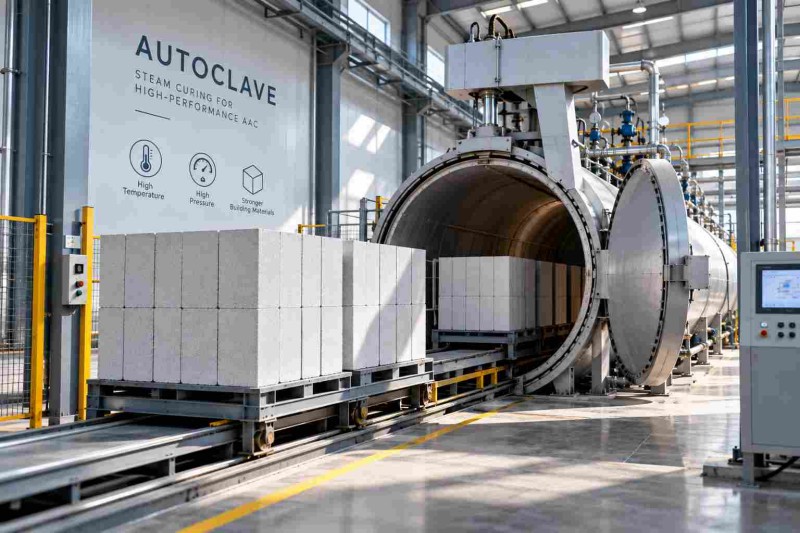
| AAC production autoclave | AAC blocks and panels | $80,000–$250,000+ per unit |
| Customized large AAC system | High-capacity AAC plant | Project-specific |
These figures are only suitable for preliminary budgeting. Your final price can change considerably once vessel diameter, effective length, design pressure, door system, insulation, rail arrangement, controls and auxiliary systems are defined.
For AAC manufacturing, you should also avoid looking at the autoclave as an isolated machine. A plant may require several autoclaves operating in parallel, which makes the total autoclaving section substantially more expensive than the price of one pressure vessel.
What Determines the Cost of an AAC Autoclave?
The largest price differences usually come from engineering specifications rather than appearance. Two autoclaves may look almost identical from outside while having very different manufacturing costs.
The main factors affecting your price include:
- vessel diameter and effective length;
- design and operating pressure;
- design temperature;
- steel plate specification and thickness;
- number and type of autoclave doors;
- safety interlocking system;
- internal rail arrangement;
- insulation and external cladding;
- condensate and steam piping;
- instrumentation and control level;
- pressure-vessel certification;
- transportation and installation requirements.
Among these factors, size, pressure-vessel construction and certification usually have the greatest influence.
Autoclave Diameter and Length
AAC autoclaves are large cylindrical pressure vessels. Increasing either diameter or length increases material consumption, fabrication work and transportation difficulty.
A simplified comparison might look like this:
| Parameter | Smaller Configuration | Larger Configuration |
| Internal diameter | ~2.0 m | ~2.85 m or larger |
| Effective length | ~20 m | ~38 m or longer |
| AAC loading per cycle | Lower | Higher |
| Steel requirement | Lower | Significantly higher |
| Transportation difficulty | Moderate | High |
| Foundation requirement | Smaller | Larger |
| Typical application | Lower-capacity plant | Medium/high-capacity plant |
Length does not affect cost in a perfectly linear way. A longer vessel requires more shell material, rails, insulation, and welding, but diameter can have an even stronger effect because increasing diameter changes the structural requirements of the pressure shell.
This is why your autoclave should be sized around actual AAC production capacity and loading configuration, rather than simply selecting the largest vessel available.
Pressure and Temperature Rating Affect Construction Cost
AAC curing typically takes place under saturated steam at elevated temperature and pressure. The autoclave shell therefore needs to withstand repeated heating, pressurization, depressurization, and cooling cycles over many years of production.
Higher design pressure generally means stricter requirements for:
- shell thickness;
- welding procedures;
- pressure-bearing components;
- door design;
- safety devices;
- inspection and testing;
- pressure-vessel documentation.
Material cost is only one part of this. Manufacturing quality and quality-control procedures become increasingly important as vessel size and pressure increase.
For this reason, comparing two autoclave quotations only by vessel dimensions can be misleading. You should compare the design pressure, material grade, corrosion allowance, weld inspection requirements, and applicable pressure-vessel standard as well.
Door and Safety Systems Are Important Cost Items
The autoclave door is one of the machine’s most crucial parts. It must provide reliable sealing while preventing unsafe opening when the vessel remains pressurized.
Depending on the configuration, your system may include:
- manual or powered door opening;
- mechanical locking;
- pressure interlocks;
- limit switches;
- sealing rings;
- safety valves;
- pressure transmitters;
- door position detection.
A more sophisticated system costs more initially but can improve operating consistency and reduce dependence on manual procedures.
For an AAC plant operating continuously, I would place more weight on door reliability, sealing performance and interlocking than on saving a small percentage of the initial purchase price.
Automation Level Changes the Price
A basic autoclave can use relatively simple local instruments and manual valve operation. A more automated system can integrate steam admission, pressure control, condensate discharge and cycle monitoring with the plant control system.
| Control Level | Typical Configuration | Relative Cost |
| Basic | Local gauges + manual valves | Lower |
| Semi-automatic | Automatic valves + basic control | Medium |
| Automated | PLC-controlled curing cycle | Higher |
| Plant-integrated | Central control + data monitoring | Highest |
For commercial AAC production, automation is usually valuable because curing quality depends on maintaining a repeatable pressure and temperature cycle.
Your operators still need to supervise the process, but automated control can reduce variation between batches and make abnormal conditions easier to identify.
One Autoclave Price Is Not Your Total Autoclaving Cost
This is an important point when budgeting an AAC plant.
If a supplier quotes $120,000 for one autoclave, that does not mean your autoclaving section costs $120,000.
Your complete section may also require:
- multiple autoclaves;
- steam distribution piping;
- valves and instrumentation;
- condensate return;
- rails and transfer equipment;
- foundations;
- electrical controls;
- insulation;
- boiler or steam source;
- installation and commissioning.
A simplified example illustrates the difference.
| Cost Item | Example Budget |
| 3 AAC autoclaves | $360,000 |
| Steam piping & valves | $45,000 |
| Rail/transfer interfaces | $25,000 |
| Controls & instrumentation | $30,000 |
| Insulation/site accessories | $20,000 |
| Installation support | $30,000 |
| Example Total | $510,000 |
These numbers are illustrative rather than quotations, but they show why the machine price and installed system cost should be separated during budgeting.
How Many Autoclaves Your AAC Plant Needs
Your required number of autoclaves depends on production capacity, autoclave loading volume, and total curing-cycle time. A plant designed for 100,000 m³/year has very different requirements from one designed for 300,000 or 500,000 m³/year.
Your calculation should consider:
- daily AAC output;
- volume loaded into each autoclave;
- number of production days per year;
- total autoclaving cycle;
- loading and unloading time;
- practical equipment utilization;
- maintenance allowance.
The objective is not to keep every autoclave occupied every minute. Your system needs enough flexibility to maintain production when loading schedules shift or one vessel is temporarily unavailable.
An autoclave section designed too tightly can become a bottleneck for the entire AAC production line.
AAC Plant Capacity and Autoclave Investment
The following table illustrates the general relationship between plant capacity and autoclaving requirements. Actual configurations vary with mold size, product dimensions, cycle design, and working schedule.
| AAC Plant Capacity | Typical Autoclave Requirement | Investment Level |
| 50,000–100,000 m³/year | Small autoclave group | Lower |
| 100,000–200,000 m³/year | Multiple medium/large units | Medium |
| 200,000–300,000 m³/year | Larger autoclave section | Medium–High |
| 300,000–500,000+ m³/year | Multiple high-capacity units | High |
Simply adding autoclaves is not enough to increase plant capacity. Your mixing, pouring, pre-curing, cutting, transfer, boiler and packaging sections also need sufficient capacity.
For your production line, the better engineering target is balanced throughput across the complete process.
Steam Use Is More Important Than a Minor Price Disparity
Autoclaves consume a significant amount of steam during AAC production. Over years of operation, energy cost can become more important than a modest difference in equipment purchase price.
Your operating cost depends on:
- autoclave insulation quality;
- steam pressure stability;
- curing cycle design;
- condensate recovery;
- steam leakage;
- door sealing;
- boiler efficiency;
- heat recovery strategy;
- loading efficiency.
A poorly insulated vessel or leaking steam system creates losses every production cycle. Saving $10,000–$20,000 during procurement has limited value if the plant then wastes steam every day for the next ten years.
This is why lifetime operating cost deserves as much attention as initial autoclave price.
Transportation Can Become a Major Cost
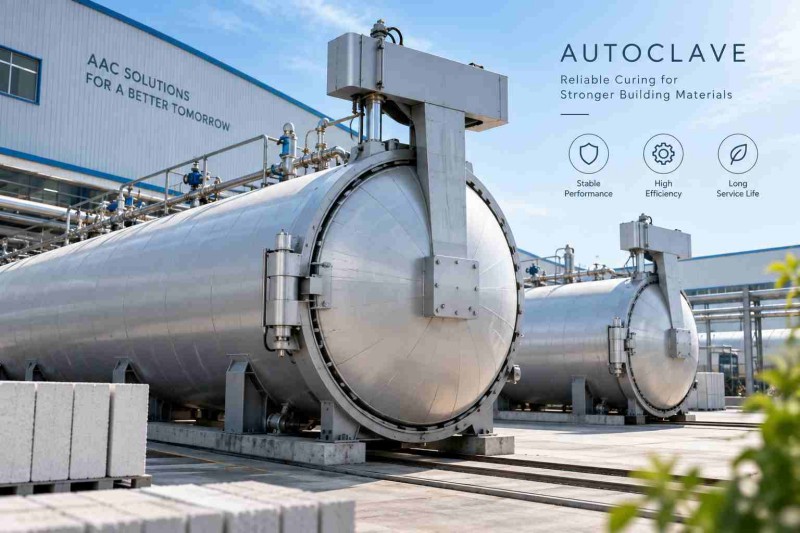
Large AAC autoclaves are difficult to transport because the pressure vessel is long, heavy and oversized. Freight therefore deserves attention early in your project rather than after the equipment has been manufactured.
Transportation cost can depend on:
- vessel diameter;
- overall length;
- equipment weight;
- distance to the loading port;
- ocean freight;
- destination-port handling;
- road restrictions;
- special trailers or permits;
- distance from port to factory.
An autoclave with somewhat reduced factory pricing for worldwide AAC projects may end up costing more after shipment if its size makes logistics challenging.
Your supplier should therefore consider manufacturing, shipping, and site installation as one engineering chain.
Installation and Foundation Costs
An AAC autoclave cannot simply be placed on a workshop floor. The vessel requires properly designed supports and foundations that account for its operating weight and thermal movement.
During installation, your project may need cranes, alignment work, rail connection, piping installation, electrical work and pressure-system commissioning.
Foundation and installation costs depend heavily on local labor, civil construction prices and site conditions, so they are difficult to include in a universal machine price.
Before comparing suppliers, clarify whether each quotation includes:
- equipment only;
- insulation;
- valves and instruments;
- internal rails;
- control cabinet;
- installation supervision;
- commissioning;
- pressure testing;
- spare parts.
This prevents a low initial quotation from becoming unexpectedly expensive later.
Certification Can Affect Autoclave Cost
The necessary certification for an autoclave relies on the location of your project and the relevant laws because it is a pressure vessel.
Your specification may need to comply with national or regional pressure-vessel requirements covering design, materials, welding, inspection, testing and documentation. Additional certification requirements can increase engineering and manufacturing cost.
For export projects, you should confirm the applicable standard before production begins. Changing pressure-vessel requirements after fabrication has started can be expensive and sometimes impractical.
New vs. Used AAC Autoclaves
Used equipment can reduce initial investment, but pressure vessels deserve more caution than ordinary mechanical equipment.
Before considering a used autoclave, you should verify:
- manufacturing year;
- operating history;
- original design pressure;
- shell thickness records;
- corrosion condition;
- welding history;
- previous repairs;
- door condition;
- certification documents;
- remaining service suitability.
For pumps, conveyors or some material-handling equipment, used machinery may be relatively straightforward to evaluate. For a large pressure vessel operating under repeated thermal and pressure cycles, inspection and documentation become much more important.
A lower purchase price should not replace a proper engineering assessment.
Autoclave Cost Should Be Evaluated at Plant Level
The best autoclave for your AAC project isn’t always the biggest vessel or the least expensive device. It is the configuration that matches your mold size, daily output, curing cycle and material-flow arrangement without creating excessive idle capacity.
Your AAC production line should coordinate batching, pouring, pre-curing, cutting, autoclaving, separation and packaging as one system. If the cutting section produces more cakes than your autoclaves can process, material begins to wait. If your autoclave capacity is excessive, expensive pressure vessels remain underutilized.
This balance becomes especially important as your plant capacity increases. Spending more on the right autoclave configuration can be more economical than correcting a production bottleneck after commissioning.
An AAC autoclave typically costs $80,000–$250,000+ per unit, depending on size, pressure rating, automation, and certification. A complete autoclaving system costs more due to multiple vessels, steam systems, piping, controls, and installation.
Accurate pricing requires your production capacity, product mix, mold size, steam conditions, operating hours, and local pressure-vessel standards.