
Powder materials in AAC production require stable conveying to ensure accurate feeding, consistent mixing, and reliable block quality.
With advantages of closed conveying and flexible mounting, screw conveyors are available with personalized schemes customized to material features, handling capacity and production layout conditions.
Screw Conveyor Structure for AAC Production Lines
Screw Flight
Material transportation mainly relies on screw flights. Conveying efficiency is affected by the flight’s diameter, pitch and wall thickness.
For powders adopted in AAC production, the design of screw flights should guarantee smooth material transfer and avoid over-compression of fine powder particles.
Screw Shaft
The screw shaft transfers motor power to the rotating flight. Heavy-duty AAC production lines usually require reinforced shaft designs to withstand continuous operation.
Conveyor Housing
The housing structure isolates materials from external pollutants and suppresses dust generation. Sealed housing design carries great significance when conveying quicklime and cement.
Drive System
Operating speed and torque are controlled by the drive system. To achieve stable feeding performance, different powdered raw materials need to operate at matched rotational velocities.
Integration with AAC Production Equipment
| Connection Position | Conveying Purpose |
| Storage Silo → Screw Conveyor | Controlled powder discharge |
| Screw Conveyor → Weighing System | Accurate material measurement |
| Weighing System → Mixer | Stable powder feeding |
| Powder Processing Equipment → Storage | Continuous material transfer |
Powder Materials Conveyed by Screw Conveyors
A variety of powders with distinct conveying requirements are adopted in AAC manufacturing. Screw conveyors are deployed to guarantee steady feeding and standardized material preparation.
To achieve dependable powder transportation, particle size, bulk density, susceptibility to moisture and flow properties should be taken into account during screw conveyor selection.
| Powder Material | Characteristics | Screw Conveyor Requirements |
| Quicklime | Fine powder, moisture sensitive, easy to react with water | Enclosed structure, good sealing, corrosion-resistant design |
| Cement | High fineness, requires stable dosing accuracy | Precise feeding control, smooth conveying performance |
| Gypsum Powder | Soft material with lower hardness | Low-speed conveying to reduce material damage |
| Fly Ash Powder | Fine particles, easy to generate dust | Dust prevention design and reliable sealing |
| Additives | Small dosage but high accuracy requirement | Customized feeding capacity and control system |
Screw Conveyor Types for AAC Powder Handling
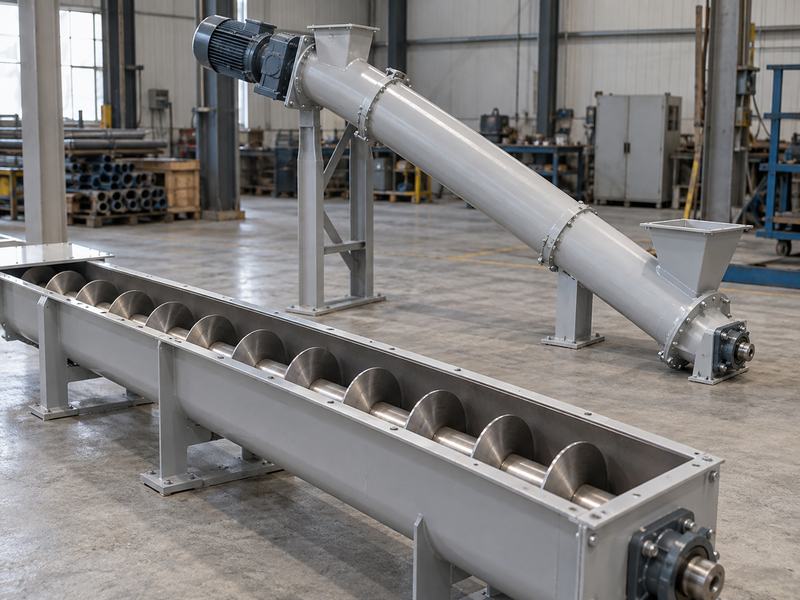
Horizontal Screw Conveyor
For the transportation of powdery materials between storage silos, batching systems and mixing facilities, horizontal screw conveyors represent a prevalent transport option.
The horizontal structure provides stable material movement with relatively simple installation and maintenance. It is suitable for short-distance conveying where consistent powder feeding is required.
In AAC production lines, horizontal screw conveyors are often installed below cement silos, lime silos, or powder storage systems to deliver materials accurately into the weighing and mixing section.
Typical Applications:
- Cement feeding system
- Quicklime transportation
- Gypsum powder transfer
- Powder material dosing units
Inclined Screw Conveyor
Powdered raw materials can be lifted to different heights by inclined screw conveyors, which deliver adaptable transportation schemes for compact AAC workshops.
Stable material flow and consistent running performance depend on properly configured inclination angle, operating speed and screw diameter.
Typical Applications:
- Connecting lower storage systems with upper mixing platforms
- Vertical layout production lines
- Powder transfer with elevation differences
Vertical Screw Conveyor
Vertical screw conveyors transport powder materials upward in limited spaces, saving floor area and requiring optimized design for stable conveying.
Typical Applications:
- Compact AAC production plants
- Limited installation spaces
- High-level powder feeding systems
Selection Based on Powder Material Characteristics
Moisture Sensitivity
Quicklime and mineral powders are moisture sensitive, requiring protection against adhesion, blockage, and reduced conveying efficiency.
Fully enclosed screw conveyors with reliable sealing help improve material protection and support stable AAC powder handling.
Flowability
Flow characteristics differ among different types of powders. Fine cement can flow freely in most cases, but humidity conditions and particle properties may cause poor mobility of other powders.
It is necessary to modify screw diameter, rotational velocity and feeding configuration to match the material flow performance.
| Material Condition | Recommended Design Focus |
| Good flowability powder | Standard screw flight design |
| Sticky powder | Larger clearance and anti-adhesion structure |
| Moist powder | Sealed conveying and moisture protection |
| High-density powder | Stronger motor and reinforced screw shaft |
Feeding Accuracy
Since material proportions exert influences on slurry quality and finished block properties, AAC manufacturing demands accurate powder feeding.
Screw conveyors can realize continuous and stable material supply; meanwhile, variable speed control helps boost metering accuracy and maintain consistent process conditions.
Capacity Selection of Screw Conveyors
Mingjie Machine provides screw conveyor solutions with different specifications according to AAC production requirements. The equipment can be customized based on material type, processing capacity, and plant layout.
| Parameter | Typical Range |
| Screw Diameter | 160–500 mm |
| Conveying Capacity | 1–80 m³/h |
| Conveying Length | Customized according to layout |
| Installation Type | Horizontal, inclined, vertical |
| Material | Carbon steel or stainless steel options |
Powder density and production requirements jointly define conveying capacity. The deployment of several screw conveyors ensures continuous material feeding for AAC manufacturing lines.
Custom Screw Conveyor Design
| Model | Main Parameters | Suitable AAC Applications |
| MJ-LS100 | Diameter: 100 mmCapacity: 1–8 m³/h | Additives feeding, small powder transfer systems |
| MJ-LS200 | Diameter: 200 mmCapacity: 5–14 m³/h | Cement, gypsum, fly ash conveying in small AAC lines |
| MJ-LS250 | Diameter: 250 mmCapacity: 10–25 m³/h | Standard AAC batching and powder feeding systems |
| MJ-LS315 | Diameter: 315 mmCapacity: 20–40 m³/h | Medium-scale AAC production lines |
| MJ-LS400 | Diameter: 400 mmCapacity: 40–80 m³/h | Large AAC plants with high-volume powder transportation |
AAC factories often have different production capacities, layouts, and raw material conditions. Standard screw conveyors may not always fit existing production systems.
Specialized screw conveyor solutions may be developed considering the items listed below:
- Powder material characteristics
- Required conveying capacity
- Installation height and distance
- Connection with AAC equipment
- Automation requirements
For example, a compact AAC plant may require a shorter inclined screw conveyor due to limited installation space, while a large-scale production line may need multiple conveyors connected with automatic batching equipment.
Screw Conveyor Selection for Raw Materials in AAC Production
| Production Requirement | Recommended Screw Conveyor Solution |
| Small AAC production line | Compact horizontal screw conveyor |
| Large-scale continuous production | Heavy-duty screw conveyor system |
| Limited plant space | Inclined or vertical screw conveyor |
| Moisture-sensitive powder | Fully enclosed sealed conveyor |
| High feeding accuracy | Variable-speed dosing screw conveyor |
Material and Manufacturing Options
Screw conveyors with outstanding durability are essential for AAC factories to keep stable operation under continuous production loads.
Carbon steel and stainless steel alternatives differ in structural strength, anti-corrosion capability and design adaptability.
Properly chosen screw conveyors can realize consistent powder supply and effective raw material treatment. Tailored designs are conducive to maintaining dependable AAC manufacturing processes.