
AAC is a lightweight building material with a reputation for precision, quick installation, fire resistance, insulation, and sound reduction. An AAC block making machine is usually a complete production line that processes raw materials through mixing, pouring, cutting, autoclaving, separation, and packing.
For investors, the right AAC machine improves efficiency, reduces labor costs, ensures stable block quality, and supports long-term business growth.
What Is a Machine for Making AAC Blocks?
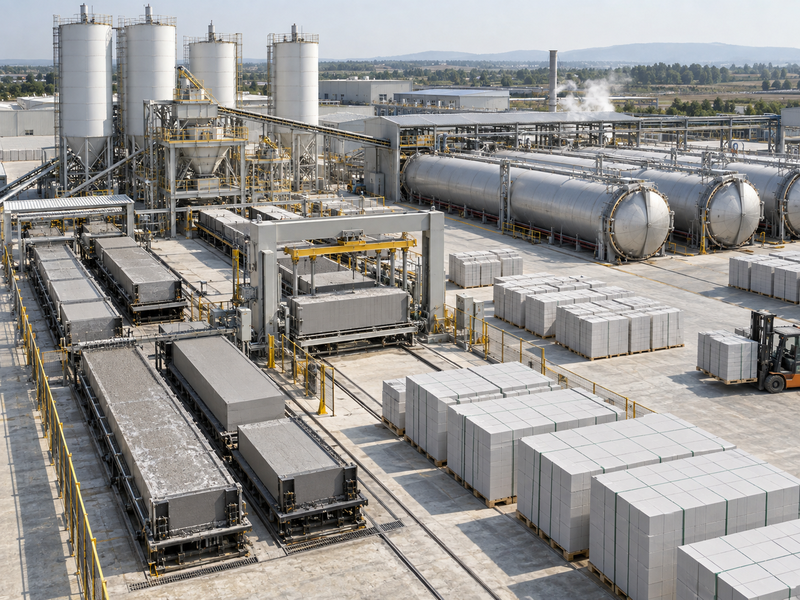
The industrial machinery used to create autoclaved aerated concrete blocks is called an AAC block producing machine. The machine system prepares raw materials, mixes them into slurry, allows the slurry to expand and harden into a green cake, cuts the cake into block sizes, and cures the blocks under high-temperature and high-pressure steam inside an autoclave.
AAC blocks are not the same as regular concrete blocks or conventional clay bricks. They contain millions of tiny air pores inside the material. These pores make the blocks lightweight while maintaining good strength and insulation performance.
A complete AAC block making machine usually includes:
- Raw material processing equipment
- Batching and measuring system
- Mixing and pouring system
- Mold and pre-curing system
- AAC cutting machine
- Autoclave curing system
- Block separating equipment
- Packing and handling system
- Electrical and automation control system
Because AAC production involves chemical reactions, material expansion, cutting accuracy, and steam curing, the equipment must be designed as an integrated production system rather than a group of unrelated machines.
Main Raw Materials Used in AAC Block Production
AAC blocks can be produced with different formulas depending on local raw material availability. The two most common types are sand-based AAC and fly ash-based AAC.
| Raw Material | Main Function in AAC Production |
| Sand or fly ash | Main silica material and structural base |
| Cement | Provides strength and binding performance |
| Lime | Reacts with silica and supports aeration |
| Gypsum | Regulates setting time and improves stability |
| Aluminum powder | Creates gas bubbles for lightweight structure |
| Water | Forms slurry and supports chemical reaction |
Sand-based AAC blocks are often used when high-quality silica sand is available. Fly ash-based AAC blocks are popular in regions with thermal power plants because fly ash can be reused as an industrial by-product. The choice of raw material affects grinding requirements, formula design, slurry density, curing conditions, and final product quality.
How Do AAC Block Production Machines Operate?
The manufacture of AAC blocks involves a number of interconnected procedures. Each step affects the quality, strength, appearance, and production cost of the final blocks.
1. Raw Material Preparation
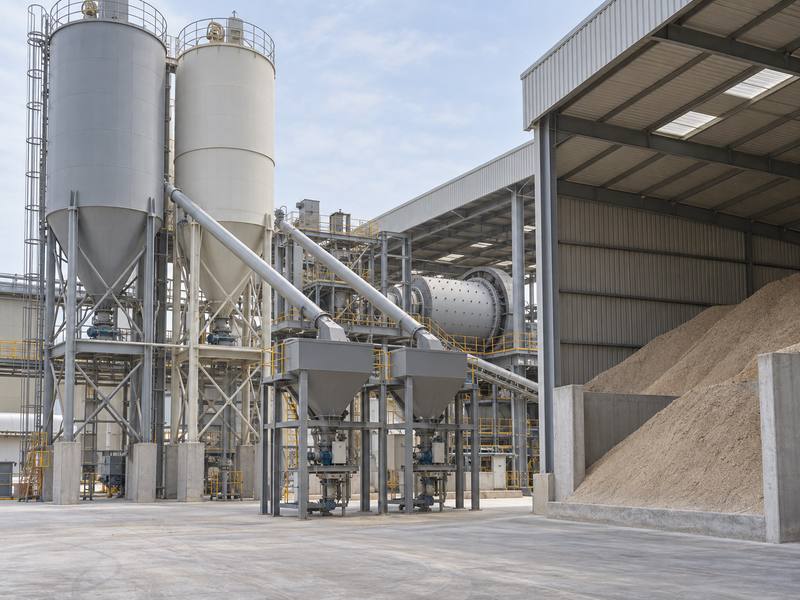
The first step is raw material preparation. Sand usually needs to be ground into fine slurry by a ball mill. Fly ash may also require processing depending on its fineness and quality. Lime and cement are stored in silos, while gypsum and aluminum powder are prepared according to the production formula.
Raw material preparation is very important because particle size, moisture content, and material stability directly affect the reaction process and block strength. If the raw materials are not prepared correctly, the blocks may have unstable density, low strength, cracks, or poor surface quality.
2. Batching and Mixing
Following preparation, a formula is used to measure the raw elements. A dosing system controls the quantity of each material. Accurate batching helps maintain consistent block density, strength, and size.
The materials are then mixed in a pouring mixer. Aluminum powder is added during this stage to create aeration. The mixture becomes a flowing slurry and is poured into molds. The mixing time, slurry temperature, water ratio, and aluminum powder dosage must be carefully controlled.
3. Pouring and Pre-Curing
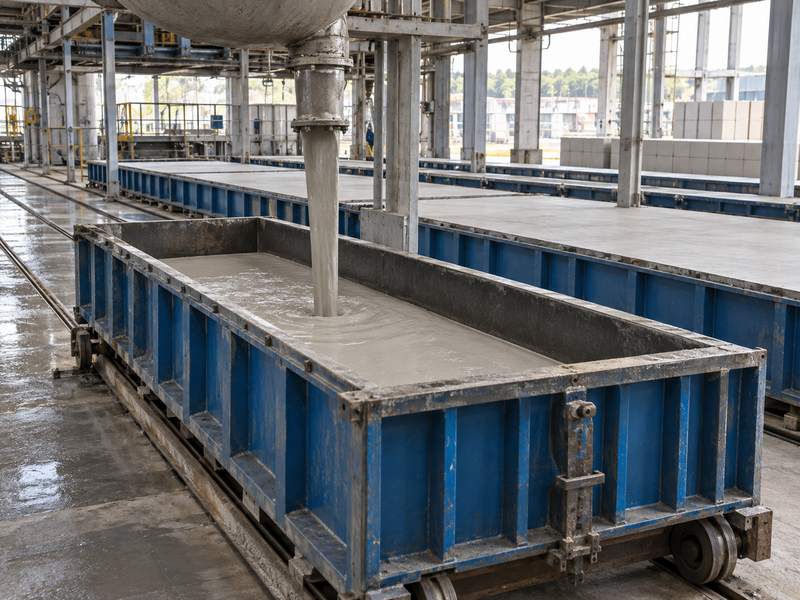
Moulds are filled with the slurry. After pouring, the aluminum powder reacts with alkaline materials such as lime and cement, producing gas bubbles. These bubbles expand the slurry and form the porous structure of AAC.
The mold is then placed in a pre-curing area where the green cake gains enough hardness for cutting. Temperature, humidity, and curing time must be controlled carefully. If the green cake is too soft, it may collapse during cutting. Cutting wires may break or block edges may become rough if it is applied too forcefully.
4. Cutting
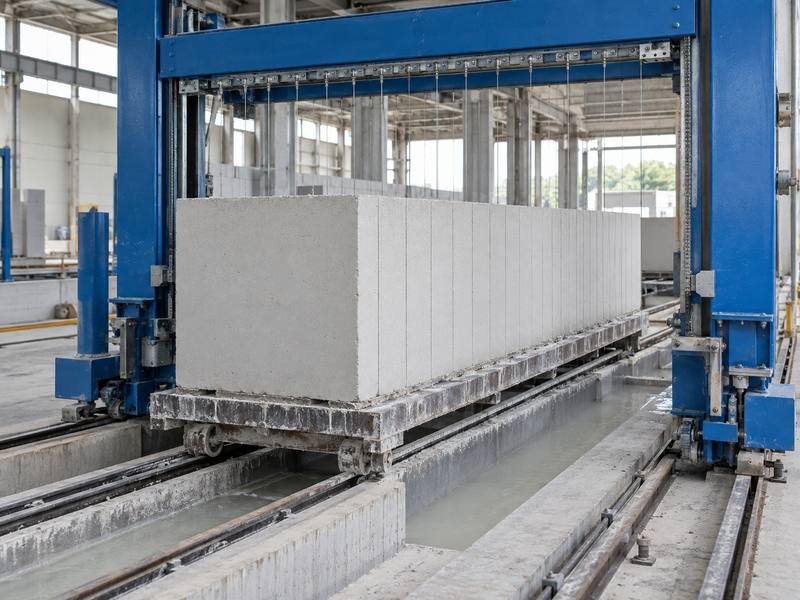
Once the green cake reaches the right hardness, it is removed from the mold and sent to the cutting machine. The cutting machine cuts the cake vertically and horizontally into accurate block sizes.
One of the most crucial measures of AAC block quality is cutting precision. High-precision cutting reduces material waste and ensures better block appearance. Accurate blocks are easier to install on construction sites and require less mortar during masonry work.
5. Autoclave Curing
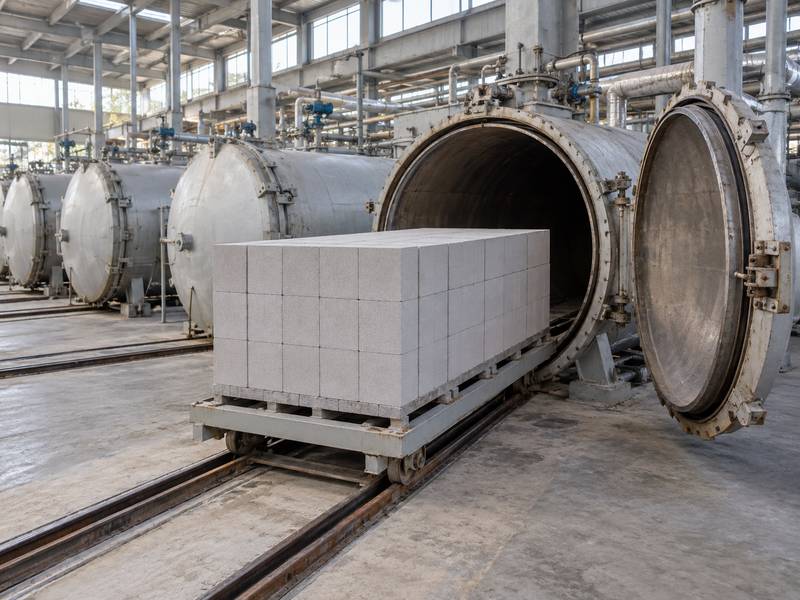
After cutting, the blocks are sent into autoclaves. An autoclave is a large pressure vessel that cures AAC blocks with high-temperature and high-pressure steam.
During autoclaving, chemical reactions create stable crystalline structures inside the blocks, giving them strength and durability. This step is essential to AAC production and is the reason the material is called “autoclaved” aerated concrete.
6. Separation and Packing
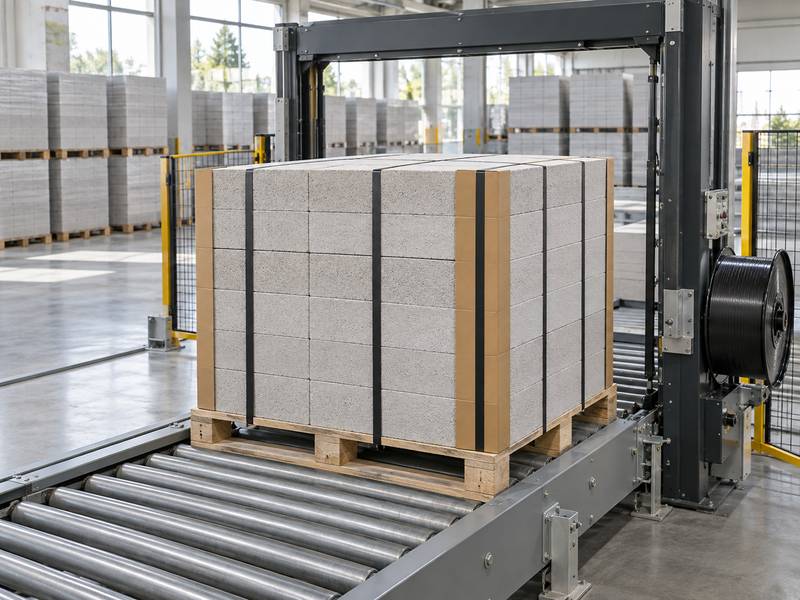
After curing, the AAC blocks are unloaded and separated. Block separation equipment helps separate blocks that may stick together during autoclaving. Finally, the blocks are stacked, packed, and prepared for storage or delivery.
Efficient separation and packing can reduce product damage, improve warehouse management, and make transportation easier.
AAC Block Production Process Overview
| Step | Process | Main Equipment |
| 1 | Raw material grinding and storage | Ball mill, slurry tank, silos |
| 2 | Batching and mixing | Dosing system, pouring mixer |
| 3 | Pouring and expansion | Mold, pouring system |
| 4 | Pre-curing | Pre-curing room or curing area |
| 5 | Cutting | AAC cutting machine |
| 6 | Steam curing | Autoclave, boiler system |
| 7 | Separation | Block separator |
| 8 | Packing | Stacking and packing system |
This process shows that AAC block manufacturing requires a complete production line rather than one independent machine.
Main Components of an AAC Block Making Machine
A complete AAC block making machine includes different equipment sections. Every department plays a distinct part in the production process.
| Equipment Section | Main Function |
| Ball mill | Grinds sand or other raw materials into slurry |
| Material silos | Stores cement, lime, fly ash, and other powders |
| Dosing system | Measures raw materials accurately |
| Pouring mixer | Mixes slurry and chemical materials |
| Mold | Holds slurry during expansion and pre-curing |
| Cutting machine | Cuts green cake into required block sizes |
| Autoclave | Cures blocks under steam pressure |
| Boiler | Supplies steam for autoclaving |
| Separator | Separates finished AAC blocks |
| Packing system | Stacks and packs blocks for transport |
| Control system | Manages production operation and automation |
The quality and coordination of these components determine the efficiency and stability of the whole AAC plant. Even if one section is poorly designed, the entire production line may face problems such as low output, block cracking, inaccurate sizes, or high maintenance costs.
Types of AAC Block Making Machines
AAC block making machines can be classified according to production capacity, automation level, and product type.
By Production Capacity
Small AAC block plants are suitable for new investors or local markets. Medium and large plants are suitable for regional building material companies and industrial-scale manufacturers.
| Plant Type | Annual Capacity | Suitable For |
| Small AAC plant | 50,000–100,000 m³/year | New investors, local construction markets |
| Medium AAC plant | 150,000–300,000 m³/year | Regional suppliers and growing businesses |
| Large AAC plant | 300,000–500,000 m³/year | Established building material manufacturers |
| Customized AAC plant | 500,000 m³/year or above | Large industrial groups and high-demand markets |
The right capacity depends on local market demand, land availability, investment budget, raw material supply, and sales channels. A larger plant can reduce unit production cost, but it also requires stronger market demand and higher initial investment.
By Automation Level
AAC block making machines can also be semi-automatic, automatic, or highly automated.
| Automation Level | Features | Advantages |
| Semi-automatic | More manual operation, simpler control | Lower investment cost |
| Automatic | Mechanical handling and PLC control | Better efficiency and stable quality |
| Highly automated | Advanced handling, data control, integrated systems | Lower labor cost and high output |
The right automation level depends on labor cost, budget, local skill level, production target, and long-term business plan. In regions where labor cost is high, a highly automated AAC production line may provide better long-term returns. In emerging markets, a semi-automatic or standard automatic line may be more practical for new investors.
Advantages of Using an AAC Block Making Machine
Investing in an AAC block making machine can bring several advantages to building material producers.
First, AAC blocks are lightweight, which reduces building load and transportation pressure. Compared with traditional bricks, AAC blocks can improve construction speed because they are larger and easier to handle.
Second, AAC blocks have good thermal insulation performance. They are therefore appropriate for energy-efficient structures, particularly in areas with hot summers or chilly winters.
Third, AAC block production can use industrial by-products such as fly ash. This supports resource recycling and helps reduce environmental impact.
Fourth, a machine that makes AAC blocks automatically can lower labour costs and increase production consistency. With proper control, the plant can produce blocks with stable density, strength, and dimensions.
Key Benefits of AAC Blocks
- Lightweight structure
- Good thermal insulation
- Fire resistance
- Sound insulation
- Accurate size
- Fast construction
- Lower transportation load
- Suitable for modern green buildings
Key Benefits of AAC Block Making Machines
- Continuous industrial production
- Stable product quality
- Reduced labor cost
- Higher production efficiency
- Better raw material utilization
- Flexible capacity options
- Support for future block and panel production expansion
AAC Block Making Machine vs Traditional Brick Production
AAC block production is different from traditional clay brick production. Clay bricks usually require soil excavation and kiln firing, while AAC blocks are produced through steam curing.
| Item | AAC Block Making Machine | Traditional Brick Production |
| Main material | Sand, fly ash, cement, lime, gypsum | Clay or soil |
| Curing method | Autoclave steam curing | Kiln firing |
| Product weight | Lightweight | Heavier |
| Insulation | Good | Lower |
| Production control | Industrial and formula-based | Often less precise |
| Environmental impact | Can use fly ash and reduce soil use | May consume clay resources |
| Product size | Larger and more accurate | Smaller and less uniform |
This comparison explains why many modern construction markets are moving toward AAC blocks and other lightweight building materials. AAC production is more suitable for industrialized, standardized, and energy-efficient construction.
What Should Purchasers Think About Before Making a Purchase?
Purchasing an AAC block manufacturing machine is a long-term commitment. Buyers should evaluate more than the machine price. A cheaper machine may lead to higher operating costs if it has poor cutting accuracy, unstable production, high energy consumption, or weak after-sales support.
Important Factors to Check
- Target annual capacity
- Available raw materials
- Land and workshop size
- Required block size
- Local construction standards
- Automation level
- Steam and power supply
- Labor availability
- Installation support
- Operator training
- Spare parts service
- Future expansion plan
Before making a purchase, investors should ask the supplier to provide a complete plant layout, equipment list, process flow, utility consumption estimate, and installation plan. This helps buyers understand the real investment cost, not just the machine price.
Common Applications of AAC Blocks
AAC blocks produced by AAC block making machines are widely used in different types of buildings.
| Application | Why AAC Blocks Are Suitable |
| Residential buildings | Lightweight, insulation, fast installation |
| Commercial buildings | Accurate size and stable quality |
| High-rise buildings | Reduces structural load |
| Industrial buildings | Fire resistance and durability |
| Interior partition walls | Easy cutting and installation |
| Energy-saving buildings | Better thermal performance |
Because AAC blocks are versatile, they are suitable for both load-reducing wall systems and non-load-bearing partition walls.
How to Choose a Reliable AAC Block Making Machine Manufacturer
A reliable AAC machine manufacturer should offer more than equipment. The supplier should understand plant planning, process design, installation, commissioning, and production training.
Good manufacturers usually provide customized solutions based on raw materials, production capacity, workshop layout, and target products. They should also provide clear technical documents and after-sales service.
Manufacturer Selection Checklist
| Evaluation Point | Why It Matters |
| Project experience | Shows whether the supplier understands real production problems |
| Technical design ability | Affects plant layout and production efficiency |
| Equipment quality | Determines long-term stability |
| Cutting accuracy | Influences product appearance and market acceptance |
| Automation control | Reduces labor and improves consistency |
| Installation support | Helps the plant start production faster |
| Spare parts supply | Reduces downtime |
| Training service | Helps operators run the plant correctly |
Selecting a supplier with turnkey project experience helps lower risk and streamline the investment process for first-time investors in the AAC sector.
An AAC block making machine is a complete production system for manufacturing autoclaved aerated concrete blocks, covering material preparation, batching, mixing, pouring, curing, cutting, autoclaving, packing, and automatic control.
For investors, it is the foundation of an AAC block business. The appropriate machine boosts productivity, lowers labour costs, enhances block quality, and fosters long-term growth. When choosing equipment, investors should consider raw materials, capacity, automation, product requirements, workshop layout, energy supply, and after-sales service.