
When choosing AAC for a building project, a common question is: how much weight can an AAC block hold?
There is no single answer. Load-bearing capacity depends on compressive strength, AAC block size, density, mortar or adhesive quality, wall geometry, moisture condition, and load distribution.
More importantly, block compressive strength is not the same as total wall strength. Understanding this helps contractors select the right AAC grade and manufacturers maintain stable production quality.
What Is AAC Blocks’ Compressive Strength?
Compressive strength describes how much compression a material can resist before failure.
It is normally expressed in MPa or N/mm².
The basic relationship is:
Compressive Strength = Failure Load ÷ Loaded Area
Or:
f = P / A
Where:
- f= compressive strength
- P= maximum compression load
- A= loaded cross-sectional area
AAC is intentionally porous, so its compressive strength is lower than that of dense structural concrete. This lower density, however, is also what gives AAC its advantages in wall weight, thermal insulation, handling, and construction efficiency.
Under China’s GB/T 11968-2020 standard, AAC blocks are divided into compressive-strength classes A1.5, A2.0, A2.5, A3.5, and A5.0, while dry-density classes range from B03 to B07. The standard identifies A1.5 and A2.0 primarily with thermal-insulation applications.
Typical AAC Strength Classes
| AAC Strength Class | Nominal Compressive Strength | General Positioning |
| A1.5 | 1.5 MPa | Low-density thermal insulation |
| A2.0 | 2.0 MPa | Insulation and light wall applications |
| A2.5 | 2.5 MPa | Common non-load-bearing wall applications |
| A3.5 | 3.5 MPa | Higher-strength wall construction |
| A5.0 | 5.0 MPa | Higher structural-performance requirements |
These application descriptions should be treated as general guidance rather than structural design rules. Actual selection depends on local building codes, wall dimensions, loading conditions, reinforcement, and engineering calculations.
European EN 771-4 similarly requires manufacturers to declare AAC masonry compressive strength and specifies that units intended for load-bearing masonry should have a declared compressive strength of at least 1.5 N/mm².
How Much Weight Can One AAC Block Theoretically Hold?
The question becomes more intriguing at this point.
Consider an AAC block measuring:
600 × 200 × 250 mm
If it is installed with a loaded bed area of approximately:
600 mm × 200 mm = 120,000 mm²
and the block has an A3.5 compressive strength:
3.5 N/mm² × 120,000 mm² = 420,000 N
That equals approximately:
420 kN, or roughly 42.8 metric tons-force.
At first glance, this sounds extremely high.
However, 42.8 tons is not the allowable building load for that block or wall.
It is simply a theoretical calculation produced by multiplying nominal material strength by gross bearing area. A real wall contains joints, imperfections, eccentric loads, openings, height effects, moisture variation, workmanship tolerances, and safety factors.
The distinction is critical.
Theoretical Compression by Block Thickness
Assuming a 600 mm block length and uniform compression:
| Strength / Wall Thickness | 100 mm | 150 mm | 200 mm |
| A2.5 | 150 kN | 225 kN | 300 kN |
| A3.5 | 210 kN | 315 kN | 420 kN |
| A5.0 | 300 kN | 450 kN | 600 kN |
These figures are illustrative material calculations only, not permissible structural wall loads.
A structural engineer must determine the actual allowable load according to wall height, thickness, eccentricity, reinforcement, connection details, safety factors, and applicable building codes.
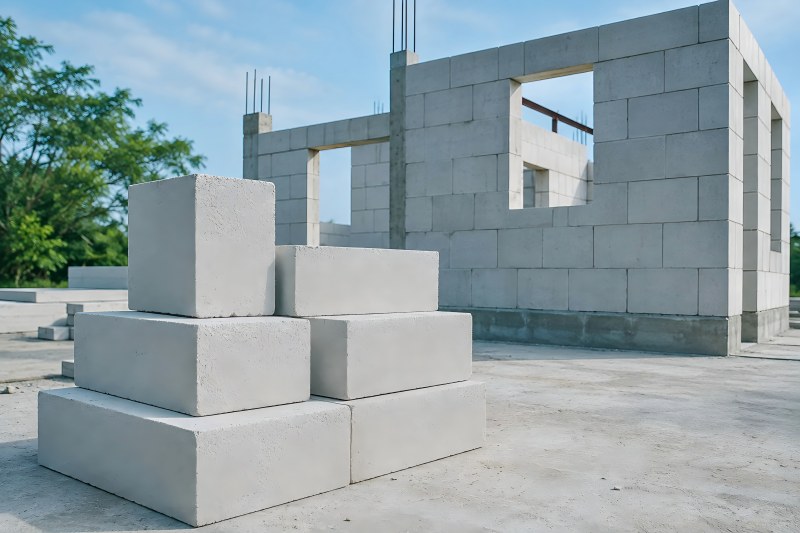
AAC Block Strength Is Not the Same as AAC Wall Strength
This is one of the most important points when discussing AAC load capacity.
A compression-testing machine applies load directly to a carefully prepared specimen under controlled conditions. A building wall operates under much more complicated conditions.
An AAC wall may experience:
- Vertical dead loads
- Floor or roof loads
- Wind pressure
- Eccentric compression
- Local concentrated loads
- Openings around doors and windows
- Thermal movement
- Moisture movement
The strength of the individual AAC block therefore represents only one part of the wall system.
Thin-joint adhesive quality, installation accuracy, wall slenderness, reinforcement, lintels, structural connections, and foundation movement can all affect wall performance.
For this reason, simply multiplying block compressive strength by wall area can significantly overestimate practical structural capacity.
Does Higher AAC Density Mean Higher Load Capacity?
Generally, increasing AAC density allows higher compressive strength, but the relationship should not be treated as unlimited.
AAC contains millions of small pores. Increasing solid material content and reducing excessive pore volume can increase strength, but it also increases block weight and usually raises thermal conductivity.
This creates one of the fundamental engineering trade-offs in AAC production:
strength vs density vs thermal performance.
GB/T 11968-2020 identifies density classes from B03 through B07, illustrating that density is deliberately controlled rather than simply maximized.
For an AAC plant, the goal should therefore not be to manufacture the densest block possible. The better target is achieving the required strength consistently at the lowest practical density.
That normally creates a more valuable product.
What Factors Affect AAC Block Load-Bearing Capacity?
Raw Material Quality
AAC strength starts long before the block enters the autoclave.
The final calcium silicate structure is influenced by fly ash or silica sand, lime, cement, gypsum, aluminium powder, and water.
Large variations in raw-material chemistry can change reaction rates and pore formation.
Even when the production recipe remains unchanged, inconsistent lime activity or silica characteristics can cause strength variation between batches.
Grinding Fineness
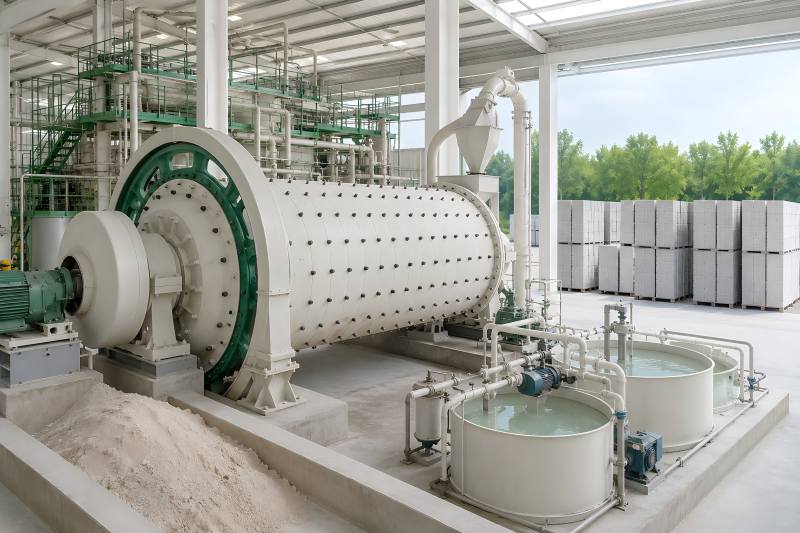
Grinding fineness is particularly important in sand-based AAC production.
Particles that are too coarse provide less reactive surface area. This can reduce silica utilization during autoclaving and leave the final material with a less developed microstructure.
Excessively fine grinding is not automatically better either.
Very fine material can increase slurry viscosity and water demand while reducing ball mill throughput and increasing power consumption.
The best fineness is therefore the range that provides sufficient reaction activity without unnecessarily increasing process instability.
Water-to-Solid Ratio
Water affects both slurry behavior and final pore structure.
Too much water may reduce green-cake stability and contribute to a weaker structure after curing. Too little water can make mixing, casting, and expansion more difficult.
Stable dosing is therefore more important than simply targeting one theoretical recipe.
Aluminum Powder Dosage
Aluminum creates the gas bubbles responsible for AAC’s porous structure.
More gas generation generally creates lower-density material. However, excessive pore volume or irregular pore distribution can reduce compressive strength.
Too little aluminum can create unnecessarily dense blocks.
The objective is a uniform pore system rather than maximum expansion.
Mixing Uniformity
A recipe can be correct on paper while still producing inconsistent blocks if the materials are not distributed evenly.
Cement, lime, silica slurry, gypsum, and aluminum must be mixed consistently throughout the batch.
Poor mixing can create areas with different pore sizes and different reaction characteristics.
This is why accurate batching and controlled mixing are essential parts of an AAC production line.
Why Pre-Curing Matters More Than Many Plants Expect
After casting, the AAC cake must develop enough green strength before cutting.
If cutting begins too early, the cake may deform, collapse around edges, or develop small internal defects.
If pre-curing continues too long, wire cutting becomes more difficult and may generate tearing or dimensional problems.
The ideal cutting point is therefore a process window rather than simply a fixed number of minutes.
Temperature, raw-material activity, aluminum reaction, ambient conditions, and slurry formulation all affect how quickly that window is reached.
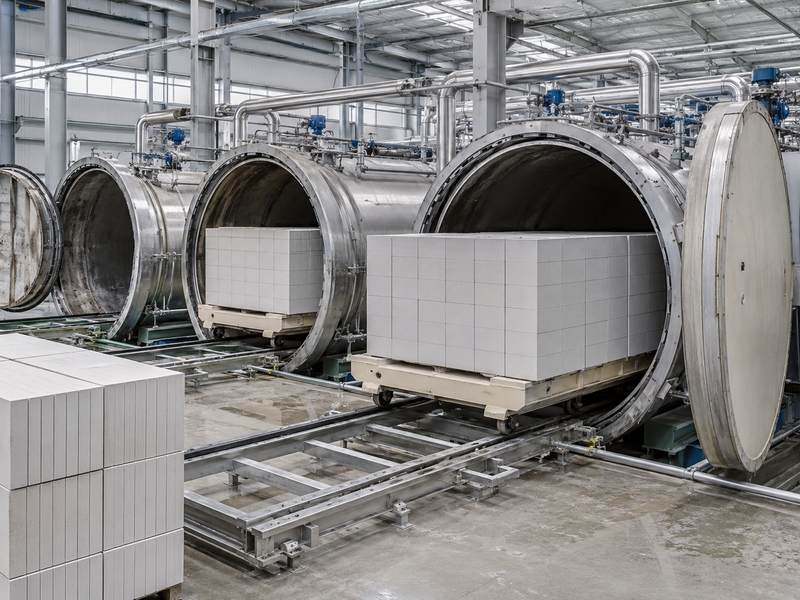
How Autoclaving Influences Final AAC Strength
Autoclaving is where much of the final AAC material structure develops.
The cut cakes are exposed to high-temperature saturated steam under pressure. During this stage, silica and calcium-bearing materials react and form calcium silicate hydrate phases responsible for much of AAC’s final mechanical performance.
Insufficient curing can leave reactions incomplete.
Simply extending autoclaving indefinitely, however, does not guarantee stronger blocks. Longer cycles also reduce autoclave utilization and increase steam consumption.
For an industrial AAC plant, strength optimization is therefore closely connected with:
- Steam pressure stability
- Heating rate
- Holding period
- Temperature distribution
- Depressurization
- Autoclave loading arrangement
This is why autoclave capacity should be matched with cutting output and overall plant throughput rather than designed independently.
Mingjie AAC production lines integrate raw-material preparation, batching, casting, cutting, grouping, autoclaving, and packaging as coordinated production stages rather than isolated machines.
Which Production Parameters Have the Greatest Impact?
| Production Variable | If Too Low | If Too High | Main Result |
| Silica fineness | Incomplete reaction | High viscosity and energy demand | Strength consistency |
| Water content | Poor slurry flow | Weak green cake | Density and pore structure |
| Aluminum dosage | High density | Excessive pores | Density and strength |
| Mixing time | Uneven composition | Possible process delay | Uniformity |
| Pre-curing | Cake too soft | Cake difficult to cut | Dimensional quality |
| Autoclave curing | Incomplete reaction | Energy and capacity loss | Final strength |
The key lesson is that AAC strength cannot be controlled by one machine.
It is a result of the entire production system.
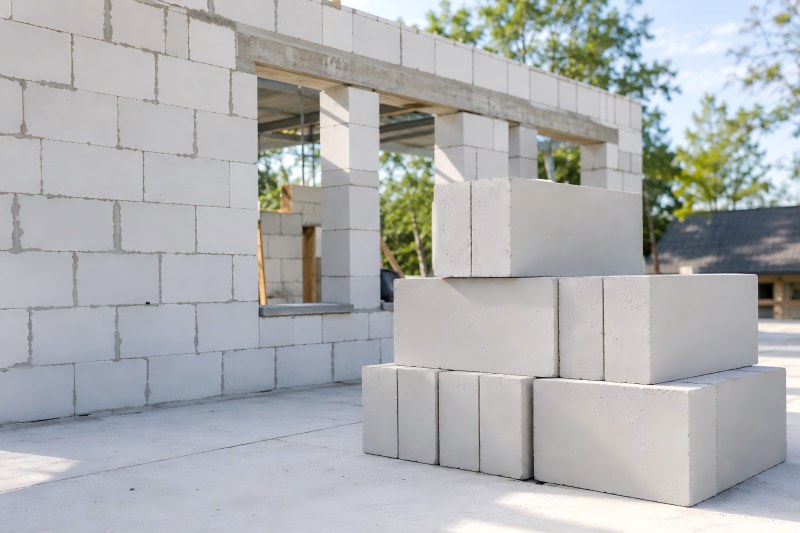
Is It Possible to Use AAC Blocks for Load-Bearing Walls?
Yes, AAC can be used in load-bearing masonry where the product grade, wall design, building code, and structural system permit it.
However, not every AAC block should automatically be treated as a structural block.
Some low-density AAC grades are designed primarily for thermal insulation. Others provide higher compressive strength suitable for more demanding wall applications.
EN 771-4, for example, sets requirements for AAC masonry units and specifies a minimum declared compressive strength for load-bearing masonry.
The final decision must still be made according to the applicable structural code and project engineering requirements.
How Can an AAC Plant Produce Stronger Blocks?
A common mistake is trying to increase strength simply by adding more cement.
That can work to a certain extent, but it may increase material cost and density without correcting the actual production problem.
If an AAC plant is consistently missing its strength target, it is usually better to investigate the entire process:
- Check sand or fly-ash characteristics.
- Verify grinding fineness.
- Measure lime activity.
- Review slurry density.
- Check batching accuracy.
- Verify aluminum dosage.
- Monitor cake temperature and rising behavior.
- Evaluate cutting condition.
- Review autoclave pressure and curing cycle.
- Compare strength results between batches.
More is frequently revealed by patterns in this data than by instantly altering the formula.
For example, a plant experiencing occasional low-strength batches may have a dosing or process-stability problem rather than a fundamentally incorrect material formulation.
The Best AAC Block Is Not Necessarily the Strongest
It is easy to assume that an A5.0 block is automatically better than an A3.5 block.
That is not always true.
If the building only requires an A3.5 product, increasing density and raw-material consumption simply to obtain higher strength may increase production cost while reducing some of AAC’s thermal and lightweight advantages.
An efficient AAC plant should instead maximize strength-to-density performance.
AAC blocks can carry substantial loads, but capacity varies with strength grade, density, dimensions, wall design, mortar, reinforcement, and moisture.
For manufacturers, consistent strength depends on stable grinding, batching, curing, cutting, and autoclaving. The goal is reliable target strength at controlled density and cost, not simply maximum strength.