
Grinding fineness affects slurry stability, mixing, autoclave reaction, energy use, and AAC strength. Too coarse can cause settling and incomplete reaction, while too fine increases viscosity and power consumption.
The best target is a balanced fineness range that supports reactivity, process stability, and consistent block strength.
Why Grinding Fineness Matters in AAC Production
Silica sand is not added to AAC only as a filler. During autoclaving, the silica participates in hydrothermal reactions with lime and cementitious components to form calcium silicate hydrate phases that contribute to the final structure and strength of the block.
The specific surface area of silica particles is increased by grinding.
Smaller particles generally provide:
- Faster contact with water and alkaline components
- Greater reaction surface
- More uniform distribution in the slurry
- Faster hydrothermal reaction during autoclaving
However, grinding also changes the physical behavior of the slurry.
Very fine particles absorb more water at their surfaces and increase internal friction between particles. The slurry may therefore become thicker even when the solid content remains unchanged.
This creates an important process relationship:
Finer grinding may improve chemical reactivity while simultaneously making slurry control more difficult.
The correct fineness must therefore be selected based on the complete AAC process rather than on particle size alone.
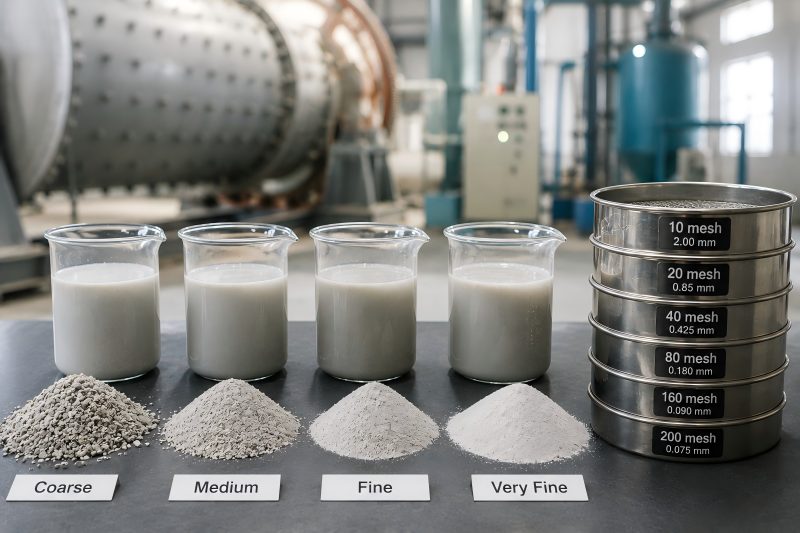
Understanding Fineness in Practical Terms
AAC plants may describe sand fineness using sieve residue, particle-size distribution, specific surface area, or a combination of these measurements.
For practical production control, engineers are usually less interested in one single particle size than in the overall distribution.
A simplified example might look like this:
| Grinding Condition | Approx. D50 | Coarse Residue | General Behavior |
| Coarse grinding | 80–100 μm | High | Fast settling, lower reactivity |
| Medium grinding | 55–75 μm | Moderate | Balanced slurry and reaction |
| Fine grinding | 35–55 μm | Low | Higher reactivity, higher viscosity |
| Very fine grinding | <35 μm | Very low | High energy use, difficult slurry control |
These values are illustrative rather than universal production limits. Different sands behave differently because mineral composition, hardness, particle shape, and clay content also influence slurry behavior.
How Finer Grinding Can Improve AAC Strength
One major reason for controlling sand fineness is its influence on autoclave reaction efficiency.
Coarse silica particles have less surface area available for reaction. Some of the silica may remain relatively inactive during the autoclave cycle, especially if curing time is limited.
When the material is ground finer, more silica surface becomes available to react with calcium-bearing components.
This can improve the formation of the microstructure responsible for strength.
Consider a simplified plant trial:
| Sand Fineness | Approx. Compressive Strength | Relative Strength |
| Coarse | 3.2 MPa | 100% |
| Medium | 3.7 MPa | 116% |
| Fine | 4.0 MPa | 125% |
| Very fine | 4.0–4.1 MPa | 125–128% |
The important point is that strength does not necessarily continue increasing at the same rate as grinding becomes finer.
Moving from coarse to medium grinding may produce a significant improvement. Moving from fine to extremely fine grinding may produce only a small additional strength gain while substantially increasing electrical consumption.
This is a well-known illustration of decreasing returns.
Fineness Also Affects Slurry Sedimentation
AAC sand slurry needs to remain reasonably uniform between grinding, storage, batching, and pouring.
Due to their higher mass and smaller surface-area-to-volume ratio, coarse particles settle more quickly.
If settlement occurs too quickly, the slurry concentration at the bottom of the tank becomes higher than at the top.
This creates several problems:
- Batch density becomes inconsistent
- Pumping becomes less stable
- Mixing ratios fluctuate
- Casting quality varies between molds
- Tank bottoms accumulate heavy sediment
Fine particles remain suspended more easily and can improve slurry stability.
A simplified sedimentation comparison is shown below.
| Grinding Level | Sedimentation After 30 min | Slurry Uniformity |
| Coarse | 10–15% visible separation | Poor |
| Medium | 5–8% | Acceptable |
| Fine | 2–5% | Good |
| Very fine | <2% | Very good, but viscosity may rise |
Again, the finest condition is not always the most desirable.
A slurry that never settles but becomes too viscous can create another set of operating problems.
Why Excessively Fine Grinding Can Increase Slurry Viscosity
When particle size decreases, total particle surface area increases.
More surface area means more water is needed to wet the particles and maintain mobility.
If the plant keeps the same water ratio while significantly increasing grinding fineness, slurry viscosity may rise.
For example:
| Grinding Condition | Water/Solid Ratio | Relative Slurry Viscosity |
| Coarse | 0.60 | 1.00 |
| Medium | 0.60 | 1.10 |
| Fine | 0.60 | 1.25 |
| Very fine | 0.60 | 1.45 |
The values are illustrative, but the trend is important.
As viscosity increases:
- Slurry becomes harder to pump
- Mixing requires more power
- Flow into the mold may become slower
- Aluminum powder may disperse less evenly
- Air release and gas expansion behavior can change
Operators sometimes compensate by adding more water.
That may solve the pumping problem but create another issue: excessive water can increase drying demand, reduce green-body strength, and influence pore development.
For this reason, grinding fineness and water ratio must be adjusted together.
Grinding Fineness Influences Gas Expansion
AAC receives its cellular structure mainly from gas generation after aluminum reacts in the alkaline slurry.
For uniform pore formation, the mixture must have the correct viscosity when gas is released.
If the slurry is too thin, gas bubbles can rise too quickly, merge, or escape.
If the slurry is too thick, gas expansion may be restricted.
Grinding fineness indirectly influences this balance because it affects both solids dispersion and slurry rheology.
A stable AAC mix requires synchronization between:
slurry viscosity + aluminum reaction speed + temperature + setting speed
If sand suddenly becomes much finer without recipe adjustment, this synchronization may change.
The plant may then observe:
- Smaller or irregular pores
- Uneven rising
- Surface cracking
- Local collapse
- Height variation between molds
This is why fineness variation can sometimes appear as a casting problem even when the aluminum dosage has not changed.
Green-Cake Strength Can Also Change
Before cutting, the AAC cake must develop enough strength to maintain its shape while still remaining soft enough for wires to pass through it.
Grinding fineness can influence this stage indirectly.
Finer particles usually improve slurry homogeneity and provide more uniform contact between silica, lime, cement, and water.
This can improve early structural consistency.
However, if finer grinding leads operators to add too much water, green strength may decrease.
This shows why no process parameter should be optimized independently.
A theoretically excellent particle-size distribution can still perform poorly if it forces an unsuitable water-solid ratio.
Coarse Grinding Creates Hidden Quality Variations
One problem with overly coarse grinding is that the block may still look acceptable after production.
The issue may appear later during testing.
Coarse silica can produce:
- Uneven reaction during autoclaving
- Lower compressive strength
- Greater strength variation between batches
- Higher density required to achieve the same strength
- More unreacted mineral particles in the final matrix
Suppose an AAC plant targets 3.5 MPa compressive strength.
If fine, well-controlled slurry consistently produces 3.8 MPa, the plant has a reasonable quality margin.
If coarse grinding causes results to range between 3.2 and 3.7 MPa, the average may appear acceptable, but production risk becomes much higher.
For AAC factories, strength consistency is often more valuable than achieving the maximum strength in one laboratory sample.
Very Fine Grinding Has an Energy Cost
Grinding energy rises quickly as the target particle size becomes smaller.
The last portion of size reduction is normally the most expensive.
A simplified energy comparison might be:
| Grinding Target | Relative Capacity | Estimated Relative Energy Use |
| Coarse | 115% | 85% |
| Medium | 100% | 100% |
| Fine | 85–90% | 115–125% |
| Very fine | 70–80% | 135–155% |
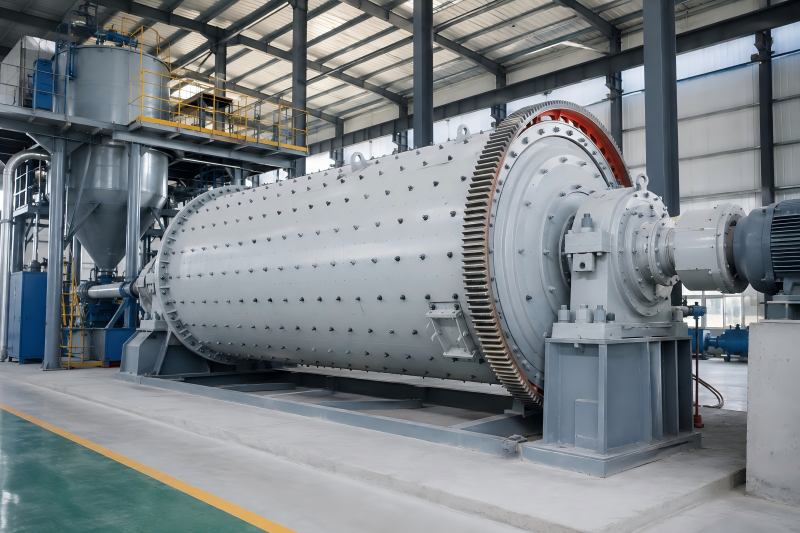
If a ball mill normally processes 15 t/h at the plant’s standard fineness, a much finer target could reduce effective throughput to around 11–13 t/h.
This has two consequences.
First, electricity consumption per ton increases.
Second, the grinding section may become the bottleneck of the entire AAC production line.
Therefore, the best fineness target must consider both product quality and ball mill capacity.
Particle Distribution Is More Important Than One Average Number
Two slurries can have the same average particle size but behave differently.
For example, one may contain a narrow distribution centered around 60 μm.
Another may contain many particles below 20 μm together with a significant fraction above 150 μm.
Both could produce a similar average value, but the second material may have higher viscosity and faster sedimentation at the same time.
This is why a well-controlled particle-size distribution is usually preferable to simply chasing a low D50 value.
For production control, engineers should monitor:
- Fine-particle fraction
- Oversized particle residue
- Average particle size
- Slurry density
- Slurry viscosity
- Settlement rate
These parameters provide a more complete picture of grinding performance.
How to Find the Best Grinding Fineness
The best target should be established through plant trials rather than selected only from equipment specifications.
A practical method is to test three or four grinding conditions while keeping the main recipe as consistent as possible.
For each condition, record:
| Test Parameter | What to Measure |
| Ball mill output | t/h |
| Power consumption | kWh/t |
| Particle size | D50 or sieve residue |
| Slurry density | kg/L |
| Slurry viscosity | Plant test method |
| Settlement | % after fixed time |
| Rising performance | Mold height and stability |
| Green strength | Cutting behavior |
| Block density | kg/m³ |
| Compressive strength | MPa |
The goal is to identify the point where making the sand finer no longer produces enough quality improvement to justify the additional grinding cost.
In many plants, this balanced operating point is more valuable than the technically finest achievable slurry.
A Better Way to Think About Grinding Control
Grinding should not be treated as a separate department whose only objective is producing a certain micron value.
Its real purpose is to supply a predictable raw material to the next process.
For example, if the ball mill produces highly consistent sand slurry at a slightly coarser target, the overall AAC line may perform better than one producing extremely fine slurry with frequent variations in density and viscosity.
This leads to a useful production principle:
Consistency is usually more important than maximum fineness.
A stable particle-size distribution allows operators to control water addition, lime dosage, aluminum reaction, pouring temperature, and pre-curing time with much greater confidence.
Final Thoughts
Grinding fineness affects AAC strength, but finer is not always better. Excessive grinding increases viscosity, energy use, and water demand, while coarse particles can reduce reaction efficiency.
The goal is stable, consistent fineness that balances silica reactivity, slurry performance, and mill productivity.