
The AAC block-making machine price in Uganda depends on capacity, automation, equipment configuration, shipping, installation, and service. This article explains key cost factors, investment range, capacity options, and how to choose a suitable AAC production line for Uganda’s construction market.
Estimated AAC Block Making Machine Price in Uganda
For Uganda, most AAC block-making machines are imported from China, India, Europe, or other industrial machinery markets. The price can vary greatly depending on whether the buyer purchases a single machine, a semi-automatic line, or a complete AAC block production plant.
AAC Block Machine Price Reference in Uganda
| Plant Type | Daily Capacity | Estimated Machine Price | Approx. Price in UGX* | Suitable Buyer |
| Small AAC plant | 50–100 m³/day | USD 250,000–600,000 | UGX 0.94–2.25 billion | Start-up investors |
| Medium AAC plant | 150–300 m³/day | USD 600,000–1.5 million | UGX 2.25–5.63 billion | Regional block suppliers |
| Large AAC plant | 300–600 m³/day | USD 1.5–3.5 million | UGX 5.63–13.13 billion | Large building material companies |
| Fully automatic plant | 600–1,000 m³/day | USD 3.5–8 million+ | UGX 13.13–30 billion+ | High-volume manufacturers |
*UGX estimates use a rough exchange rate near 1 USD = 3,750 UGX. Recent market data showed USD/UGX around the 3,750–3,760 range in May 2026, but exchange rates change daily.
These prices are only reference ranges. The final AAC block machine price in Uganda should be confirmed by a customized quotation based on capacity, raw materials, factory layout, automation level, and delivery terms.
Why AAC Block Machine Price Varies So Much
AAC block production is not completed by one machine. Preparing raw materials, batching, mixing, pouring, pre-curing, cutting, autoclaving, separating, packing, and handling the final product are all necessary components of a complete production system.
A low quotation may only include basic machinery, while a complete quotation may include the full production line, boiler, autoclaves, electrical control system, installation guidance, spare parts, and technical support.
Main Factors Affecting Price
| Cost Factor | How It Affects Price |
| Production capacity | Larger capacity requires bigger machines, more moulds, larger autoclaves, and stronger handling systems |
| Automation level | Fully automatic systems cost more but reduce labor demand |
| Raw material type | Sand AAC needs grinding equipment; fly ash AAC may need different storage and slurry systems |
| Cutting machine quality | High-precision cutting systems increase cost but improve block accuracy |
| Autoclave quantity and size | Autoclaves are major cost items in an AAC plant |
| Boiler system | Steam generation capacity must match curing demand |
| Control system | PLC control and automatic weighing improve consistency but increase investment |
| Shipping and inland transport | Uganda is landlocked, so freight and inland logistics affect total cost |
| Installation and training | On-site technical support increases initial cost but reduces start-up risk |
For serious investors, the total project cost is more important than the basic machine price.
Complete AAC Block Plant Cost in Uganda
Besides machinery, investors must consider land, factory building, civil foundation, power supply, water system, raw material storage, forklift, laboratory equipment, working capital, and local approvals.
Total Investment Cost Reference
| Investment Item | Small Plant | Medium Plant | Large Plant |
| AAC production equipment | USD 250,000–600,000 | USD 600,000–1.5 million | USD 1.5–3.5 million+ |
| Land and workshop | Depends on location | Medium to high | High |
| Civil foundation | Medium | Medium to high | High |
| Boiler and steam system | Medium | High | Very high |
| Power and water system | Medium | High | Very high |
| Installation and commissioning | Medium | High | High |
| Raw material stock | Low to medium | Medium | High |
| Working capital | Medium | Medium to high | High |
For Uganda, the final cost also depends on whether the plant is located near major construction markets such as Kampala, Wakiso, Mukono, Jinja, or other fast-developing regions. A location closer to customers can reduce delivery costs, but land and factory costs may be higher.
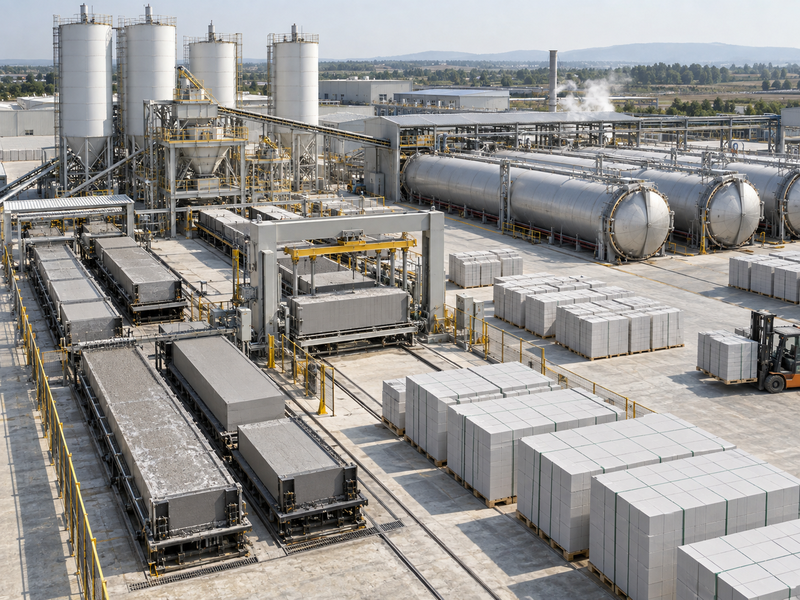
Main Equipment Included in an AAC Block Production Line
When comparing AAC block-making machine prices in Uganda, buyers should check what equipment is included. Some suppliers quote only core machines, while others quote a full production line.
AAC Block Production Line Equipment
| Production Section | Main Equipment | Function |
| Raw material preparation | Ball mill, crusher, slurry tank, cement silo, lime silo | Prepares sand, fly ash, cement, lime, and gypsum |
| Batching and mixing | Weighing system, mixer, pouring system | Controls formula accuracy and slurry quality |
| Moulding system | Mould, side plate, ferry car | Forms the AAC green cake |
| Pre-curing system | Pre-curing room, temperature control | Helps green cake reach cutting strength |
| Cutting system | Vertical cutting machine, horizontal cutting machine, cross-cutting machine | Cuts AAC cake into required block sizes |
| Autoclaving system | Autoclave, curing trolley, boiler | Cures blocks with high-pressure steam |
| Finished handling | Separator, packing machine, conveyor | Separates, stacks, and packs finished AAC blocks |
| Control system | PLC cabinet, sensors, operation panel | Improves automation and production stability |
A complete AAC block plant quotation should clearly list these sections.
Small AAC Block Plant Price in Uganda
A small AAC block plant is usually suitable for start-up investors who want to test the market before expanding. The capacity may be around 50–100 m³/day.
The main advantage is lower investment. The main limitation is lower output, higher labor dependence, and limited ability to supply large construction projects.
Small Plant Advantages and Limitations
| Item | Details |
| Estimated price | USD 250,000–600,000 |
| Main advantage | Lower investment and easier start-up |
| Main limitation | Limited output and lower automation |
| Suitable market | Local block supply, small contractors, regional distributors |
| Recommended buyer | First-time investors with limited budget |
A small plant can be practical if the local AAC market is still developing. However, if the target market includes large real estate projects or government construction, a higher-capacity plant may be more suitable.
Medium AAC Block Plant Price in Uganda
A medium AAC plant is often a balanced choice for Uganda. It can supply regional construction demand while keeping investment more controlled than a large automatic plant.
A 150–300 m³/day line usually includes a more complete cutting system, better material handling, larger autoclave capacity, and more stable production flow.
Medium Plant Cost Profile
| Item | Details |
| Estimated price | USD 600,000–1.5 million |
| Capacity | 150–300 m³/day |
| Main advantage | Balanced output and investment |
| Suitable market | Regional construction supply |
| Automation level | Semi-automatic or automatic |
| Recommended buyer | Building material companies and serious investors |
For many investors, a medium plant offers better long-term competitiveness because it can reduce production cost per cubic meter compared with a very small line.
Large AAC Block Plant Price in Uganda
A large AAC block plant is suitable for investors who want to supply multiple regions, large contractors, distributors, or large-scale building projects.
Stronger funding, competent management, a steady supply of raw materials, and effective sales channels are all necessary for large operations. However, they can reduce unit production cost and improve market influence.
Large Plant Features
| Item | Details |
| Estimated price | USD 1.5–3.5 million+ |
| Capacity | 300–600 m³/day or higher |
| Main advantage | High output and lower unit cost |
| Main requirement | Strong market demand and sales network |
| Suitable buyer | Large manufacturers and industrial investors |
Before investing in a large plant, buyers should conduct a serious feasibility study, including monthly sales volume, competitor pricing, transportation radius, and raw material cost.
Operating Costs in Uganda
The AAC block machine price is only the first part of the investment. Daily operating cost determines long-term profit.
Operating costs include cement, lime, gypsum, fly ash or sand, aluminum powder, water, electricity, fuel for steam generation, labor, maintenance, packaging, and transport.
Uganda’s electricity cost is an important point for AAC production because the plant uses power for grinding, mixing, cutting, conveying, and handling. In 2025, Uganda reduced certain industrial electricity tariffs, and medium-scale manufacturers were reported to pay 355.1 Ugandan shillings per unit after a tariff reduction.
Main Operating Cost Items
| Cost Item | Importance |
| Cement and lime | Major raw material cost |
| Fly ash or sand | Depends on local availability |
| Aluminum powder | Small quantity but important for aeration |
| Electricity | Used for grinding, mixing, cutting, and conveying |
| Steam/fuel | Used for autoclave curing |
| Labor | Depends on the automation level |
| Maintenance | Cutting wires, valves, bearings, motors, and reducers |
| Transport | Important because AAC blocks are bulky |
A factory close to raw materials and customers can reduce both production and delivery costs.
Raw Materials for AAC Blocks in Uganda
AAC blocks can be made from fly ash or sand as the main silica material. The best option depends on local supply.
If fly ash is available at a stable quality and price, it may reduce raw material costs. If sand is easier to source, a sand-based AAC plant can be designed, but it may require grinding equipment such as a ball mill.
Fly Ash AAC vs Sand AAC
| Item | Fly Ash AAC | Sand AAC |
| Main material | Fly ash | Silica sand |
| Equipment need | Slurry system | Ball mill and slurry system |
| Color | Usually gray | Often white or light gray |
| Cost advantage | Good near power plants | Good near-stable sand supply |
| Formula control | Depends on fly ash quality | Depends on sand fineness and purity |
| Suitable buyer | Plants near the fly ash supply | Plants with reliable sand resources |
Before confirming the machine price, buyers should test local raw materials. Raw material quality affects formula design, equipment configuration, production stability, and final block strength.
Shipping, Import, and Installation Cost
For Uganda, shipping and inland logistics are important because imported machinery usually arrives through regional seaports and then moves inland by road or rail. This adds freight cost, customs clearance, inland transport, unloading, and installation expenses.
Import Cost Checklist
| Item | What to Confirm |
| Shipping terms | FOB, CIF, or other delivery terms |
| Port route | Common East Africa import route and inland delivery |
| Container quantity | Depends on plant size and equipment volume |
| Customs duties and taxes | Must be checked with the local clearing agent |
| Inland transport | Heavy equipment needs proper trucks and unloading tools |
| Installation engineers | Air tickets, accommodation, visa, and service fee |
| Spare parts | Should be shipped with the initial equipment package |
A reliable AAC block machine supplier should help provide packing lists, machine dimensions, foundation drawings, installation drawings, and technical documents.
ROI Considerations for Uganda
AAC block production can be profitable if the plant has stable sales, controlled raw material costs, good quality, and efficient operation. Uganda’s construction-related activity has shown strength in recent economic reporting, and World Bank materials noted a strong contribution from construction activity in recent growth trends.
However, ROI depends heavily on local selling price, production cost, and sales volume. Investors should not calculate payback only from theoretical capacity. Real production may be lower during the first months because of commissioning, worker training, and market development.
Simple ROI Factors
| Factor | Positive Impact |
| Higher plant utilization | Reduces fixed cost per block |
| Stable raw material supply | Keeps production cost predictable |
| Accurate cutting system | Reduces waste and customer complaints |
| Good autoclave curing | Improves strength and product quality |
| Strong sales channels | Supports cash flow |
| Lower transport distance | Improves profit margin |
A medium or large AAC plant usually needs strong sales planning before installation starts.
How to Choose an AAC Block Machine Supplier
When buying an AAC block-making machine for Uganda, price should not be the only decision factor. A cheap machine may cause poor cutting accuracy, high downtime, unstable curing, and higher maintenance costs.
Supplier Selection Table
| Factor | What to Ask |
| Project experience | Has the supplier built AAC plants in export markets? |
| Complete line ability | Can it supply the full production line, not only single machines? |
| Customization | Can the line match your raw materials and capacity target? |
| Technical support | Does the supplier offer advice on commissioning and installation? |
| Spare parts | Are cutting wires, valves, sensors, and wear parts available? |
| Automation | Can the supplier offer semi-automatic and automatic options? |
| Training | Can operators learn batching, cutting, curing, and maintenance? |
| Documentation | Are layout drawings, foundation drawings, and manuals provided? |
For investors looking to develop or upgrade an AAC block factory, Runding AAC can offer comprehensive AAC block machine and production line solutions. For Uganda buyers, a customized quotation should include capacity design, equipment list, plant layout, power requirement, steam system, installation support, and spare parts recommendation.
The AAC block making machine price in Uganda may range from about USD 250,000 for a small plant to several million dollars for a large automatic AAC production line, depending on capacity, configuration, shipping, installation, exchange rate, and local needs.
Investors should evaluate market demand, raw materials, factory location, energy cost, transport distance, and sales volume before choosing capacity and requesting a quotation.
Runding AAC can provide practical AAC production line solutions based on Uganda’s market, budget, raw materials, and long-term goals.