
AAC producers should assess delivery radius route by route, using delivered contribution, vehicle capacity, round-trip time, damage exposure, and customer service requirements. There is no single distance that is profitable for every plant or every order. A distant full load on a predictable road may work better than a nearby part load with long unloading delays.
Draw a commercial service area only after testing actual routes and order patterns. Straight-line distance is useful for an initial map, but customers receive blocks through roads, loading schedules, and site access points. Those conditions determine how far the plant can serve reliably.
What Limits the Quantity on One Truck?
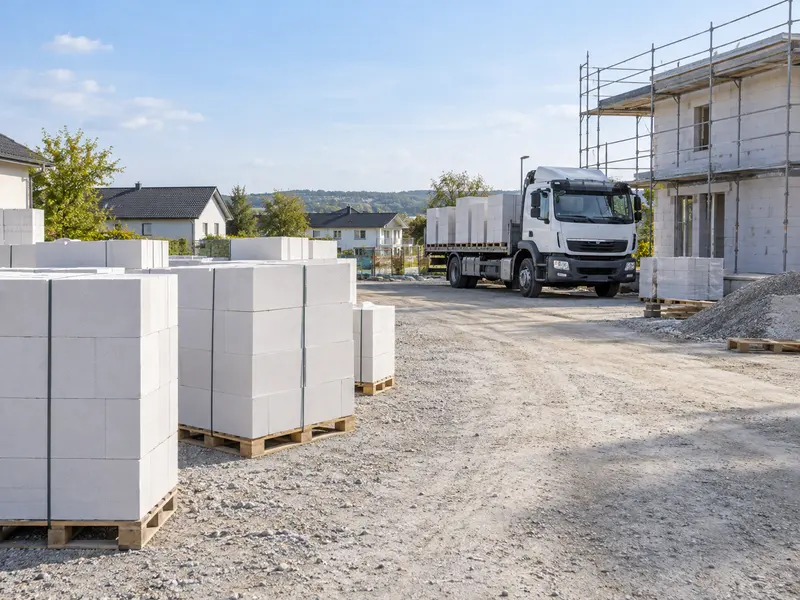
Determine the permissible shipment from the vehicle’s usable loading space, applicable weight and axle limits, package geometry, and the actual shipment mass. Use the most restrictive condition. Do not convert nominal dry block density directly into a legal truckload without accounting for moisture, pallets, packaging, and vehicle configuration.
Obtain a loading arrangement suitable for the product and vehicle, and have the carrier confirm compliance with local requirements. Load restraint and unloading must follow approved methods. Commercial calculations should use that verified arrangement rather than an optimistic maximum stacking assumption.
- Measure the dimensions and mass of the complete shipping unit.
- Identify the truck configuration and usable deck dimensions.
- Confirm route-specific restrictions with the carrier.
- Allow for safe restraint, support, and practical unloading access.
- Record the accepted cubic metres delivered, not just the volume loaded.
Runding’s AAC packing equipment should be considered alongside the package design and dispatch process. Consistent bundles help planning, but equipment selection does not replace a transport assessment for the actual route.
Convert the Complete Trip Cost Into a Unit Freight Allowance
Allocate the entire transport cycle to the usable block volume received by the customer. Specify the services covered and distinguish a contracted carrier charge from the plant’s own vehicle operating costs.
Delivered transport cost per cubic metre = Total attributable trip cost ÷ Accepted volume delivered.
For outsourced transport, examine what the carrier’s price includes. Waiting time, tolls, unloading assistance, difficult access, repeat delivery, or fuel adjustments may sit outside the basic rate. Compare quotations on the same service basis.
For an owned fleet, fuel alone is not the trip cost. Include driver time, maintenance, tires, depreciation or lease costs, insurance, and the share of overhead appropriate to the decision. Keep fixed and variable costs visible when comparing short-term dispatch choices with long-term fleet investment.

What Does a Simple Route Example Show?
Consider a hypothetical trip costing 600 currency units and delivering 30 cubic metres of accepted blocks. Its transport cost is 20 units per cubic metre. If the same trip carries only 20 accepted cubic metres at a similar total cost, the figure rises to 30 units.
Now suppose waiting and access charges add 150 units to the full-load trip. The cost becomes 25 units per cubic metre, even though the distance has not changed. These examples illustrate why load utilization and site time can matter as much as kilometres.
The figures are not freight benchmarks. Replace them with carrier quotations, measured shipment quantities, and actual delivery records. Use one currency and a consistent tax basis throughout the comparison.
What Margin Must Remain After Delivery?
Define the minimum contribution the plant needs after production and order-specific service costs. Then calculate how much transport cost the order can absorb. A route is commercially acceptable only if the resulting margin meets that requirement under realistic conditions.
Available transport allowance = Realized selling price − Relevant production cost − Other order costs − Required contribution.
Use the delivered or factory-gate selling price consistently with who pays freight. Include discounts, commissions, expected claims, and credit costs where relevant. An attractive quoted price is not the same as cash ultimately retained.
Check sensitivity to smaller loads, longer waiting, higher freight rates, and lower realized prices. If a route is viable only when every assumption is favorable, classify it as conditional rather than routine service. A minimum order quantity or scheduled delivery day may improve its economics.
| Route Condition | Commercial Effect | Possible Response |
| Regular full loads | Lower transport cost per unit | Reserve predictable dispatch slots |
| Small scattered orders | More handling and travel per unit | Use local distribution or consolidated deliveries |
| Long site waiting | Higher trip cost and fewer trips | Confirm appointments and waiting terms |
| Frequent damage claims | Less accepted volume and replacement cost | Investigate packaging and handling points |
Can the Truck Complete the Service Reliably?
Calculate round-trip time from arrival at the factory through loading, outbound travel, site waiting, unloading, return travel, and required driver breaks. Use conditions appropriate to the route and the applicable operating rules. A distance that looks economical may still prevent the delivery frequency the customer needs.
Record departure and return times on trial deliveries. Check whether congestion, restricted access hours, road conditions, or seasonal weather changes the result. Avoid promising a daily service based on one unusually easy trip.
What If the Customer Cannot Receive a Full Load?
Discuss site storage and unloading before dispatch. Some projects cannot receive a full truck even when their total weekly demand is large. Repeated small deliveries can turn a commercially attractive project into an expensive service commitment.
Evaluate alternatives such as a nearby distributor, an agreed off-site holding area, or fewer scheduled deliveries where feasible. Assign the storage, handling, and financing costs explicitly. Moving inventory closer to the buyer changes the cost structure rather than making those costs disappear.
How Should Breakage and Returns Affect the Radius?
Use accepted delivered volume and the full cost of claims in the route assessment. A damaged unit may create replacement freight, additional handling, and disruption to the customer’s installation schedule. These effects can exceed the manufacturing cost of the block itself.
Record condition at dispatch and receipt using an agreed process. Distinguish damage already present after packing from damage during loading, transport, unloading, or site storage. The guide to reducing AAC block handling damage provides useful factory-side checks.
Do not assume that distance alone causes breakage. Poor support, unstable packages, unsuitable handling, or repeated transfers may be more important. Correct the demonstrated cause before rejecting an otherwise viable territory.
How Can Routes Be Turned Into a Practical Service Map?
Group tested routes by the conditions under which the plant will accept orders. Define routine, conditional, and individually quoted service areas. State the minimum load, expected lead time, receiving requirements, and freight basis for each group.
- Routine routes: Repeatable trip time and acceptable margin with normal order sizes.
- Conditional routes: Viable only with full loads, planned delivery days, or specific site arrangements.
- Special quotations: Unusual access, long distance, or uncertain unloading conditions that need a separate assessment.
Review the map when freight costs, customer mix, vehicle availability, or local competition changes. A new distributor can extend commercial reach without requiring every customer delivery to originate at the factory. Conversely, a slow-paying distant account may remain unattractive even if freight is affordable.
The final delivery radius should describe a service promise the plant can keep at an acceptable return. Keep the route assumptions attached to that promise so sales staff know when an exception needs review. A useful map is the outcome of measured logistics, not a circle chosen around the factory address.