
AAC blocks offer flexible masonry solutions, while ALC panels provide reinforced large-scale construction systems with faster installation and higher integration.
Deciding on one of the two hinges on project configuration, installation demands, throughput and custom modification needs.
A Brief Guide to AAC Blocks and ALC Panels
AAC blocks and ALC panels use similar AAC production processes, but differ in structure, reinforcement, and applications. AAC blocks suit masonry, while ALC panels fit prefabricated construction systems.
| Product | Definition | Main Feature |
| AAC Block | Lightweight masonry unit produced by cutting and autoclaving AAC cake | Flexible size selection and traditional wall construction |
| ALC Panel | Reinforced AAC wall panel with embedded steel reinforcement | Large-size installation and prefabricated building systems |
Core Difference
AAC blocks are mainly lightweight concrete units without internal reinforcement. Their strength comes from the uniform porous structure formed during the aeration and autoclave curing process.
ALC panels contain reinforced steel mesh or steel framework inside the panel body. Reinforcement enhances bending performance and permits production of oversized panels.
| Comparison | AAC Block | ALC Panel |
| Internal Structure | Aerated concrete material | Reinforced aerated concrete panel |
| Reinforcement | Usually without steel reinforcement | Embedded anti-corrosion treated steel mesh |
| Product Size | Small and medium blocks | Large wall panels |
| Installation Method | Individual block masonry | Prefabricated panel installation |
Manufacturing Process Comparison
Both AAC blocks and ALC panels require several major stages:
- Raw material preparation
- Slurry mixing
- Casting and pre-curing
- Cutting
- Autoclave curing
AAC Block Production Process
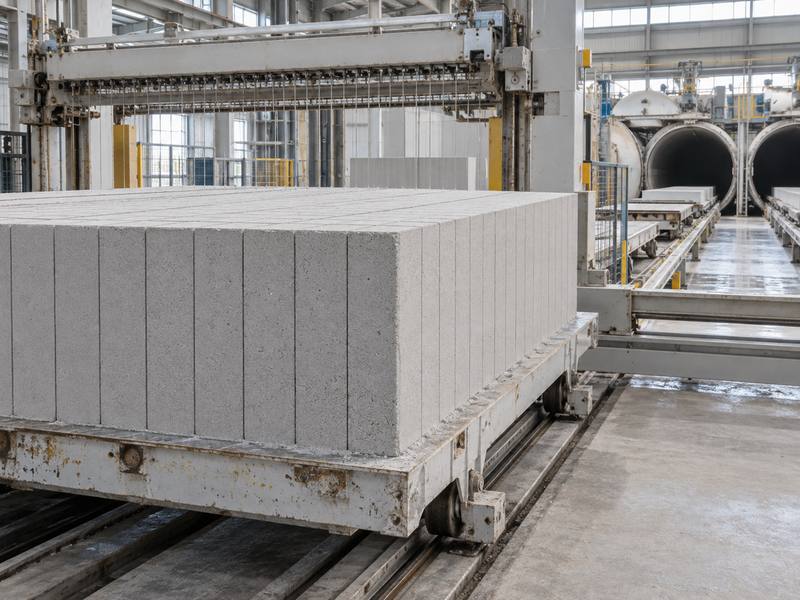
AAC block cutting machine mainly focuses on accurate cutting and stable material properties.
The basic process includes:
- Raw material grinding
- Slurry preparation
- Aluminum powder mixing
- Cake rising and pre-curing
- Wire cutting
- Autoclavecuring
During cutting, the green cake is divided into standard block sizes before entering the autoclave.
A high-precision AAC Block Cutting Machine plays an important role in controlling product dimensions, surface quality, and material utilization.
ALC Panel Production Process
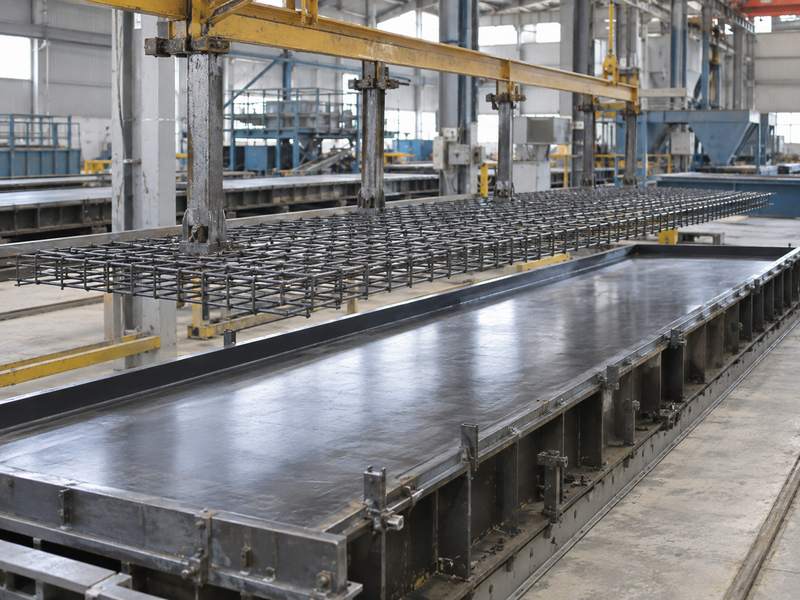
ALC panel production requires additional reinforcement preparation before cutting.
The process usually includes:
- Steel mesh preparation
- Anti-corrosion treatment
- Reinforcement frame installation
- AAC slurry casting
- Pre-curing
- Panel cutting
- Autoclave curing
Owing to the larger size and reinforced structure of panels, stricter and more sophisticated production control standards are required.
The reinforcement system must maintain accurate positioning inside the panel. Any deviation may affect installation accuracy and structural performance.
| Process | AAC Block | ALC Panel |
| Material Preparation | Standard AAC raw materials | AAC materials + reinforcement system |
| Cutting Requirement | Block dimension accuracy | Large panel dimensional stability |
| Additional Process | None | Steel reinforcement treatment |
Size and Application Flexibility
AAC blocks are produced in smaller units, allowing workers to adjust wall layouts during installation. This makes them suitable for residential buildings, commercial spaces, and renovation projects where flexibility is important.
ALC panels are manufactured as large components. A single panel can cover a larger wall area, reducing the number of installation joints and improving construction efficiency.
| Aspect | AAC Block | ALC Panel |
| Size | Custom blocks, cutting length up to 6,000 mm | Large reinforced panels with custom dimensions |
| Accuracy | Cutting deviation within ±1 mm | Requires precise reinforcement alignment |
| Cutting | Horizontal & vertical wire cutting | Reinforced panel cutting process |
| Customization | Flexible block specifications | Prefabricated wall solutions |
| Applications | Masonry construction | Large-scale building systems |
Strength and Performance Comparison
Since both products are produced through autoclave curing, they share similar advantages:
- Lightweight structure
- Good thermal insulation
- Fire resistance
- Stable dimensional performance
AAC Block Performance Characteristics
- Density control
- Raw material fineness
- Slurry stability
- Cutting accuracy
- Autoclave curing quality
ALC Panel Performance Characteristics
- Steel mesh quality
- Reinforcement positioning
- Panel thickness
- Connection design
- Surface accuracy
Cost Comparison
The production of AAC blocks is uncomplicated and free of reinforcing steel, yet ALC panels need steel component machining. Expense discrepancies stem from machinery, delivery modes, construction approaches and project demands.
| Cost Factor | AAC Block | ALC Panel |
| Production Process | Simpler AAC production flow | Requires reinforcement processing |
| Equipment Investment | Lower equipment complexity | Higher production system requirements |
| Transportation | Easier handling due to smaller units | Requires larger transport planning |
| Installation | More manual masonry work | Faster panel installation |
For production enterprises, the decision on AAC blocks versus ALC panels involves more than just manufacturing costs; target market demands and project parameters also matter greatly.
Equipment Requirements
AAC Block Production Requirements
AAC block production focuses on stable raw material preparation, accurate cutting, and efficient autoclaving.
The key equipment includes:
- Ball mill for raw material grinding
- Slurry mixing system
- Casting machine
- AAC Block Cutting Machine
- Autoclave system
ALC Panel Production Requirements
ALC panel production requires additional equipment and process control.
Main manufacturing concerns involve:
- Reinforcement mesh processing
- Anti-corrosion treatment system
- Steel frame positioning equipment
- Large panel cutting system
Different Construction Applications
Neither AAC blocks nor ALC panels work for every project. Building configuration, construction modes and production demands govern the appropriate selection.
AAC Block Applications
- Residential partition walls
- Commercial building interiors
- Low-rise construction projects
- Renovation projects
Their modular size allows workers to adjust layouts during installation, making them practical for projects with changing requirements.
ALC Panel Applications
- Prefabricated buildings
- Large industrial facilities
- Commercial complexes
- Fast-track construction projects
Large panel dimensions reduce the number of wall joints and improve installation speed.
Decision Reference
Choose AAC Block Production When:
- Targeting traditional masonry markets
- Requiring
- Serving multiple small and medium projects
- Prioritizing production flexibility
AAC block lines are easier to adapt for different block specifications, especially when equipped with adjustable cutting systems.
Choose ALC Panel Production When:
- Targeting prefabricated construction projects
- Supplying large wall systems
- Focusing on high-efficiency installation
- Supporting standardized building solutions
ALC panel production requires stronger production coordination but provides opportunities for larger-scale construction applications.
Selection for Different Products
Various AAC products correspond to distinct equipment setups, and conventional production lines often fail to satisfy specialized market requirements.
Manufacturers can customize equipment solutions according to:
- Product dimensions
- Production capacity
- Raw material characteristics
- Automation requirements
- Final application markets
For example, AAC Block Cutting Machine customization can include cutting wire arrangement, cake size adjustment, and automation upgrades to improve production stability.
A suitable customized solution helps manufacturers produce consistent AAC blocks or panels while reducing production waste and improving operational efficiency.