
Match an AAC jaw crusher to the size range of the incoming material and the feed specification of the next machine. The crusher must accept the delivered lumps reliably, while its actual product grading must suit the mill, conveyors and storage that follow. Do not select the system by comparing a single crusher opening dimension with a single mill feed-size figure.
Which Material Stream Needs Crushing?
Identify the material and its destination before selecting a crusher. An AAC plant may receive some ingredients already prepared, while other streams arrive as lumps requiring reduction. Confirm that crushing is necessary for the actual supply rather than adding a machine because it appears in a general process diagram.
Describe the delivered material across the expected supply range. Include its largest pieces, the distribution of smaller fractions, moisture, bulk density and relevant crushing characteristics. A photograph of one typical load helps explain the situation but does not replace a representative sampling plan.
Record seasonal and supplier changes separately. Material that flows adequately during a dry trial may behave differently after wet storage or when the proportion of fines increases. The equipment proposal should explain which variations are included in the quoted duty and which require further investigation.
What Does the Crusher Feed Opening Tell the Buyer?
The feed opening helps define the machine’s intake geometry, but it is not a guarantee that every irregular piece of that nominal size will enter smoothly. Lump shape, orientation and feeding arrangement also matter. Request the manufacturer’s permitted feed envelope for the proposed machine and jaw configuration.
Use the AAC jaw crusher specification to identify candidate equipment. Then give the supplier the representative feed information and required output duty. The final selection should state the operating assumptions behind its capacity rather than relying only on a catalogue range.
Look upstream of the jaw as well. The receiving hopper, feeder and any oversize-management arrangement must deliver material in the manner expected by the crusher designer. If occasional oversize pieces are credible, define how they will be detected and managed through the site’s approved handling system.
- Record the largest expected lumps and their shape.
- Provide grading information for the full feed, including fines.
- Explain how material enters the hopper and reaches the jaw.
- Identify changes in moisture and delivery consistency.
- Confirm the manufacturer’s feed limits for the selected configuration.
Why Is the Discharge Setting Different From Product Grading?
A jaw crusher produces a distribution of particle sizes, not a stream of identical pieces. Its setting influences that distribution along with operating and material conditions. Ask for an expected grading curve or test results rather than interpreting the setting as a promise that every discharged particle has the same dimension.
The closed-side setting is an important operating parameter, and its measurement depends on the applicable jaw profile and manufacturer’s procedure. It affects more than product size: capacity and wear must also be considered. Request a setting range that satisfies the whole duty, not simply the smallest mechanically available opening.
Do not transfer a universal conversion factor from another crusher into the purchase specification. Establish how the proposed machine is expected to perform with the actual material. If the downstream process needs a strict maximum particle size, discuss whether classification or another control stage is necessary.
What Must the Ball Mill Receive?
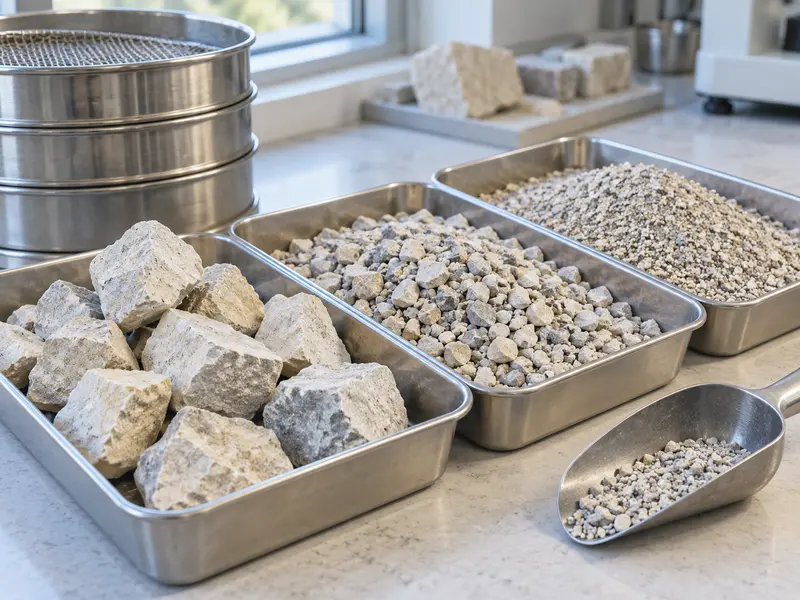
Obtain the mill supplier’s accepted feed envelope, including the required throughput and the material conditions attached to it. The largest acceptable particle is only one part of that envelope. The overall size distribution and consistency of delivery should also be reviewed.
Check the ball mill feed requirements against the proposed crusher product. If the crusher’s normal discharge does not meet the agreed mill feed specification, resolve the gap before placing orders. Reducing production later to compensate for a mismatch may leave the rest of the AAC line waiting for prepared material.
| Interface | Evidence to Request |
| Delivery to crusher | Representative feed grading and lump limits |
| Crusher to conveyor | Discharge grading and expected flow variation |
| Storage to mill | Reliable withdrawal and controlled feed rate |
| Mill to batching | Accepted fineness at the required dry-solids output |
A finer crusher product is not automatically the best commercial choice. Extra crushing duty may bring additional wear or reduce crusher capacity, while the mill may gain from the changed feed. Compare the combined preparation route at the required final product condition instead of optimizing each machine independently.
How Should Hourly Capacity and Buffer Storage Be Matched?
Use the same mass basis when comparing equipment capacities. Wet material flow, dry-solids throughput and finished AAC volume describe different quantities. Convert the production plan into the material demand relevant to this crusher and state the moisture assumptions used.
Also distinguish operating schedules. A crusher that runs for one shift may need to prepare material for a mill operating longer, with storage between them. Conversely, a large instantaneous crusher capacity can overload the receiving equipment if feed is released in uncontrolled surges.
For an illustrative schedule, a downstream requirement of 12 dry tonnes per hour over 16 hours represents 192 dry tonnes per day. Preparing that quantity within eight effective crusher hours requires an average of 24 dry tonnes per hour before separately allowing for the project’s losses and interruptions. These numbers demonstrate scheduling arithmetic and are not a recommended equipment capacity.
Check whether the storage can actually deliver its planned buffer. Nominal bin volume may include material that cannot be withdrawn consistently under the operating conditions. Discuss usable inventory, discharge behaviour and the controls needed to avoid starving or overfeeding the mill.
What Should the Acceptance Trial Demonstrate?
Agree the sampling points, test material and measurement methods before commissioning. Record the feed grading, operating setting and output grading during the same test period. A result without its operating conditions is difficult to reproduce or use for acceptance.
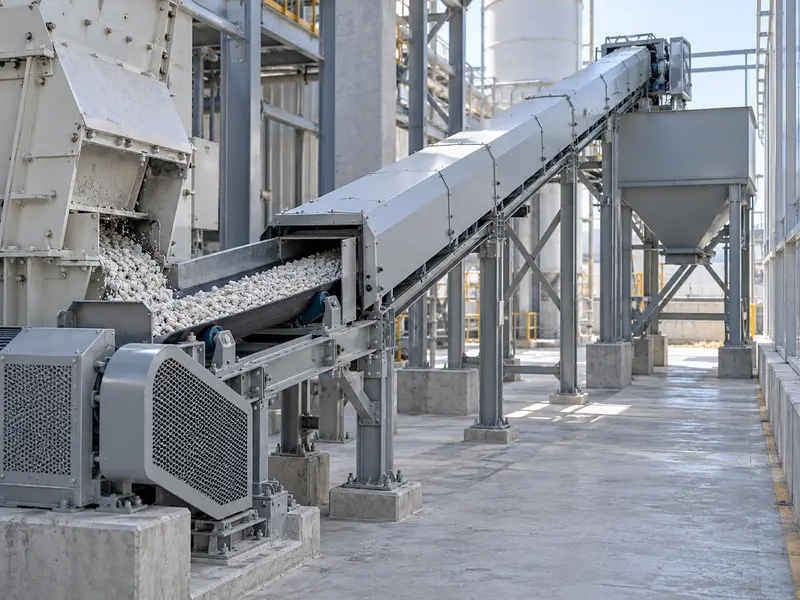
Measure sustained flow through the complete agreed equipment boundary. A short burst of crusher output does not show that the conveyors, storage outlet and mill feed arrangement can maintain the required supply. Include observations of interruptions and material buildup so that apparent capacity is not confused with dependable delivery.
Check the final grinding result as well as the crusher discharge. If the mill fails to meet its required product condition, investigate feed variation and the mill’s own operating conditions together. The acceptance record should help distinguish an upstream size problem from a separate grinding or transfer issue.
What Should the Final Interface Sheet Contain?
Put the agreed feed and discharge envelopes, capacity basis and operating schedule on one interface sheet. Identify responsibility for the hopper, feeder, conveyor, storage and any oversize-control equipment. Make exclusions explicit so that necessary equipment does not disappear between separate quotations.
Include the inspection arrangements and the method for checking changes as wearing parts age. A setting recorded at commissioning may need review during service according to the manufacturer’s instructions. Give operators a documented reference for recognizing when the material delivered to the mill has moved outside its agreed limits.
The best match is the one that supplies suitable feed consistently at the required rate. Ask bidders to demonstrate the proposed crusher-to-mill feed relationship with samples from the intended supply and a test procedure agreed by both equipment suppliers. This provides a clearer basis for plant performance than choosing the largest jaw opening or the smallest advertised discharge figure.