
For an existing AAC producer, increasing capacity does not always require a new factory. If autoclaves, buildings, utilities and other core assets remain usable, upgrading key bottlenecks can increase output with lower capital investment.
However, outdated layouts, undersized equipment, limited steam capacity and old automation can make brownfield expansion increasingly complex.
The decision should therefore focus on how much useful capacity remains in the existing plant and how economically it can be increased.
Start With the Capacity You Actually Have
One of the first mistakes in an AAC expansion project is using nameplate capacity as the starting point.
A plant originally designed for 200,000 m³/year may currently produce only 130,000–150,000 m³. That does not automatically mean another 200,000 m³ line is required.
The missing capacity may be caused by:
- Long batching and mixing cycles
- Slow mold circulation
- Unstable pre-curing
- Excessive cutting downtime
- Limited autoclave availability
- Slow loading and unloading
- Insufficient boiler capacity
- Packaging bottlenecks
- Frequent mechanical maintenance
- Poor coordination between production sections
Before investing, measure the actual cycle time and utilization of every major section.
A surprisingly large amount of capacity can sometimes be recovered without changing the entire factory.
What Is a Brownfield AAC Plant Upgrade?
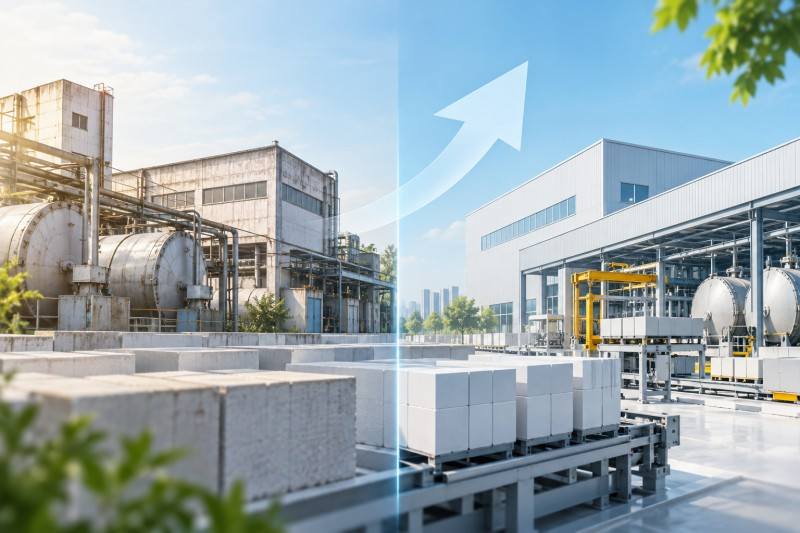
A brownfield upgrade means expanding or modernizing an existing AAC factory while continuing to use part of the original infrastructure and equipment.
The scope can vary from a nearly full reconstruction to a comparatively small modernisation project.
For example, a plant may retain its raw-material preparation system, building and autoclaves while replacing the cutting line, mold circulation system and control system. Another factory may keep only the autoclaves and civil infrastructure while rebuilding most of the production equipment.
A greenfield project is different. The production line, factory layout, utilities and supporting infrastructure are designed largely from the beginning.
| Factor | Brownfield Upgrade | New AAC Production Line |
| Initial investment | Usually lower | Higher |
| Existing infrastructure | Reused where possible | Mostly new |
| Layout flexibility | Limited | High |
| Construction period | Often shorter | Longer |
| Production disruption | Possible | Minimal to existing plant |
| Automation potential | Moderate to high | Very high |
| Expansion flexibility | Depends on old layout | Can be designed in advance |
| Technical uncertainty | Higher | Lower |
| Long-term capacity ceiling | Often limited | Higher |
The financial attraction of brownfield expansion is obvious. The technical decision is more complicated.
Do Not Replace Equipment That Is Not Limiting Production
AAC plants are sequential production systems.
Improving one machine does not necessarily improve factory output.
Imagine an existing cutting line can process one cake every six minutes. Replacing it with a new system capable of processing one cake every four minutes sounds like a substantial improvement.
But if the autoclaving section can still process only the original number of cakes per day, factory output barely changes.
The cutting line simply spends more time waiting.
This is why I would not begin an AAC modernization project with an equipment list. I would begin with a bottleneck map.
| Production Section | Existing Performance | Required Performance | Upgrade Priority |
| Mixing | 10 batches/hour | 12 batches/hour | Medium |
| Mold circulation | 9 molds/hour | 12 molds/hour | High |
| Pre-curing | Stable | Stable | Low |
| Cutting | 8 cakes/hour | 12 cakes/hour | High |
| Autoclaving | 10 cakes/hour equivalent | 12 cakes/hour | High |
| Packing | 14 cakes/hour | 12 cakes/hour | Low |
In this example, replacing the packing system first would provide almost no capacity benefit.
Investment should follow the bottleneck.
Existing Autoclaves Can Make Brownfield Expansion Attractive
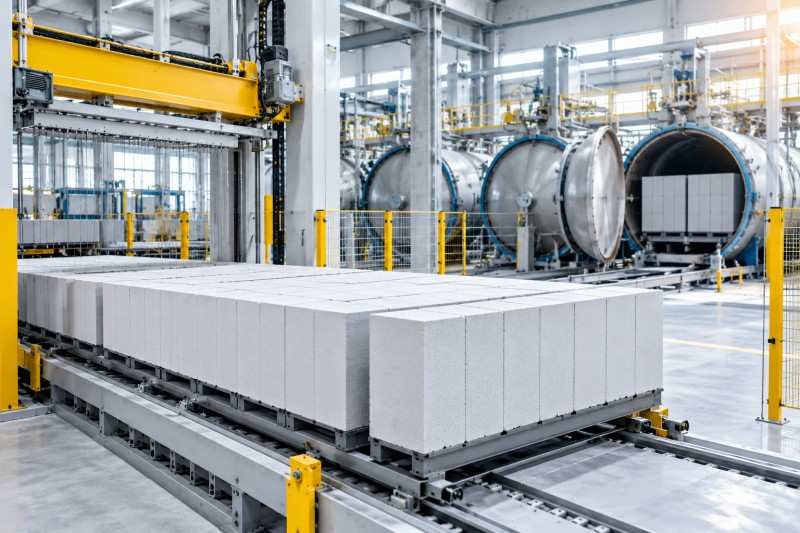
Autoclaves represent a significant part of an AAC plant’s infrastructure. Besides the pressure vessels themselves, the system includes foundations, rails, steam piping, condensate systems, loading equipment and safety systems.
If existing autoclaves remain structurally suitable and have sufficient capacity, retaining them can significantly improve the economics of an upgrade.
This is particularly true when the original factory was designed with some spare autoclaving capacity.
Suppose an old plant produces 150,000 m³/year but its autoclave section can theoretically support around 200,000 m³. Improving batching, cutting and material handling may allow the plant to approach that higher output without installing an entirely new curing section.
However, autoclaves should never be reused based only on their external appearance.
Their condition, pressure-vessel documentation, corrosion, fatigue history, door and sealing systems, safety devices and applicable inspection requirements must be evaluated professionally.
A pressure vessel is not simply another piece of mechanical equipment that can be kept running indefinitely because it still operates.
Steam Capacity Is Often the Hidden Constraint
AAC expansion discussions tend to focus heavily on production machinery. Steam generation receives less attention until commissioning approaches.
That can become an expensive mistake.
Increasing the number of cakes entering the autoclaves means increasing steam demand. Even if the existing autoclaves have enough physical volume, the boiler and steam distribution network may not support shorter cycle intervals or additional autoclaves.
A brownfield assessment should therefore examine the complete thermal system:
Boiler → Main Steam Header → Autoclaves → Steam Transfer → Condensate Recovery
Check actual steam production rather than boiler nameplate capacity alone. Boiler age, fuel type, efficiency, operating pressure, water treatment and distribution losses all influence usable steam capacity.
If production increases 30% but steam generation is already operating near its practical limit, the boiler plant becomes part of the expansion project.
Layout Is Where Brownfield Projects Become Difficult
A new AAC factory has one major advantage: the production flow can be designed around the equipment.
A brownfield project has to make the equipment fit the factory.
Existing columns, foundations, pits, rail tracks, pipe racks, electrical rooms, and building dimensions can restrict equipment placement. Even small dimensional conflicts can create significant engineering work.
This becomes especially important when changing from older manual or semi-automatic handling to automated mold and cake transport.
Modern automation requires predictable movement paths.
A production line with multiple unnecessary turns, crossings, and transfer points may technically work, but every additional movement creates another opportunity for waiting, mechanical wear, or synchronization problems.
For brownfield projects, therefore, layout engineering should happen before equipment purchasing.
A slightly less automated configuration that fits the existing building naturally may perform better than an advanced system forced into an unsuitable layout.
When a Cutting Line Upgrade Makes Sense
Older AAC plants often have substantial opportunities for improvement around cutting.
Cutting accuracy influences product dimensions, surface quality, waste generation, and downstream separation. At the same time, cutting cycle time directly affects production flow.
A modernization may include:
- New horizontal and vertical cutting systems
- Improved cutting wire tension control
- Faster cake transfer
- Automated positioning
- Waste recycling improvements
- More accurate servo-controlled movements
- Updated control systems
- Improved side and top waste removal
However, cutting speed should not be optimized independently.
The green cake must have sufficient strength when it reaches the cutting station. Increasing cutting throughput without controlling pre-curing can produce more breakage, wire drag and dimensional defects.
The objective is not the fastest cutting machine. It is the fastest stable cutting cycle that the material can tolerate.
Automation Is Not Always an All-or-Nothing Decision
One advantage of a new production line is the ability to integrate automation from the beginning.
Brownfield factories often require a more selective approach.
Instead of attempting to automate every operation, identify areas where automation provides measurable benefits. Mold circulation, batching, cake transfer, autoclave scheduling and packing usually offer better returns than automating occasional low-frequency operations.
This approach can also reduce commissioning risk.
An old factory that has operated manually for 15 years contains a great deal of operator knowledge. Replacing every manual decision with automation in one project can introduce unexpected problems.
A staged modernization allows the plant team to adapt while production data becomes more reliable.
Production Downtime Must Be Included in Brownfield Economics
Brownfield upgrades are often described as cheaper because existing equipment and infrastructure are reused.
That is true only if production interruption is included in the calculation.
Connecting new machinery to an operating factory may require temporary shutdowns for electrical work, foundations, rail modifications, piping changes or equipment removal.
Consider a simple example.
If a factory produces 500 m³/day and must stop for 20 days, approximately 10,000 m³ of potential production is affected.
There is economic value to such lost production.
Therefore, as much work as feasible is moved outside the shutdown window by a good brownfield plan. Foundations, steel structures, control panels, piping preparation and equipment preassembly can often be completed while the existing plant continues operating.
The final shutdown should focus on disconnection, installation, integration and commissioning.
When Building a New AAC Line Makes More Sense
Brownfield expansion becomes less attractive when too many major systems have reached their limits simultaneously.
Suppose the existing plant has:
- Insufficient raw-material storage
- Outdated batching
- Slow mold circulation
- Unstable pre-curing
- Old cutting equipment
- Fully utilized autoclaves
- Insufficient boiler capacity
- Limited building space
- Aging electrical systems
Technically, all these systems can be upgraded.
Economically, however, the project is beginning to resemble a new factory assembled inside an old one.
This is the point where greenfield investment deserves serious consideration.
A new AAC production line allows capacity, building dimensions, logistics, steam systems and automation to be designed as one integrated system.
Compare Total Project Cost, Not Equipment Price
The financial comparison should extend well beyond machinery quotations.
| Cost Item | Brownfield Upgrade | New Production Line |
| Production equipment | Medium | High |
| Civil construction | Low–Medium | High |
| Equipment removal | Medium | Low |
| Modification work | Medium–High | Low |
| Utilities | Depends on existing capacity | New |
| Installation complexity | High | Moderate |
| Production downtime | Potentially significant | Low for existing operation |
| Engineering uncertainty | Higher | Lower |
| Future expansion | Often constrained | Easier |
Brownfield projects frequently contain more unknown costs.
Old drawings may not match the actual factory. Underground foundations may be discovered during construction. Existing electrical capacity may be insufficient. Rail elevations could not align with the standards for new equipment.
Having a contingency budget is essential because of this.
A Practical Decision Framework
The simplest way to choose between upgrading and building new is to evaluate how much of the existing factory still has useful life and usable capacity.
Brownfield expansion generally makes sense when the plant has strong infrastructure, usable autoclaves, adequate utilities and only a few clearly identified bottlenecks.
A new line becomes more attractive when capacity limitations exist throughout the entire process.
Before deciding, evaluate:
- Current actual output versus original design capacity
- Utilization of each production section
- Remaining mechanical life of major equipment
- Autoclave condition and available curing capacity
- Boiler and steam-system capacity
- Available factory space
- Required automation level
- Expected production downtime
- Target capacity for the next 5–10 years
- Total investment per additional cubic meter of capacity
The last figure is particularly useful.
Instead of asking whether a brownfield project costs $3 million and a new line costs $8 million, compare how much reliable saleable capacity each investment actually creates.
Brownfield or Greenfield: The Better Choice Depends on What You Can Reuse
Upgrading an old AAC plant is not always cheaper than building a new one. If the existing autoclaves, utilities and buildings remain suitable, targeted upgrades to cutting, handling, batching or control systems can recover capacity economically.
However, when modifications extend across most production stages, complexity, downtime and inherited layout limitations can reduce the advantage of modernization.
For manufacturers such as Runding, the priority is to determine what should remain, what should be upgraded and what needs replacement. A successful brownfield project preserves valuable assets while investing where capacity, quality and reliability can genuinely improve. A new AAC production line might be a preferable long-term investment when such gains are minimal.