
By interconnecting production workflows, autoclave workspaces and material treatment areas with high layout adaptability, AAC ferry trolleys effectively raise the overall efficiency of material delivery.
To realize optimized transport operation, personalized AAC ferry cart designs are formulated by taking factory space parameters, rail operation systems, bearing capacity and production specifications into comprehensive consideration.
AAC Ferry Cart in Factory Layout Design
AAC manufacturing layouts cover raw material mixing, casting, cutting, autoclaving and finished goods processing zones, all of which need smooth and rapid material conveyance.
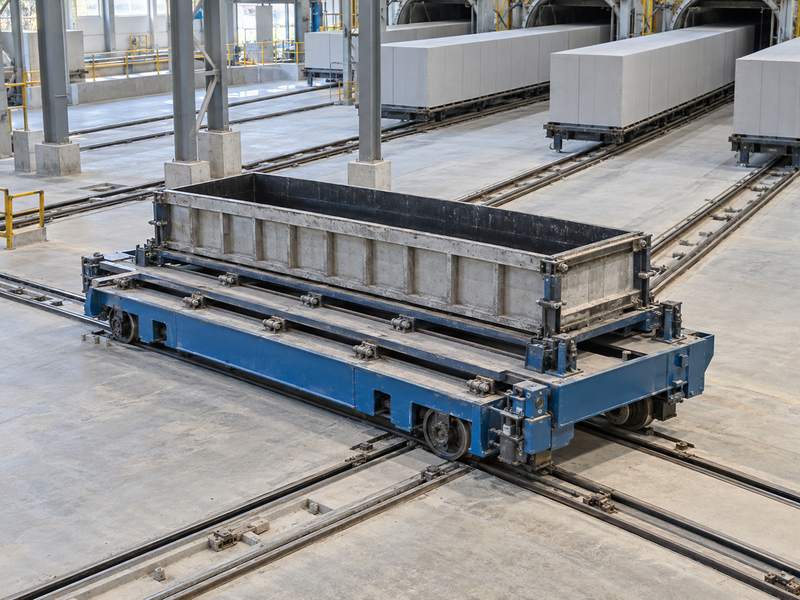
When direct track connections cannot be laid out, AAC ferry trolleys bridge parallel production lines and processing areas to realize flexible material shifting.
The main function of an AAC ferry cart is not only transportation but also layout optimization.
Key application functions include:
- Horizontal transfer between parallel tracks
- Connection between production lines
- Movement of autoclave cars
- Reduction of manual handling distance
- Improvement of workshop space utilization
- Flexible adaptation to different plant structures
A well-designed ferry cart system allows manufacturers to arrange production equipment according to available factory space instead of being restricted by transportation routes.
Custom AAC Ferry Cart Design Based on Factory Conditions
| Customization Factor | Design Consideration |
| Factory Layout | Rail direction, transfer position, available installation space |
| Production Capacity | Frequency of cart movement and transportation efficiency |
| Load Requirement | Weight of AAC moulds, autoclave cars, or material racks |
| Transfer Distance | Short-distance or long-distance horizontal movement |
| Control Method | Manual, remote control, or automatic operation |
For example, a factory with multiple autoclaves arranged in parallel may require a ferry cart to transfer autoclave cars between different rail tracks. A compact plant with limited floor space may require a smaller cart design with optimized turning and positioning accuracy.
Types of AAC Ferry Cart Solutions
AAC ferry trolleys support diversified configuration schemes tailored to varying material transport demands. The model selection is determined by factory architectural layout, overall production workflow and inter-area connection modes.
Parallel Track Transfer Ferry Cart
The ferry cart moves along a main transfer track and connects multiple branch tracks. It allows AAC moulds or autoclave cars to be transferred between different production lines without adding additional floor space.
Typical applications:
- Multiple autoclave lines
- Parallel cutting and curing areas
- Large AAC production workshops
| Layout Type | Ferry Cart Function | Suitable Application |
| Parallel Production Lines | Transfer between multiple tracks | Medium and large AAC plants |
| Multiple Autoclaves | Connect autoclave areas | Continuous AAC production |
| Limited Floor Space | Optimize transportation route | Compact factory layout |
Cross Workshop AAC Ferry Cart
In certain AAC factories, production zones are split into separate workshops and functional sections. Specially designed cross-workshop ferry trolleys running on dedicated rails can connect these separated areas.
This solution is commonly used when:
- Production equipment cannot be arranged in one straight line
- Existing buildings limit equipment placement
- Expansion requires additional production connections
Heavy Load AAC Ferry Cart
RunDing AAC ferry cart solutions can be customized according to different load requirements, including cart dimensions, motor configuration, rail design, and control systems.
| Model | Load Capacity | Speed | Main Application |
| FC-1 | 5 tons | 20 m/min | Raw material transport and mould transfer |
| FC-2 | 10 tons | 25 m/min | Finished block transfer and mould handling |
| FC-3 | 15 tons | 30 m/min | Autoclave loading/unloading and material transport |
| FC-4 | 20 tons | 35 m/min | Finished product transport and mould handling |
| FC-5 | 25 tons | 40 m/min | Heavy material transfer and large batch handling |
Key Parameters for AAC Ferry Cart Customization
Instead of focusing only on transportation speed, AAC manufacturers should consider the relationship between cart capacity and the complete production cycle.
Important parameters include:
- Load capacity
- Cart size
- Rail gauge
- Travel distance
- Motor power
- Control accuracy
- Operating frequency
RunDing provides different AAC ferry cart configurations according to production requirements.
| Parameter | Custom Range |
| Load Capacity | 5–25 tons |
| Cart Size | 4000×1500×1200 mm to 6500×2700×1600 mm |
| Rail Gauge | 1435 mm |
| Power Supply | Electric 380V, 50Hz |
| Control System | PLC Control / Remote Control |
| Speed Range | 20–40 m/min |
The correct configuration should ensure that the ferry cart can match the production speed without creating waiting time between processes.
How Factory Layout Affects AAC Ferry Cart Design
Linear Production Layout
The ferry cart mainly performs short-distance transfer between connected sections.
Suitable characteristics:
- Simple rail arrangement
- Short transportation route
- High movement efficiency
Parallel Production Layout
Parallel layouts usually contain multiple production lines or autoclave groups. The ferry cart works as a connection device between different tracks.
Suitable characteristics:
- Multiple track connections
- Flexible production scheduling
- Improved space utilization
Compact Factory Layout
For factories with limited space, the ferry cart needs more precise customization.
Design focus:
- Reduced installation area
- Optimized rail position
- Flexible transfer direction
| Factory Layout | Ferry Cart Design Focus | Main Benefit |
| Linear Layout | Short transfer distance | Stable production flow |
| Parallel Layout | Multi-track connection | Flexible material movement |
| Compact Layout | Space optimization | Better factory utilization |
AAC Ferry Cart Control System Options
Manual Control Ferry Cart
Suitable for smaller AAC production lines or factories requiring simple operation.
Features:
- Easy operation
- Lower system complexity
- Flexible maintenance
Remote Control Ferry Cart
Remote operation improves operator convenience and reduces unnecessary walking distance.
Features:
- Wireless operation
- Better visibility during transfer
- Improved working efficiency
Automatic Ferry Cart System
Large-scale AAC factories are able to integrate automatic control modules into their whole production system.
Features:
- Program-controlled movement
- Accurate positioning
- Reduced manual intervention
Custom AAC Ferry Cart Solution Process
Factory Layout Analysis
The whole design procedure starts with systematic assessment of the plant’s available space dimensions, pre-installed rail coordinates, overall equipment layout and customized material transport standards.
Technical Configuration Design
Design parameters including the ferry trolley’s construction, bearing capacity, power drive system and control logic are formulated based on the factory’s actual production requirements.
Manufacturing and Assembly
In accordance with the finalized design drawings, manufacturing and assembly operations are carried out for the trolley frame, electrical assembly, wheel sets and all control parts.
Installation and Commissioning
Upon finishing installation, commissioning tests of the ferry trolley shall be carried out in coordination with the original AAC production workflow, so as to guarantee seamless operational linkage.
Custom AAC Ferry Cart Solutions for Different Production Capacities
| Production Requirement | Recommended Ferry Cart Solution |
| Small AAC Production Line | Compact ferry cart with simple control system |
| Medium AAC Factory | Standard electric ferry cart with remote control option |
| Large AAC Production Line | Heavy-duty ferry cart with automatic positioning system |
Custom AAC ferry carts optimize logistics, cut redundant transit paths and boost production efficiency. RunDing tailors carts from design to installation to fit factories’ production and long-term plans.