
In AAC production, raw-material fineness is easy to treat as a milling specification: grind the sand or fly ash to a target residue, send it to the slurry tank, and move on. In practice, fineness reaches much further into the process. It changes slurry behavior, lime and silica reaction rates, gas-bubble stability, green-cake strength, cutting performance, autoclaving response, and ultimately the density-to-strength relationship of the finished block.
It’s crucial to remember that finer does not always equate to better. An AAC plant needs raw materials fine enough to react efficiently and support a stable pore structure, but not so fine that water demand, slurry viscosity, grinding energy, or process sensitivity becomes excessive. The best fineness is therefore a production window rather than the smallest particle size a mill can achieve.
Why Fineness Matters in AAC Production
AAC is produced through a sequence of closely connected reactions. Lime, cement, gypsum, water, and a tiny bit of aluminium powder or paste are combined with silica-containing materials like fly ash or sand. Aluminum reacts in the alkaline slurry and releases hydrogen, creating millions of small pores that cause the fresh mass to expand.
After pre-curing and cutting, the green cake enters the autoclave. Under high-temperature saturated steam, calcium and silica react to form strength-producing calcium silicate hydrate phases, particularly tobermorite-type structures.
Particle size affects both stages.
Before autoclaving, it influences how the slurry flows and how evenly gas bubbles develop. During autoclaving, it affects how readily silica becomes available for hydrothermal reactions. This is why two plants using chemically similar sand can obtain noticeably different expansion stability and compressive strength when their grinding conditions differ.
Fineness Changes the Available Reactive Surface
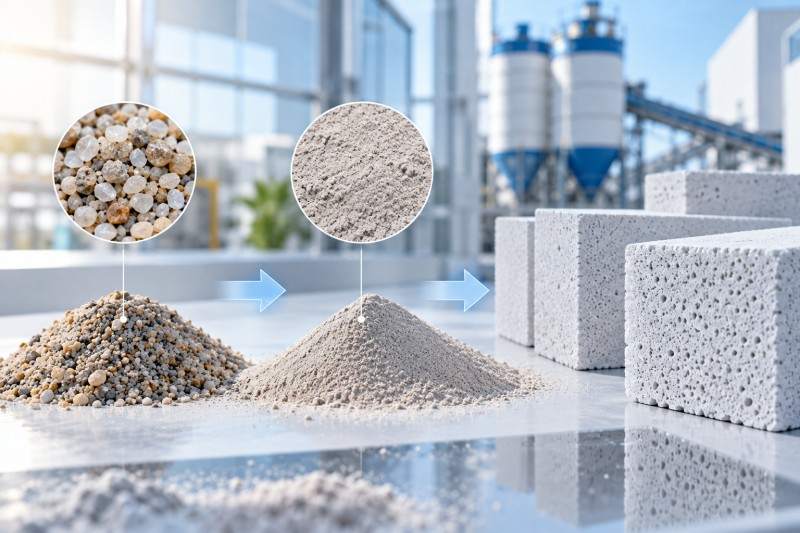
Consider two silica particles with the same chemical composition but very different sizes. The finer material provides considerably more surface area per kilogram for contact with water and calcium-bearing components.
That increased surface area generally improves reaction accessibility.
Coarse quartz particles can remain partly unreacted because reactions occur primarily from the particle surface inward. When particles are smaller, the reaction distance decreases and a greater proportion of the silica can participate during the available autoclaving period.
A simplified relationship looks like this:
| Raw Material Condition | Reaction Behavior | Likely Production Effect |
| Too coarse | Slow silica availability | Lower reaction efficiency |
| Moderately fine | Balanced reaction rate | Stable process and good strength |
| Fine | Faster reaction availability | Potential strength improvement |
| Excessively fine | Very high surface area and water demand | Higher process sensitivity |
This explains why fineness can improve strength, but it also explains why grinding cannot compensate indefinitely for poor chemistry or poor process control.
How Fineness Affects AAC Expansion
AAC expansion happens long before the autoclave creates the final strength. At this stage, the fresh slurry must be fluid enough for hydrogen bubbles to expand but viscous enough to hold them in a stable structure.
Raw-material fineness strongly influences this balance.
Finer particles have greater total surface area and normally bind or interact with more water. As fineness increases, slurry viscosity can rise if the water dosage remains unchanged. The expanding gas then faces greater resistance.
If the slurry becomes too thick, expansion may slow or become incomplete. The result can be higher cake density, irregular pores, or insufficient mold rise.
The opposite problem appears when operators compensate for high viscosity simply by adding more water. Expansion may become easier, but excessive water weakens the green structure and can create instability during rising and pre-curing.
The target is therefore not maximum slurry fluidity. It is controlled rheology that matches the gas-generation curve.
Gas Generation and Slurry Stiffening Must Stay Synchronized
One useful way to understand AAC expansion is to think of two processes happening simultaneously.
Aluminum is generating gas and trying to increase the volume of the mass. At the same time, cementitious reactions are gradually stiffening the slurry and building enough structure to retain those bubbles.
Raw-material fineness can influence the timing of that balance.
If the slurry stiffens too rapidly relative to gas generation, expansion becomes restricted. If gas generation occurs while the slurry remains too fluid, bubbles can merge, migrate upward, or escape.
A stable AAC recipe therefore requires coordination between several variables:
- Sand or fly-ash fineness
- Lime reactivity and fineness
- Cement characteristics
- Aluminum dosage and activity
- Slurry temperature
- Water-to-solids ratio
- Mixing time
- Casting temperature
- Pre-curing conditions
This is one reason changing the grinding system can require recipe adjustment even when the chemical composition of the raw material has not changed.
Coarse Sand Can Reduce Autoclaving Efficiency
Coarse silica is particularly important when evaluating finished AAC strength.
During autoclaving, calcium-bearing phases must react with silica to create the microstructure responsible for much of the block’s mechanical performance. Large silica particles offer less reactive surface and require reactions to penetrate farther into each particle.
If grinding is insufficient, more unreacted quartz may remain after curing.
That does not mean every quartz particle must disappear. Some residual quartz is normal. The issue is whether enough reactive silica is available at the required rate to produce the intended hydrothermal structure within the plant’s curing cycle.
With excessively coarse feed, manufacturers may see a combination of:
- Lower compressive strength at the same dry density
- Greater variability between batches
- Less efficient use of lime
- Greater dependence on longer autoclaving cycles
- Uneven microstructure
- Higher levels of unreacted mineral material
Trying to solve these problems only by extending autoclave time is usually an expensive approach. Steam, vessel capacity, and production hours all have value. Improving raw-material preparation may be more economical.
Finer Raw Material Can Improve Strength—but Only to a Point
Reducing silica particle size can improve the conditions for strength development because more silica becomes accessible during hydrothermal curing.
But the relationship is not linear.
If grinding from a coarse condition to a suitable fineness significantly increases reaction efficiency, the strength improvement can be meaningful. Grinding far beyond that point may provide only a small additional strength benefit while electricity consumption and milling capacity requirements rise sharply.
For preliminary process thinking, the relationship can be viewed like this:
| Fineness Change | Expansion Stability | Strength Potential | Grinding Cost |
| Very coarse → coarse | Often improves | Clear improvement possible | Low–moderate increase |
| Coarse → suitable | Usually improves significantly | Strong improvement potential | Moderate |
| Suitable → fine | Recipe dependent | Smaller incremental gain | Higher |
| Fine → extremely fine | May become harder to control | Limited additional benefit | Very high |
The economic optimum is usually somewhere in the middle.
An AAC producer is not selling micron size. The plant is selling blocks that meet density, compressive strength, dimensional accuracy, and production-cost targets.
Fineness Also Influences Pore Structure
Compressive strength in AAC cannot be separated from pore structure.
Two blocks can have similar dry density but different strength because their pores are distributed differently. Uniform, relatively small and well-separated pores generally provide a more favorable structural skeleton than irregular pores connected by weak walls.
Particle-size distribution contributes to the behavior of the slurry surrounding these bubbles.
A well-prepared slurry provides sufficient suspension stability and allows gas to distribute throughout the mass. Poorly controlled particle size can contribute to segregation, inconsistent viscosity, and uneven rising.
This becomes especially noticeable across the height of a cake. Operators may find the upper and lower sections developing different pore characteristics, density, or cutting behavior.
In this situation, checking only aluminum dosage misses part of the problem. Slurry solids, particle-size distribution, temperature, water content, and mixing conditions should be examined together.
Do Not Control Fineness With One Number Alone
One weakness in many AAC raw-material specifications is reliance on a single sieve-residue value.
For example, two ground-sand samples can show similar residue on a specified sieve while having noticeably different particle-size distributions below that sieve size.
One sample may contain a broad distribution of useful particles. Another may contain an unusually high proportion of ultrafines.
Their behavior inside the mixer may not be identical.
For routine production control, sieve residue remains useful because it is simple, inexpensive, and easy for operators to monitor. But when commissioning a new plant, changing a raw-material source, troubleshooting strength, or optimizing grinding energy, a more complete particle-size analysis can provide much better information.
Useful indicators include median particle size, coarse fraction, ultrafine fraction, sieve residue, specific surface area where relevant, and batch-to-batch consistency.
Sand and Fly Ash Should Not Be Treated Identically
AAC recipes using quartz sand and those using fly ash should not automatically share the same grinding target.
Quartz sand is generally crystalline and relatively stable, so mechanical size reduction is particularly important for increasing available reaction surface.
Fly ash can already contain substantial fine material and may include reactive amorphous phases. Its particle morphology and chemistry are also different from ground quartz.
Therefore, the practical question should not be:
“What is the standard AAC raw-material fineness?”
It should be:
“What fineness allows this particular raw material to deliver stable expansion and the required strength at an economical grinding cost?”
That distinction becomes important when an AAC equipment supplier or plant operator works across several countries. Sand mineralogy, fly-ash quality, lime activity, cement characteristics, and even water chemistry can vary significantly from one project to another.
Lime Fineness Matters Too
Silica usually receives most of the attention, but lime grinding also influences AAC behavior.
Finer quicklime generally reacts more rapidly because more surface is available for hydration. This can affect slurry temperature, alkalinity development, stiffening rate, and ultimately the timing of aluminum gas generation.
Extremely reactive lime combined with high fineness can create a process that develops heat and viscosity too quickly.
Coarser or less reactive lime may produce the opposite behavior.
This is why replacing a lime supplier can disturb an apparently stable AAC recipe even when the chemical CaO content looks similar on the certificate.
The plant should evaluate lime chemistry, activity and particle size together, rather than approving material from chemical composition alone.
Fineness Influences Green-Cake Cutting
The consequences of grinding continue into the cutting section.
Before autoclaving, AAC must develop enough green strength to survive demolding, turning, cutting, and transfer. Raw-material characteristics influence how quickly this structure develops and how uniform it becomes.
A properly prepared cake should be strong enough to retain its shape but soft enough for cutting wires to pass through cleanly.
If material preparation and pre-curing are poorly balanced, the plant may experience wire drag, surface tearing, cake deformation, edge damage, sticking, or cracking.
Operators sometimes respond by changing pre-curing time. That may help, but repeated cutting problems deserve a wider investigation that includes raw-material fineness and slurry properties.
Grinding Energy Should Be Part of the Decision
Grinding finer always has a cost.
As the target particle size decreases, achieving each additional reduction generally requires progressively more milling energy. Throughput may also fall, increasing the required mill size or operating hours.
Imagine that finer grinding improves block strength by 8% while increasing grinding electricity by 10%. That could be an excellent trade if it allows lower product density while maintaining the required strength.
But if further grinding increases strength by only 1% while electricity consumption rises another 15%, the economics are very different.
This is why I prefer to evaluate AAC grinding through strength-to-density performance and production cost, rather than fineness alone.
A useful plant optimization table might look like this:
| Trial | Grinding Energy | Slurry Behavior | Dry Density | Compressive Strength | Decision |
| A | Low | Slightly unstable | Higher | Lower | Too coarse |
| B | Moderate | Stable | Target | Good | Promising |
| C | Moderately high | Stable | Target | Very good | Possible optimum |
| D | High | High viscosity | Target | Slightly higher | Questionable economics |
Actual values should come from plant trials because raw-material systems differ too much for a universal optimum.
Consistency Is Often More Important Than Extreme Fineness
A production manager should worry more about large fineness fluctuations than about whether the average particle size can be reduced another few microns.
AAC is highly sensitive to timing. If one batch of sand slurry behaves differently from the next, operators compensate by changing water, temperature, aluminum, mixing time, or pre-curing. Those corrections introduce further variation.
Eventually the plant begins operating by continuous adjustment rather than controlled recipes.
Stable grinding helps stabilize everything downstream.
This requires attention to mill feed rate, circulating load, classifier performance, slurry concentration, liner or grinding-media wear, raw-material moisture, and feed particle size.
For an AAC production line, the grinding section should therefore be viewed as process-control equipment, not merely size-reduction equipment.
A Practical Approach to Optimizing AAC Raw Material Fineness
When commissioning or improving a plant, avoid selecting a fineness target from another factory and treating it as fixed. Start with laboratory characterization and then confirm performance through controlled production trials.
A practical optimization sequence is:
- Characterize the chemical and mineralogical properties of sand, fly ash, lime, and cement.
- Establish an initial particle-size range based on the raw-material system.
- Produce several controlled grinding levels rather than testing only one.
- Keep other recipe variables as consistent as possible during comparison.
- Record slurry viscosity and temperature behavior.
- Measure mold rise and expansion time.
- Observe pore uniformity and green-cake condition.
- Record cutting performance and reject rates.
- Compare finished dry density and compressive strength.
- Measure grinding energy per ton and overall production impact.
The final target should sit where expansion stability, cutting behavior, autoclaving efficiency, strength and grinding cost overlap favorably.
Raw-material fineness strongly affects AAC expansion, strength, slurry behavior and curing performance. Material that is too coarse may limit silica reaction, while excessive grinding increases water demand, energy use and process sensitivity.
The goal is not maximum fineness, but an economical particle-size distribution that delivers stable expansion and target strength. For AAC line suppliers such as Runding, raw-material testing helps match grinding, mixing, pre-curing and autoclaving systems for more stable production.