
AAC slurry with high solid density needs consistent pumping output, precise flow adjustment and anti-abrasion components to maintain steady material transport for block production.
When choosing a matching slurry pump, operators need to consider slurry traits, production output, pipeline routing and custom demands to support dependable AAC production.
Key Factors Affecting AAC Slurry Pump Selection
Unlike common industrial liquid media, AAC slurry operates under unique working parameters. Pumping units must be capable of processing high-density materials carrying suspended particulates, and limit excessive shear load to keep the slurry’s uniform texture intact.
Main selection factors include:
- Slurry density
- Solid particle content
- Material viscosity
- Required flow capacity
- Pumping distance
- Installation height difference
- Continuous working hours
- Wear resistance requirements
- Production line connection design
A mismatch between slurry characteristics and pump performance may lead to unstable feeding, uneven batching, increased maintenance frequency, or production interruptions.
Slurry Characteristics in High Density AAC Production
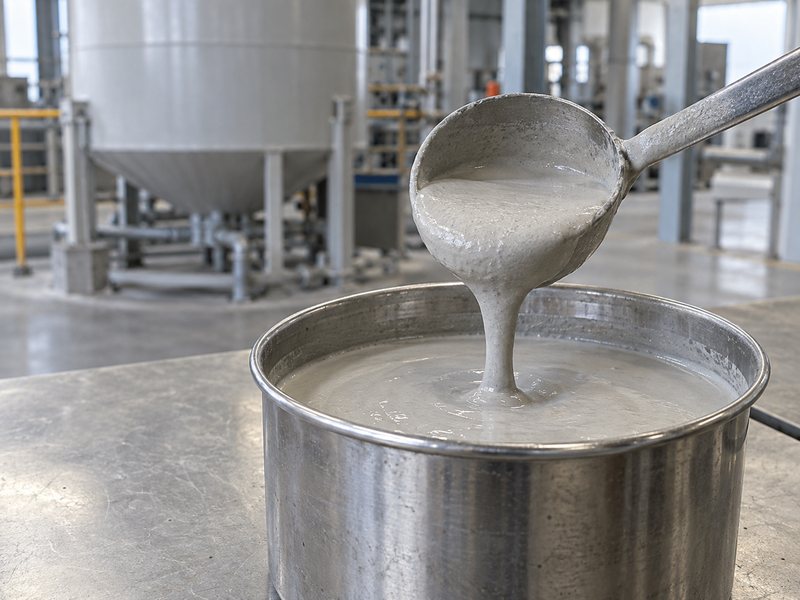
It is necessary to convey high-density AAC slurry smoothly from the slurry preparation zone to the batching system. The pump must keep pressure and flow constant; otherwise, variable operating parameters will lead to inaccurate raw material blending ratios.
| AAC Slurry Parameter | Typical Requirement | Influence on Pump Selection |
| Material Density | High density slurry with solid particles | Requires strong conveying capability |
| Slurry Condition | Continuous mixing and transfer | Needs stable operation under long working hours |
| Particle Content | Cement, sand, fly ash, gypsum particles | Requires wear-resistant pump components |
| Flow Requirement | Depends on AAC production capacity | Determines pump size and motor power |
Flow Capacity and Pump Size Matching
When picking an AAC slurry pump, the first consideration is matching its rated capacity to the production output of the AAC assembly line.
A pump with excessive specifications brings high flow velocity and extra energy loss, whereas a small-capacity pump results in slurry shortage during raw material batching.
Calculate the necessary flow volume with reference to the criteria below:
- Daily AAC block production capacity
- Slurry consumption per batch
- Mixing cycle time
- Transfer distance
- Pipeline diameter
| Production Scale | Recommended Pump Consideration | Application Characteristics |
| Small AAC Line | Compact slurry pump system | Suitable for limited production capacity |
| Medium AAC Line | Stable flow slurry pump | Supports continuous batching operation |
| Large AAC Line | Heavy-duty slurry pump system | Designed for long-distance and high-volume transfer |
A professional AAC equipment manufacturer can provide a suitable pump configuration according to the complete production line instead of selecting the pump separately.
Pump Structure for High Density AAC Slurry
The structure of the slurry pump directly affects service life and operating stability. Since AAC slurry contains abrasive particles, the internal components need sufficient wear resistance.
Important structural parts include:
- Pump casing
- Impeller
- Shaft
- Bearing assembly
- Sealing system
- Motor drive system
Impeller structure directly impacts slurry delivery performance. For high-concentration AAC slurry, the impeller shall guarantee enough output pressure and cut down useless turbulence inside the pump housing.
Slurry Pump Performance Parameters
Pump specifications must be adjusted according to the varied environmental conditions of AAC block production. The selection process should center on actual service scenarios rather than relying solely on motor power as the judging standard.
| Parameter | RunDing Slurry Pump Specification | Selection Consideration |
| Flow Rate | 20–320 m³/h | Select according to AAC production capacity and slurry transfer demand |
| Power Range | 3–45 kW | Match motor power with slurry density and pipeline resistance |
| Head Range | 11–39 m (Model dependent) | Suitable for different plant layouts and transfer distances |
| Speed Range | 1430–1480 rpm | Maintains stable slurry conveying performance |
| Power Supply | 380V, 400V, 415V, 440V, 460V, 480V, 600V, 660V | Supports different industrial electrical systems |
For high density AAC slurry applications, RunDing slurry pumps provide a flow range of 20–320 m³/h with power options from 3–45 kW. Different models can be selected according to slurry volume, pipeline distance, and AAC production capacity.
For example, MJ-5 provides 80 m³/h flow with 21 m head and 11 kW power, while MJ-12 reaches 320 m³/h flow for larger AAC production lines.
Motor Power and Operating Stability
Slurry pump operational efficiency is significantly impacted by motor power, a core technical indicator. When transporting high-density AAC slurry, abundant driving force is essential to overcome internal fluid resistance and pressure losses generated within piping systems.
Even so, boosting motor power blindly will not deliver better working results. Optimized motor configuration requires comprehensive balance of multiple indicators, including:
- Pump efficiency
- Energy consumption
- Operating stability
- Maintenance requirements
Installation Layout and Pipeline Matching
AAC slurry pump installation should be considered together with the complete production layout.
The following factors influence pump performance:
- Distance between slurry tank and batching system
- Pipeline length
- Pipeline diameter
- Number of elbows
- Vertical lifting height
- Maintenance space
When the production plant has special space limitations, the slurry pump system can be customized according to actual installation conditions.
Material Selection for Long-Term AAC Slurry Operation
Since liquid AAC slurry maintains persistent contact with every internal pump component, the materials adopted for pump manufacturing are critical factors governing equipment wear resistance and longevity.
| Component | Recommended Design Focus | Purpose |
| Pump Body | Strong structural material | Handles continuous slurry impact |
| Impeller | Wear-resistant design | Reduces abrasion damage |
| Shaft | High-strength material | Maintains rotation stability |
| Seal System | Reliable sealing structure | Prevents slurry leakage |
Customized AAC Slurry Pump Solutions
There exist notable disparities among AAC production plants in terms of processing capacity, ingredient formulas and overall factory layout. Conventional standardized pump products are not universally applicable to all installation scenarios.
Personalized slurry pump solutions are available for custom development with reference to:
- AAC production output
- Slurry concentration
- Pumping distance
- Pipeline design
- Electrical requirements
- Automatic control needs
Selection Guide for AAC Production
| Selection Item | Key Consideration |
| Slurry Property | Density, viscosity, particle content |
| Production Demand | Required transfer volume and working time |
| Pump Structure | Wear resistance and continuous operation |
| Installation Condition | Pipeline distance and layout limitations |
| Custom Requirement | Special capacity and connection design |
Optimal selection of slurry pumps dedicated to AAC production enables stable medium transport, raises the accuracy level of raw material proportioning, and maintains reliable long-running production efficiency.
High density AAC slurry pumps offer 20–320 m³/h flow capacity, 3–45 kW power, and stable conveying performance for continuous production.
Selection should consider slurry density, pipeline layout, and models like MJ-5 or MJ-12 to match different AAC production requirements.