
AAC is a lightweight building material valued for insulation, fire resistance, sound reduction, and accuracy. In AAC block production, the autoclave is a key machine that cures blocks with high-temperature, high-pressure steam.
This autoclaving process gives AAC blocks their final strength, stability, and durability. For investors, choosing the right autoclave is important because it affects capacity, steam consumption, block quality, safety, and long-term operating cost.
What Is an Autoclave for AAC Blocks?
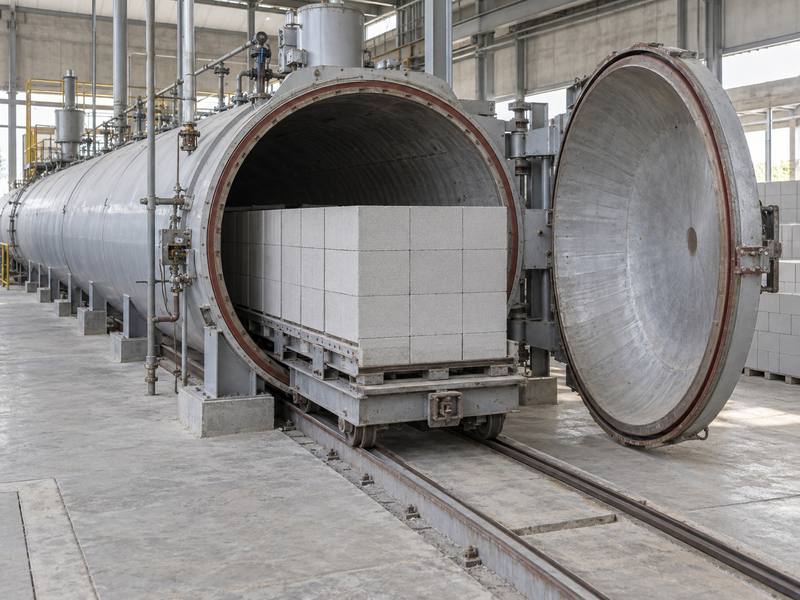
An autoclave for AAC blocks is a horizontal cylindrical pressure vessel used in AAC production. After raw materials are mixed, poured, expanded, pre-cured, and cut, the green AAC blocks are sent into the autoclave for steam curing.
Inside the autoclave, AAC blocks are cured under controlled temperature and pressure. During this process, chemical reactions occur between silica materials, lime, cement, and water. These reactions form stable crystalline structures inside the blocks, improving strength and durability.
In simple terms, the autoclave is the curing chamber that turns soft green AAC blocks into finished construction blocks.
Why Is an Autoclave Important in AAC Block Production?
The autoclave is one of the core machines in an AAC production line because it determines whether the blocks can achieve the required strength and performance.
Before autoclaving, the AAC green cake has already been cut into block sizes, but it is still not strong enough for construction. The material structure is unstable and needs steam curing to complete the chemical reaction.
The autoclave helps AAC blocks achieve:
- Higher compressive strength
- Stable internal structure
- Better dimensional stability
- Improved durability
- Better thermal insulation performance
- Lower shrinkage after production
- Longer service life in buildings
Without proper autoclaving, AAC blocks may have low strength, cracks, high shrinkage, poor appearance, or unstable quality.
Main Role of the Autoclave in AAC Production
| Function | Explanation |
| Steam curing | Uses high-temperature and high-pressure steam to cure AAC blocks |
| Strength development | Helps blocks reach the required compressive strength |
| Structure stabilization | Forms a stable internal crystalline structure |
| Moisture control | Reduces unstable moisture inside the block |
| Quality improvement | Improves durability, size stability, and final performance |
| Mass production support | Allows large batches of blocks to be cured efficiently |
How Does an AAC Autoclave Work?
The working process of an AAC autoclave is closely connected with the entire AAC block production line. After the cutting process, the green blocks are placed on autoclave cars or curing trolleys. These trolleys move along rails into the autoclave.
Once the autoclave door is closed and locked, steam is introduced into the vessel. The temperature and pressure rise gradually according to the curing program. After reaching the required conditions, the blocks are held inside the autoclave for a certain curing time. When curing is complete, pressure is released gradually, and the finished AAC blocks are taken out.
AAC Autoclave Working Process
| Step | Process | Purpose |
| 1 | Loading | Green blocks are loaded onto autoclave cars |
| 2 | Door closing | Autoclave door is sealed and locked |
| 3 | Vacuum or exhaust stage | Air is removed or replaced by steam |
| 4 | Steam heating | Temperature and pressure rise gradually |
| 5 | Constant curing | Blocks are cured under stable steam conditions |
| 6 | Pressure reduction | Steam pressure is released safely |
| 7 | Unloading | Finished AAC blocks are removed from the autoclave |
Each step must be controlled carefully. If heating or pressure release is too fast, the blocks may crack. If curing time is not enough, block strength may be insufficient. If steam distribution is uneven, block quality may vary in different positions inside the autoclave.
Typical Autoclave Curing Conditions
The exact curing parameters depend on raw materials, block density, formula, plant design, and product requirements. However, AAC autoclaves usually work under high-temperature and high-pressure steam conditions.
| Parameter | Common Range |
| Steam pressure | About 1.0–1.3 MPa |
| Steam temperature | About 180–200°C |
| Curing time | About 8–12 hours |
| Autoclave type | Horizontal pressure vessel |
| Loading method | Rail trolley or autoclave car |
| Heating medium | Saturated steam |
These values are for general reference only. In real AAC production, the supplier and plant engineer should adjust the curing system according to material formula and product standards.
Main Components of an AAC Autoclave
An AAC autoclave is not only a steel cylinder. It consists of a number of crucial components that cooperate to guarantee stable and safe operation.
Autoclave Body
The autoclave body is the main pressure vessel. It is typically made of high-strength steel and designed to withstand extreme pressure and temperature conditions. The body must be manufactured according to strict pressure vessel standards because safety is extremely important.
Autoclave Door
The door seals the autoclave during steam curing. AAC autoclaves usually use a quick-opening door structure. The door must close tightly and lock securely before steam enters the vessel. A good door design improves safety and operating efficiency.
Sealing System
The sealing system prevents steam leakage during curing. A reliable seal helps maintain pressure, save steam, and protect workers. Poor sealing can cause energy loss and safety risks.
Rail System
AAC blocks are usually loaded into the autoclave on autoclave cars. These cars move on rails. The rail system must be aligned accurately to ensure smooth loading and unloading.
Steam Inlet and Exhaust System
The steam inlet system introduces steam into the autoclave. The exhaust system removes air and releases steam after curing. Proper steam circulation helps ensure even curing throughout the vessel.
Safety Devices
Because the autoclave works under pressure, safety devices are essential. These may include safety valves, pressure gauges, temperature sensors, interlock systems, and automatic control devices.
Main Components and Functions
| Component | Function |
| Autoclave body | Holds steam pressure and curing space |
| Door system | Opens and closes the pressure vessel |
| Sealing system | Prevents steam leakage |
| Rail system | Supports loading and unloading of block trolleys |
| Steam system | Controls steam inlet, exhaust, and circulation |
| Safety valve | Prevents overpressure |
| Pressure gauge | Monitors internal pressure |
| Control system | Manages the curing process and safety operation |
Types of Autoclaves Used for AAC Blocks
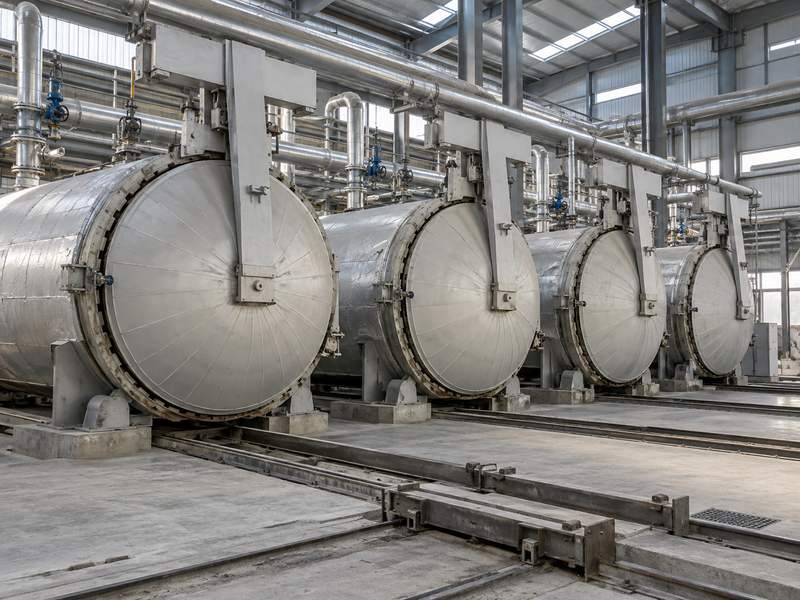
Most AAC block plants use horizontal autoclaves because they are suitable for large-volume block curing. The autoclave size and number depend on plant capacity.
AAC autoclaves can be classified by diameter, length, loading capacity, door type, and automation level.
By Size
| Autoclave Size | Suitable Plant Type |
| Small diameter and short length | Small AAC block plants |
| Medium diameter and medium length | Medium-capacity AAC plants |
| Large diameter and long length | Large AAC block or panel plants |
| Customized autoclave | Special production requirements |
By Operation Level
| Type | Features |
| Manual operation | Lower cost, more operator involvement |
| Semi-automatic operation | Some process controls automated |
| Automatic operation | Better control of temperature, pressure, and timing |
For modern AAC plants, automatic control is becoming more common because it improves curing consistency and reduces human error.
Autoclave in the Complete AAC Block Production Line
The autoclave is only one part of the AAC block production line, but it is one of the most important sections.
A typical AAC production line includes:
- Raw material preparation system
- Ball mill and slurry tank
- Cement, lime, and gypsum storage silos
- Batching and mixing system
- Pouring mixer
- Mould and pre-curing area
- Cutting machine
- Autoclave curing system
- Block separation system
- Packing system
- Automation control system
The autoclave must match the capacity of the cutting section and packing section. If the autoclave capacity is too small, it becomes a bottleneck in the whole production line. Investment and energy costs may rise unnecessarily if it is too big.
How to Choose the Right Autoclave for AAC Blocks
Choosing the right AAC autoclave requires careful planning. Investors should consider plant capacity, product type, steam supply, workshop layout, and future expansion.
Production Capacity
The autoclave size and quantity should match the target annual capacity of the AAC plant. A small plant may need fewer autoclaves, while a large plant may require multiple autoclaves working in rotation.
Block Size and Product Type
AAC blocks and AAC panels may require different loading methods and curing arrangements. If the plant plans to produce both blocks and panels, the autoclave system should be designed with enough space and suitable trolleys.
Steam Supply
The autoclave needs stable steam from a boiler system. Steam pressure, steam volume, and pipeline design must match the curing requirements. Insufficient steam supply can reduce production efficiency and affect block strength.
Safety Standard
Because an autoclave is a pressure vessel, safety is a top priority. Buyers should choose equipment manufactured according to recognized pressure vessel standards. The autoclave should include safety valves, interlocks, pressure monitoring, and reliable door locking systems.
Energy Consumption
Steam curing consumes energy. A well-designed autoclave system can reduce steam loss and improve energy efficiency. Good insulation, proper sealing, and optimized curing programs can reduce operating costs.
Installation and Maintenance
AAC autoclaves are large and heavy pieces of equipment. Buyers should consider installation space, foundation requirements, rail alignment, pipeline connection, and maintenance access. A good manufacturer should provide installation guidance and technical support.
Key Selection Factors
| Factor | Why It Matters |
| Diameter and length | Determines loading capacity |
| Quantity | Affects production rhythm |
| Door design | Influences safety and operation efficiency |
| Sealing quality | Affects steam loss and pressure stability |
| Control system | Improves curing consistency |
| Safety devices | Protects workers and equipment |
| Steam efficiency | Reduces long-term operating cost |
| Manufacturer experience | Supports installation and maintenance |
Common Problems in AAC Autoclave Operation
Even with good equipment, improper operation can cause production problems. Operators should follow the correct curing process and maintenance plan.
Common Problems and Causes
| Problem | Possible Cause |
| Block cracking | Heating or depressurisation too fast |
| Low block strength | Insufficient curing time or steam pressure |
| Uneven quality | Poor steam distribution |
| Steam leakage | Damaged seal or poor door locking |
| High energy cost | Poor insulation or an inefficient steam system |
| Slow production | Autoclave capacity does not match the production line |
| Safety risk | Poor maintenance or incorrect operation |
To avoid these problems, AAC plants should train operators, inspect seals regularly, maintain safety valves, monitor pressure and temperature, and follow the recommended curing curve.
Maintenance of an AAC Autoclave
Regular maintenance is necessary for safe and efficient operation. Since the autoclave works under high pressure, small problems should not be ignored.
Basic maintenance tasks include:
- Checking the autoclave door and locking system
- Inspecting sealing rings
- Testing safety valves
- Checking pressure gauges and temperature sensors
- Inspecting rails and autoclave cars
- Cleaning steam pipelines
- Checking insulation condition
- Monitoring corrosion or wear
- Keeping operation records
- Following the pressure vessel inspection requirements
Good maintenance can extend the service life of the autoclave, reduce downtime, and improve plant safety.
Advantages of a High-Quality AAC Autoclave
A reliable autoclave can bring long-term benefits to an AAC block factory.
Main advantages include:
- Stable block quality
- Better curing efficiency
- Lower steam loss
- Safer operation
- Longer equipment service life
- Lower maintenance cost
- Higher production reliability
- Better support for continuous production
For AAC plant investors, the autoclave should not be treated as a simple accessory. It is a key investment that directly affects product quality and production cost.
AAC blocks are cured using high-temperature, high-pressure steam in an autoclave, which is a sizable pressure vessel. It is a core machine in an AAC production line and helps develop block strength, stability, and durability.
The curing process turns green AAC blocks into finished building materials, affecting strength, dimensional accuracy, moisture behavior, and long-term performance.
When choosing an AAC autoclave, investors should consider capacity, size, steam supply, safety standards, control system, energy efficiency, and after-sales service.