
The best autoclave machine for AAC blocks is not simply the largest or highest-pressure model. The right autoclave should match your production capacity, curing cycle, steam supply, block dimensions, and overall AAC line configuration.
Because autoclaving directly affects the strength, dimensional stability, and consistency of finished AAC blocks, the machine should be selected as part of the complete production system rather than as an isolated pressure vessel.
What Does an Autoclave Actually Do in AAC Production?
After cutting, AAC blocks are still relatively soft green products. They need controlled high-temperature and high-pressure steam curing to develop their final material properties.
Inside the autoclave, hydrothermal reactions take place between the calcium- and silica-containing materials. The resulting structure gives finished AAC products their required strength, dimensional stability, and durability.
A typical production sequence around the autoclave looks like this:
Cutting → Grouping → Loading → Autoclaving → Unloading → Separation → Packing
The quality of the autoclave itself matters, but so does the way it interacts with the grouping crane, steaming wagons, rail system, boiler, steam piping, and downstream handling equipment.
That is why the “best” autoclave should be judged by production compatibility, not only vessel specifications.
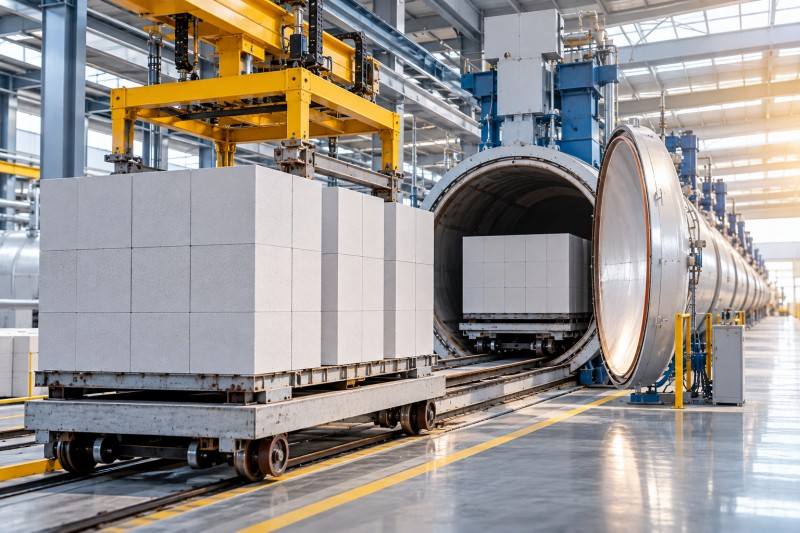
Key Factors That Define a Good AAC Autoclave
From a plant engineering perspective, there are several factors worth evaluating before comparing manufacturers.
| Factor | What You Should Evaluate | Why It Matters |
| Production capacity | m³/day and batches/day | Determines autoclave size and quantity |
| Effective loading volume | Usable internal space | Affects blocks cured per cycle |
| Working pressure | Required process pressure | Influences curing stability |
| Steam distribution | Uniformity inside vessel | Affects block consistency |
| Door and locking system | Reliability and safety | Important for frequent cycles |
| Control system | Pressure, temperature, time | Improves repeatability |
| Insulation | Heat-loss control | Influences steam consumption |
| Rail arrangement | Match with steaming wagons | Affects loading efficiency |
| Safety system | Interlocks and protection | Critical for pressure-vessel operation |
| Maintenance | Seals, valves, piping access | Influences long-term downtime |
A supplier giving you only the diameter, length, and price of the autoclave has not provided enough information for a serious AAC project.
Match the Autoclave to Your Actual AAC Capacity
Capacity should come first.
Suppose your plant is designed for 200–300 m³/day. Installing an autoclave system intended for a much larger plant may increase capital investment, occupied space, steam-system requirements, and heat losses without creating useful production capacity.
The opposite problem is usually worse. An undersized autoclaving section creates a bottleneck after cutting. Green products wait for available curing capacity while the upstream line continues producing.
For planning purposes, you need to consider:
- Daily AAC production in m³
- Effective blocks loaded per autoclave
- Number of autoclaves
- Complete curing cycle
- Loading and unloading time
- Number of operating hours per day
- Maintenance allowance
- Planned future capacity expansion
For example, a small AAC plant and a 1,000+ m³/day industrial line should not use the same autoclave configuration simply because both produce standard AAC blocks.
Typical Planning Logic
| AAC Plant Capacity | General Autoclave Planning |
| 50–200 m³/day | Compact configuration, often around 2 units depending on process design |
| 200–300 m³/day | Multiple autoclaves coordinated with batch output |
| 500–800 m³/day | Multi-autoclave system with continuous scheduling |
| 1,000–1,500 m³/day | Large coordinated autoclave section for high-volume production |
These figures should be treated as planning references rather than fixed purchasing specifications. The final quantity depends on mould dimensions, product loading arrangement, cycle time, and your actual production schedule.
Internal Dimensions Matter More Than They First Appear
Autoclave diameter and length should not be selected independently from your AAC production system.
Your steaming wagon dimensions, block grouping arrangement, side plate system, rail gauge, and available workshop length all affect the practical size of the vessel.
A slightly larger autoclave does not automatically provide proportionally higher useful capacity. If the internal loading arrangement leaves excessive unused space, you are heating a larger pressure vessel without gaining equivalent production.
A better engineering objective is high effective loading utilization with sufficient operational clearance.
Before ordering, the manufacturer should therefore confirm the relationship between:
Autoclave internal dimensions → Steaming wagon → Block group → Mould size → Daily production capacity
This is one reason Runding normally approaches the autoclave as part of the AAC line configuration rather than treating it as a stand-alone catalogue product.
Stable Steam Distribution Is More Important Than Fast Heating
AAC curing is not simply about reaching a high temperature as quickly as possible.
The pressure and temperature should rise according to a controlled curing profile, remain stable during the holding stage, and then decrease in a controlled manner. Aggressive heating or depressurization may create unnecessary stress in the green products.
A practical curing cycle normally contains several stages:
| Stage | Main Purpose |
| Loading | Position green AAC products inside the vessel |
| Air removal/preparation | Prepare chamber for steam curing |
| Pressure and temperature rise | Gradually establish curing conditions |
| Constant-pressure curing | Complete hydrothermal reactions |
| Controlled depressurization | Reduce pressure without damaging products |
| Unloading | Transfer cured AAC to downstream processing |
Actual pressure, temperature, and holding time depend on the raw material formulation, block density, product type, and production process.
This is why copying another factory’s curing parameters is not always good practice. The autoclave needs sufficient control flexibility to support the process developed for your AAC material.
Look at Steam Consumption, Not Only Machine Price
The purchase price is visible immediately. Steam losses continue for years.
An AAC factory running multiple curing cycles every day consumes a significant amount of thermal energy. Poor insulation, condensate management, steam leakage, inefficient piping, or unnecessarily large vessel volume can gradually increase production cost.
When comparing autoclaves, pay attention to:
- Vessel insulation
- Steam inlet arrangement
- Condensate discharge
- Pipeline design
- Valve quality
- Door sealing
- Heating uniformity
- Steam recovery possibilities
- Coordination with the boiler system
A cheaper autoclave that requires more steam per cubic meter of finished AAC can become more expensive over its operating life.
For a commercial AAC plant, it is more useful to compare equipment using cost per m³ of finished product, rather than equipment price alone.
Safety Cannot Be Treated as an Optional Feature
An AAC autoclave is a large industrial pressure vessel. Safety therefore belongs at the top of the equipment specification.
The door deserves particular attention because it is opened and closed repeatedly throughout production. A reliable locking arrangement should prevent unsafe opening while the vessel remains pressurized.
Your evaluation should include the vessel structure, pressure monitoring, safety valves, door locking and interlocking system, temperature monitoring, pressure control, weld quality, inspection requirements, and applicable local pressure-vessel regulations.
Documentation is equally important. Importing an autoclave without considering the destination country’s pressure-vessel requirements can create serious problems during installation and commissioning.
The correct specification should therefore be discussed before manufacturing, not after the equipment arrives at your factory.
Manual, Semi-Automatic, or Automatic Control
Automation level should match the scale of your AAC plant.
For a smaller operation, a simpler control system may be adequate. As production capacity increases, however, maintaining repeatable curing cycles becomes more important.
An automatic system can control and record key process parameters such as:
- Steam introduction
- Pressure rise
- Temperature
- Holding period
- Pressure reduction
- Cycle timing
- Alarm conditions
The main benefit is not simply reducing operators. It is repeatability.
If one shift operates the autoclave differently from another, block quality can fluctuate even when the raw material recipe remains unchanged. A well-configured control system reduces this variation.
The Autoclave Must Match the Rest of the AAC Line
This is one of the most overlooked points during equipment selection.
Imagine that your cutting section can continuously support 600 m³/day, but your autoclaving section effectively handles only 450 m³/day. Your real plant capacity is much closer to 450 m³/day.
The same principle applies to every major section:
Raw Material Preparation → Batching & Pouring → Pre-Curing → Cutting → Grouping → Autoclaving → Separation → Packing
The slowest major section can become the production constraint.
At Runding, this is why autoclave selection is normally considered together with mould circulation, cutting capacity, grouping equipment, steaming wagons, factory layout, and the target daily output.
For a new AAC plant, this integrated approach is usually more useful than purchasing each machine based on an individual maximum capacity.
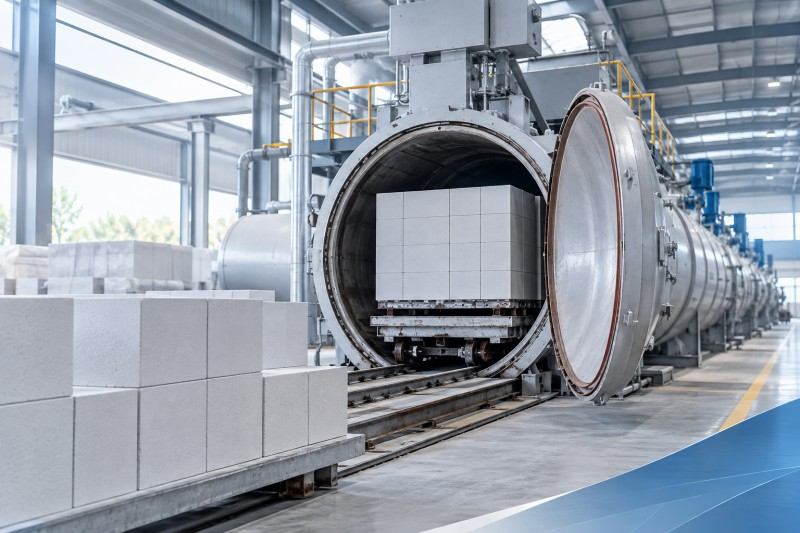
What Makes Runding Autoclaves Suitable for AAC Blocks?
Runding autoclaves are designed for industrial steam-curing applications, including AAC blocks and panels. The horizontal cylindrical pressure-vessel configuration integrates with the grouping and autoclaving section of an AAC production line.
More importantly, Runding can configure the autoclave together with the surrounding AAC production equipment.
For your project, the engineering team can consider:
- Target AAC capacity
- Block or panel dimensions
- Mould configuration
- Steaming wagon arrangement
- Required autoclave quantity
- Workshop layout
- Steam supply
- Material flow
- Automation level
- Future expansion
This becomes particularly valuable when you are building a new AAC factory. Instead of adapting your factory around separately purchased machines, the equipment can be selected around one production target.
Runding provides solutions for mini, medium, and large AAC plants, together with equipment manufacturing, plant layout, installation, commissioning, control-system support, and technical service.
A Practical Autoclave Selection Checklist
Before requesting a quotation, prepare the basic project information first.
| Information | Example |
| Target capacity | 300 m³/day |
| Product | AAC blocks / AAC panels |
| Block dimensions | According to local market |
| Raw materials | Sand/fly ash, lime, cement, gypsum |
| Working schedule | 16 or 24 hours/day |
| Mould size | Based on selected production system |
| Steam source | Existing or new boiler |
| Automation | Manual/semi-auto/automatic |
| Factory status | New plant/expansion |
| Destination | Country and installation location |
Providing this information allows the equipment manufacturer to calculate a much more realistic configuration.
If you only request “one AAC autoclave,” the quotation may tell you the equipment price, but it will not necessarily tell you whether that equipment can achieve your production target.
What Autoclave Is Ideal for AAC Blocks?
The best AAC autoclave is one that provides stable curing, reliable pressure control, efficient steam use, safe operation, and sufficient capacity without creating a bottleneck in your production line.
Runding configures AAC autoclaves around your actual plant capacity, mould system, steaming wagons, steam supply, and production layout. For a new AAC block plant or capacity expansion, this integrated approach helps you build a more balanced and reliable curing section.