
Sand is one of the most important raw materials in sand-based AAC block production, but choosing it should not be reduced to finding the sand with the highest silica content. What matters is whether the material can be processed economically into a stable silica slurry and react consistently during hydrothermal curing.
A sand source that looks excellent on a laboratory report may still create problems if it is difficult to grind, contains too much clay, varies from batch to batch, or carries harmful impurities. For an AAC plant, the better question is therefore not simply “Is this silica sand?” but “Can this sand support stable, economical AAC production every day?”
Why Sand Quality Matters in AAC Production
In a typical sand-based AAC formulation, sand provides the main siliceous component. During autoclaving, reactive silica participates in hydrothermal reactions with calcium-bearing materials such as lime and cement, contributing to the formation of calcium silicate hydrate phases that give AAC its final strength and dimensional stability.
Sand therefore affects more than raw-material cost. Its characteristics influence:
- grinding capacity and power consumption;
- slurry density and viscosity;
- mixing and casting stability;
- lime and cement reaction behavior;
- green cake development;
- autoclaving performance;
- final block strength and density;
- production consistency.
This is why changing the sand source can require adjustments elsewhere in the process even when the chemical analysis appears similar.
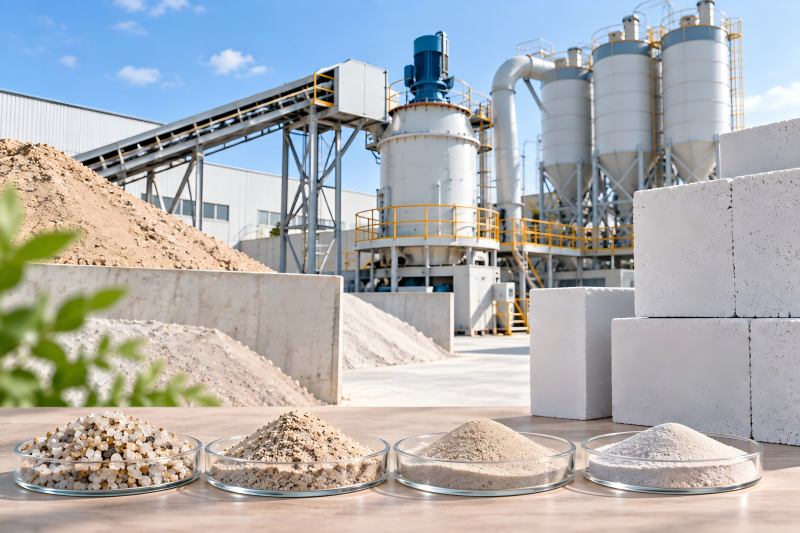
Typical Sand Requirements for AAC Blocks
There is no single specification that applies to every AAC factory because formulations, equipment, and local raw materials vary. However, the following ranges provide useful preliminary guidance.
| Parameter | Practical Reference Range | Why It Matters |
| SiO₂ content | Preferably >70%; often 80–90%+ | Main reactive silica source |
| Clay/mud | Preferably low, often <3–5% | Can affect slurry and reaction consistency |
| Organic matter | Very low | May interfere with gas generation and hydration |
| Sulfur compounds | Low | Can create process and durability concerns |
| Chlorides / soluble salts | Low | May affect process chemistry and equipment |
| Moisture | Stable and measurable | Important for batching accuracy |
| Feed size | Compatible with grinding system | Influences mill capacity and energy |
| Final ground fineness | Commonly around 80–200 μm depending on process | Influences silica reactivity |
These should be treated as screening values rather than purchase specifications. A plant should confirm the acceptable limits through laboratory analysis and production trials using its actual formulation.
Silica Content: Higher Is Usually Better, but Not the Whole Story
Quartz-rich silica sand is normally preferred because AAC needs sufficient reactive silica to combine with calcium compounds during autoclaving.
A sand containing 80–90% or more SiO₂ is generally attractive. Lower-grade material may still be usable, particularly if the remaining minerals are relatively harmless and the plant formulation is adjusted accordingly.
For example:
| Sand Sample | SiO₂ | Other Minerals | Initial Assessment |
| A | 94% | Low impurities | Excellent candidate |
| B | 86% | Moderate feldspar | Generally suitable |
| C | 75% | Clay and alumina | Requires testing |
| D | 62% | High clay/other minerals | Higher process risk |
It would be tempting to automatically choose Sample A. In reality, that decision should also consider grinding energy, delivered price, consistency and required processing.
If Sample A comes from 250 km away while Sample B is available 15 km from the factory and performs reliably in trials, Sample B could easily be the more economical raw material.
AAC raw-material selection should optimize production cost per cubic meter of acceptable blocks, not chemical purity alone.
Quartz-Rich Natural Sand Is Usually the First Choice
For conventional sand-based AAC production, clean natural sand with a high quartz content is normally the most straightforward option.
It should preferably have relatively low levels of clay, organic material, salts and other undesirable impurities. The sand is generally crushed or screened if necessary, ground with water, and stored as silica slurry before entering the batching system.
A typical preparation route looks like:
Sand Receiving → Screening/Crushing → Wet Grinding → Slurry Tank → Homogenization → Batching
The sand entering the plant does not need to be extremely fine because the grinding system performs the final size reduction. However, excessively coarse feed or large stones increase the burden on upstream crushing and milling equipment.
The key is a predictable feed material, not visually perfect sand.
Why Clay Content Deserves Special Attention
Clay is one of the first impurities I would investigate when evaluating a new sand source.
A small amount may be manageable, but excessive clay can change slurry behavior significantly. Clay particles have a high specific surface area and interact strongly with water, potentially increasing water demand and slurry viscosity.
This can affect casting consistency and make raw-material control more difficult.
Consider two sands:
| Property | Sand A | Sand B |
| SiO₂ | 88% | 91% |
| Clay/mud | 1.5% | 6% |
| Moisture variation | Low | High |
| Grinding behavior | Stable | Stable |
| Slurry consistency | Good | Variable |
Sand B has higher silica content, but I would probably investigate Sand A first for industrial production. Its improved uniformity and lower clay content might make the process easier to manage overall.
This illustrates an important principle: a slightly lower-grade but stable raw material is often more useful than a theoretically superior but unstable one.
Is Extremely Fine Sand Necessary?
The natural sand does not necessarily need to arrive at the AAC factory already finely ground.
Most sand-based AAC plants include a dedicated sand grinding system, commonly involving a ball mill or another suitable wet-grinding configuration. Water is added during grinding to produce silica slurry.
What matters more is whether the sand can be economically ground to the required fineness.
Finer silica generally provides more surface area for reaction, but grinding indefinitely finer is not automatically beneficial. As fineness increases, mill energy consumption rises, capacity may fall and slurry characteristics can change.
A practical relationship looks like this:
| Grinding Condition | Reactivity | Energy Consumption | Practical Result |
| Too coarse | Lower | Low | Incomplete/slow reaction risk |
| Suitable fineness | Good | Moderate | Preferred operating zone |
| Very fine | High | High | Often unnecessary |
| Excessively fine | Very high surface area | Very high | Poor economics / slurry issues |
The correct grinding target should therefore be determined by block performance and total processing cost, rather than by trying to achieve the smallest possible particle size.
Sand Hardness Affects Your Grinding Cost
Two sands with nearly identical chemical composition may behave differently in a ball mill.
Hard, highly crystalline quartz can require more energy to reach the desired fineness. A softer siliceous material may grind more easily, increasing mill throughput and reducing electricity consumption.
Suppose a plant produces 300,000 m³ of AAC annually. Even a relatively small difference in grinding energy per tonne becomes significant over thousands of operating hours.
When evaluating a new source, I would therefore request both:
chemical analysis + grinding test
Chemical analysis tells you what is in the sand. Grinding tests tell you how expensive it may be to use.
Both matter.
Can River Sand Be Used for AAC Blocks?
River sand can sometimes be suitable, provided its composition meets the process requirements.
The term “river sand” describes the source rather than the chemical quality. One deposit may contain high levels of quartz and very little contamination, while another may contain substantial clay, organic material or unsuitable minerals.
River sand should therefore be evaluated for:
- silica content;
- clay and silt;
- organic contamination;
- particle-size distribution;
- moisture variation;
- soluble salts;
- consistency between different extraction areas.
Washing may improve sand containing excessive fine dirt or clay, but adding washing equipment also increases water consumption, wastewater handling requirements and operating cost.
The economic question becomes whether cleaning local sand is cheaper than transporting better sand from another source.
Can Manufactured or Crushed Sand Be Used?
Manufactured silica-rich sand or suitable crushed siliceous rock can also be considered.
The main challenge is usually particle shape and size distribution rather than the fact that the material is manufactured. Since the material will normally undergo grinding before batching, its original particle shape becomes less important than it would be in conventional concrete production.
However, crushed material may contain excessive coarse particles or wear-inducing minerals.
A crusher and grinding system should therefore be designed around the actual feed characteristics.
If a nearby quarry can provide consistent quartz-rich material at a low delivered price, manufactured sand may be commercially attractive even if additional crushing is required.
What About Sea Sand?
Sea sand requires much more caution.
Its main concern is normally the presence of chlorides and soluble salts. Even when the silica content is high, salt contamination can affect process chemistry, equipment and potentially product performance.
Washing and desalination may technically make certain materials usable, but the plant must evaluate the additional water consumption, treatment equipment and quality-control requirements.
Unless local raw-material conditions make sea sand economically necessary, clean inland silica sources are generally easier to manage.
Chemical Composition Is Only Half of the Evaluation
Before approving a sand source for an AAC project, I would divide the evaluation into four areas.
| Evaluation Area | Main Parameters |
| Chemical | SiO₂, Al₂O₃, Fe₂O₃, CaO, MgO, sulfur, chlorides, alkalis |
| Physical | Particle size, moisture, clay, bulk density |
| Processing | Grindability, slurry behavior, sedimentation |
| Production | Cake stability, cutting, autoclaving, strength, density |
The fourth category is the most important.
Laboratory reports can eliminate obviously unsuitable materials, but they cannot fully reproduce a production line. The final decision should be based on how the sand behaves when combined with the actual lime, cement, gypsum and aluminum system.
Consistency Is More Valuable Than an Excellent Single Sample
One of the most common mistakes in raw-material evaluation is testing one carefully selected sample and assuming it represents the entire deposit.
A quarry can vary significantly across different layers and extraction zones.
Imagine a supplier delivering sand with SiO₂ values over several months of:
91% → 90% → 92% → 78% → 85%
The average might still look acceptable, but production operators would constantly be adjusting slurry concentration, lime dosage or process parameters.
Compare that with another supplier consistently delivering:
86% → 87% → 86% → 88% → 87%
For continuous AAC manufacturing, I would often prefer the second source.
A factory needs repeatability more than impressive laboratory numbers.
How Much Sand Does an AAC Plant Need?
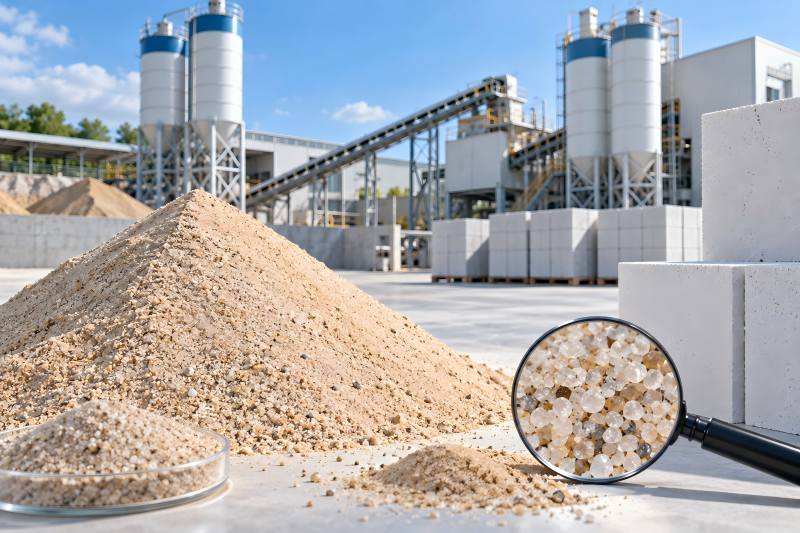
Actual consumption depends heavily on product density, formulation and raw-material composition. For preliminary planning, sand-based AAC formulations may use approximately 350–550 kg of dry sand per cubic meter of finished AAC, although individual plants can operate outside this range.
Using 450 kg/m³ as a simple planning assumption:
| AAC Capacity | Approx. Sand Requirement/Year |
| 100,000 m³ | 45,000 tonnes |
| 200,000 m³ | 90,000 tonnes |
| 300,000 m³ | 135,000 tonnes |
| 500,000 m³ | 225,000 tonnes |
At this scale, transportation quickly becomes important.
Saving even $2 per tonne on delivered sand could represent approximately $450,000 per year for a 500,000 m³ plant under this simplified example.
This is why locating an AAC plant near a suitable silica source can be more valuable than purchasing slightly cheaper production equipment.
How I Would Evaluate Sand Before Building an AAC Plant
Before the final equipment configuration is selected, representative samples should be taken from the intended commercial source rather than relying on one small sample provided specifically for testing.
The evaluation should then move through three stages:
- Laboratory characterization— analyze chemical composition, moisture, clay, particle-size distribution and potentially harmful impurities.
- Processing trials— test crushing and grinding behavior, slurry preparation, settling characteristics and required energy.
- AAC production trials— produce test blocks using the intended lime, cement, gypsum and aluminum system, then evaluate green cake behavior, cutting quality, autoclaving response, density, compressive strength and dimensional stability.
Only after these stages should the sand source be considered fully qualified.
For a new plant, I would also test at least one alternative source. Depending entirely on one quarry creates a supply-chain risk that can become expensive once the factory is operating.
For most AAC plants, suitable sand should be clean, quartz-rich, consistent and easy to grind, with low clay, organic matter and salts. Around 80–90%+ SiO₂ is generally preferred, although lower levels may still be workable depending on the overall composition.
The sand with the highest silica concentration is not the best. It should combine chemical suitability, reliable supply and economical processing to produce stable density, strength and block quality at a practical cost.