
Starting a mini AAC plant is a practical way to enter the lightweight building materials market with lower investment, less land, fewer workers, and a shorter setup time than a large factory. However, AAC production still requires complete processes such as batching, mixing, casting, cutting, autoclaving, separation, and packing.
For beginners, the key question is cost. Mini AAC plant cost depends on capacity, automation level, raw materials, local construction costs, steam system design, and supplier configuration.
A Mini AAC Plant: What Is It?
Autoclaved aerated concrete blocks are produced on a small-scale production line called a tiny AAC plant. AAC bricks are made from sand or fly ash, cement, lime, gypsum, water, and aluminium powder. After mixing, the slurry expands inside molds, forms a green cake, is cut into block sizes, and then cured in autoclaves under high temperature and pressure.
In most markets, a mini AAC plant usually refers to a production capacity of about 30,000 to 100,000 cubic meters per year. It is suitable for new investors, regional block suppliers, building material companies, and contractors who want to produce AAC blocks locally instead of buying from distant factories.
| Plant Type | Annual Capacity | Suitable Investor | Main Advantage |
| Small Mini AAC Plant | 30,000–50,000 m³/year | Beginners, local suppliers | Lower investment |
| Standard Mini AAC Plant | 50,000–75,000 m³/year | Regional block producers | Balanced cost and output |
| Large Mini AAC Plant | 75,000–100,000 m³/year | Growing manufacturers | Better unit cost |
| Medium AAC Plant | 100,000–200,000 m³/year | Established companies | Higher automation |
Estimated Mini AAC Plant Cost
The total cost of a mini AAC plant normally includes equipment, land, workshop construction, boiler system, electrical system, installation, labor training, raw material storage, working capital, and local permits. For a beginner, it is better to separate machinery cost from complete project investment.
| Capacity | Machinery Cost Estimate | Complete Project Investment Estimate |
| 30,000 m³/year | $250,000–$450,000 | $450,000–$800,000 |
| 50,000 m³/year | $350,000–$650,000 | $650,000–$1,150,000 |
| 75,000 m³/year | $500,000–$900,000 | $900,000–$1,600,000 |
| 100,000 m³/year | $700,000–$1,300,000 | $1,200,000–$2,200,000 |
These figures are for planning only. A very basic manual line may cost less, while a highly automated line with better cutting accuracy, larger autoclaves, automatic packing, advanced control systems, and imported components can cost much more.
Main Factors That Affect Mini AAC Plant Cost
Production Capacity
Capacity is the first factor that changes the investment amount. A 30,000 m³/year line needs fewer molds, fewer autoclaves, smaller material storage, and a smaller workshop. A 100,000 m³/year line needs more molds, larger batching systems, more curing carts, stronger cranes, and more autoclave capacity.
However, higher capacity can reduce the production cost per cubic meter. This is because labor, management, workshop, boiler operation, and maintenance costs are spread across more finished blocks.
Automation Level
A manual or semi-automatic line has lower initial cost, but it needs more workers and may have less stable quality. A more automated line costs more at the beginning, but it improves efficiency, reduces labor dependence, and supports more stable output.
| Automation Level | Initial Cost | Labor Demand | Best For |
| Manual | Low | High | Very small local projects |
| Semi-Automatic | Medium | Medium | Most beginner investors |
| Fully Automatic | High | Low | Long-term industrial production |
For many new investors, a semi-automatic mini AAC plant is the most practical choice. It controls initial investment while still providing acceptable production efficiency and product quality.
Raw Material Type: Sand or Fly Ash
AAC blocks can be made with sand-based or fly-ash-based formulas. If fly ash is available at low cost near a power plant, it can reduce raw material cost. If fly ash quality is unstable or unavailable, sand may be a better choice. Sand-based AAC usually requires a ball mill for grinding, which adds equipment and power cost.
| Raw Material Route | Main Advantage | Cost Consideration |
| Fly Ash AAC | Lower material cost if fly ash is local | Quality must be stable |
| Sand AAC | More stable and widely available | Requires grinding system |
| Mixed Formula | Flexible sourcing | Needs stronger quality control |
Before investing, beginners should test local raw materials. Poor raw material quality can cause cracking, low strength, poor rising, cutting defects, or unstable density.
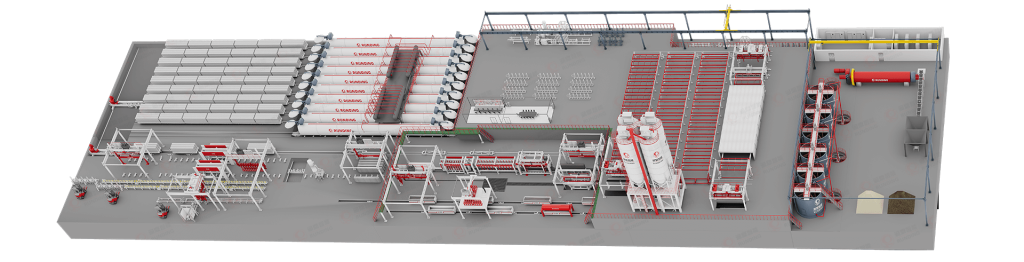
Equipment Included in a Mini AAC Plant
A mini AAC plant is not a single machine. It is a complete production system. The core equipment usually includes raw material storage, weighing system, slurry mixing system, molds, pre-curing area, cutting machine, autoclaves, boiler, cranes, carts, separation system, and packing equipment.
| Equipment Section | Main Function | Cost Importance |
| Crushing/Grinding System | Prepare lime, sand, or other materials | Medium to high |
| Batching and Mixing System | Control formula accuracy | High |
| Molds and Side Plates | Shape the AAC cake | Medium |
| Cutting Machine | Cut blocks accurately | High |
| Autoclaves | Steam curing under pressure | Very high |
| Boiler System | Provides steam | High |
| Cranes and Carts | Move molds and green cakes | Medium |
| Control System | Manages production process | Medium |
| Packing System | Bundles finished blocks | Optional/medium |
Among these, the autoclave, boiler, cutting machine, and batching system are especially important. Saving too much money on these parts may lead to quality problems and higher long-term maintenance cost.
Typical Investment Breakdown
For beginners, it is useful to understand where the money goes. Equipment is usually the largest part, but civil work, utilities, and working capital should not be ignored.
| Cost Item | Share of Total Investment | Example for $1,000,000 Project |
| Core Equipment | 50%–60% | $500,000–$600,000 |
| Boiler and Steam System | 8%–12% | $80,000–$120,000 |
| Civil Work and Workshop | 10%–18% | $100,000–$180,000 |
| Electrical and Water System | 5%–8% | $50,000–$80,000 |
| Installation and Training | 4%–8% | $40,000–$80,000 |
| Testing and Commissioning | 2%–4% | $20,000–$40,000 |
| Working Capital | 8%–15% | $80,000–$150,000 |
Many new investors only ask for the equipment price. This is a common mistake. The complete investment is always higher than the machinery quotation because the plant also needs land preparation, foundations, power supply, water treatment, steam pipelines, labor housing, raw material storage, and initial production capital.
Land and Workshop Requirements
A mini AAC plant does not need as much land as a large plant, but it still requires enough space for production flow, raw material storage, autoclaves, finished product storage, truck loading, and future expansion.
| Capacity | Recommended Land Area | Workshop Area | Finished Product Yard |
| 30,000 m³/year | 3,000–4,000 m² | 1,200–1,800 m² | 1,000–1,500 m² |
| 50,000 m³/year | 4,000–5,000 m² | 1,800–2,500 m² | 1,500–2,500 m² |
| 100,000 m³/year | 5,000–8,000 m² | 2,500–4,000 m² | 2,500–4,000 m² |
The layout should be designed carefully. A poor layout increases material handling cost, wastes labor, slows production, and makes future expansion difficult.
Operating Cost of a Mini AAC Plant
Besides initial investment, beginners must calculate the daily operating cost. The main operating expenses include raw materials, fuel, electricity, labor, maintenance, packaging, water, and administration.
| Cost Item | Estimated Cost per m³ | Notes |
| Raw Materials | $18–$30 | Depends on sand/fly ash, lime, cement cost |
| Fuel/Steam/Electricity | $4–$9 | Depends on boiler fuel and power price |
| Labor | $3–$8 | Lower with higher automation |
| Maintenance and Spare Parts | $1.5–$4 | Cutting wires, valves, carts, pumps |
| Packing and Handling | $2–$5 | Pallets, straps, loading |
| Quality Control/Admin | $1–$3 | Testing, management, office |
| Total Estimated Cost | $29.5–$59 | Excludes loan interest and tax |
The actual production cost depends heavily on local conditions. For example, a plant with cheap fly ash, low-cost fuel, and efficient labor may produce at a much lower cost than a plant that imports lime and uses expensive electricity.
Sample Profit Calculation
The following example shows a simple calculation for a 50,000 m³/year mini AAC plant. It assumes 70% capacity utilization in the first stable year.
| Item | Value |
| Designed Capacity | 50,000 m³/year |
| Actual Utilization | 70% |
| Annual Sales Volume | 35,000 m³ |
| Average Selling Price | $60/m³ |
| Annual Revenue | $2,100,000 |
| Estimated Production Cost | $40/m³ |
| Annual Production Cost | $1,400,000 |
| Estimated Gross Profit | $700,000 |
This is only a model. It does not include taxes, loan interest, depreciation, marketing costs, or unexpected downtime. However, it shows why capacity utilization is so important. A plant that runs at 30% utilization may struggle, while a plant that reaches 70%–85% utilization can become much more profitable.
Payback Period Estimate
The payback period depends on total investment, selling price, production cost, market demand, and plant utilization.
| Total Investment | Annual Gross Profit | Estimated Payback Period |
| $700,000 | $250,000 | 2.8 years |
| $1,000,000 | $400,000 | 2.5 years |
| $1,500,000 | $600,000 | 2.5 years |
| $2,000,000 | $700,000 | 2.9 years |
A realistic payback period for a mini AAC plant is often around 2.5 to 5 years, depending on the market. Beginners should avoid overly optimistic calculations. It is safer to calculate revenue based on moderate utilization during the first year.
Hidden Costs Beginners Should Not Ignore
Many investment plans fail because hidden costs are not included. Before buying equipment, investors should prepare a complete budget.
Common hidden costs include:
- Land leveling and foundation work
- Transformer and electrical installation
- Water supply and drainage system
- Boiler room construction
- Environmental permits
- Raw material testing
- Spare parts inventory
- Operator training
- Product certification
- Marketing and dealer development
- Loading equipment, such as forklifts
- Interest during installation period
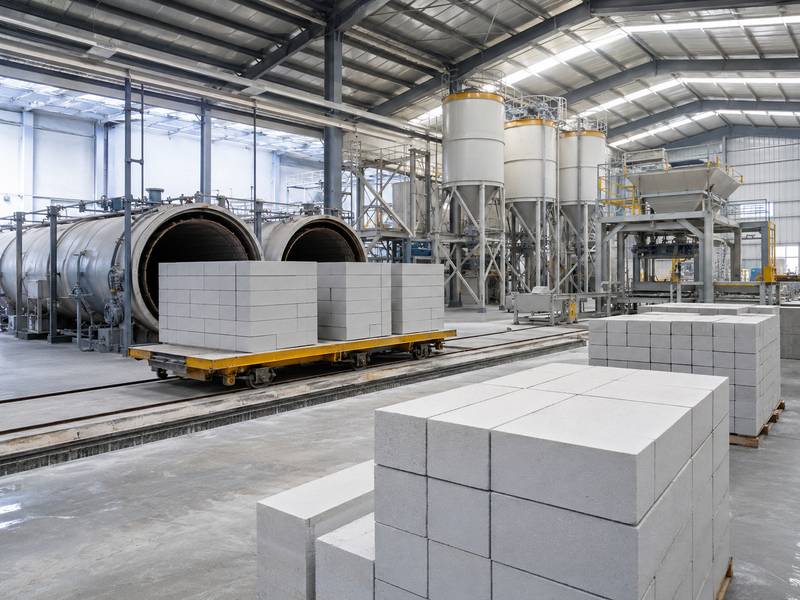
Forklifts, loaders, laboratory equipment, and storage sheds are often forgotten in early budgets. Although they are required for day-to-day operations, these items are not often included in the machinery quotation.
How to Reduce Mini AAC Plant Investment Risk
Start with Market Research
Before buying a plant, study local AAC block demand. Check housing projects, commercial buildings, government infrastructure plans, brick restrictions, energy-saving building policies, and competitor prices. A mini AAC plant is profitable only when there is stable demand.
Choose the Right Capacity
Do not choose the largest capacity just because the unit cost looks lower. Beginners should match capacity with realistic market demand. If your local market can only absorb 30,000 m³ per year, a 100,000 m³ line may create financial pressure.
Test Raw Materials First
Raw material testing should be completed before final plant design. The supplier should help test sand, fly ash, lime, cement, and gypsum. The formula affects equipment selection, curing time, block strength, density, and production stability.
Compare Complete Solutions, Not Only Machine Price
A low quotation may exclude boiler, autoclave, installation, training, cutting system, packing equipment, or electrical control. Always ask suppliers for a complete scope list. The lowest total investment isn’t always the cheapest offer.
Plan for Expansion
A good mini AAC plant layout should allow future capacity expansion. Even if you start with 50,000 m³/year, you may later want to add more molds, autoclaves, packing systems, or automation. Planning expansion at the beginning is cheaper than redesigning the factory later.
Recommended Budget Plan for Beginners
For most new investors, a practical starting plan is a 50,000 m³/year semi-automatic mini AAC plant. It offers a reasonable balance between investment, output, quality, and management difficulty.
| Budget Level | Suggested Plan | Suitable For |
| Low Budget | 30,000 m³/year basic line | Small local market |
| Balanced Budget | 50,000 m³/year semi-auto line | New AAC business |
| Growth Budget | 75,000–100,000 m³/year line | Strong demand market |
| Premium Budget | Higher automation | Labor-cost-sensitive market |
A balanced budget should include not only machinery, but also working capital for at least three to six months. This allows the plant to survive the early stage while building customer relationships and improving production stability.
Mini AAC plant cost depends on capacity, automation, raw materials, land, civil work, boiler system, and local conditions. A small plant may cost several hundred thousand dollars, while a complete 100,000 m³/year project can exceed one million dollars.
For beginners, the best choice is not the lowest price, but a reliable capacity, tested raw materials, complete investment planning, and an experienced AAC plant supplier. With proper planning, a mini AAC plant can support stable production, controlled risk, and long-term business growth.