
An AAC plant should choose wet grinding when its silica preparation route requires a controlled slurry and the available materials, water balance and storage system support that route. Dry grinding is appropriate when the process needs a dry powder or when adding water would create an unwanted material reaction or downstream handling problem. Select the method for each material stream and its destination, rather than applying one grinding rule to the entire plant.
Which Material Is Actually Being Ground?
Start by separating silica preparation from binder preparation. Sand, fly ash, lime and other ingredients do not have identical grinding needs, and some purchased materials may already meet the process specification. The decision begins with material testing and the approved recipe.
For sand, establish the incoming moisture, particle-size distribution, mineral composition and grindability. A wet sand route can combine size reduction with slurry preparation, while a dry route must also explain how the ground product will be stored, conveyed and eventually dosed. Neither route can be judged from the mill’s motor rating alone.
Quicklime deserves a separate assessment because it reacts with water. A decision to add water is a process-design decision involving reaction control, rather than a simple way to make a dry mill discharge easier to handle. Use the material supplier’s information and the plant process designer’s requirements before specifying its preparation route.
Likewise, avoid assuming that every fly ash supply needs the same milling step. The useful question is whether the received material consistently meets the recipe’s requirements. Grinding an already suitable material adds equipment and operating obligations without automatically improving the finished block.
What Does the Batching System Need to Receive?
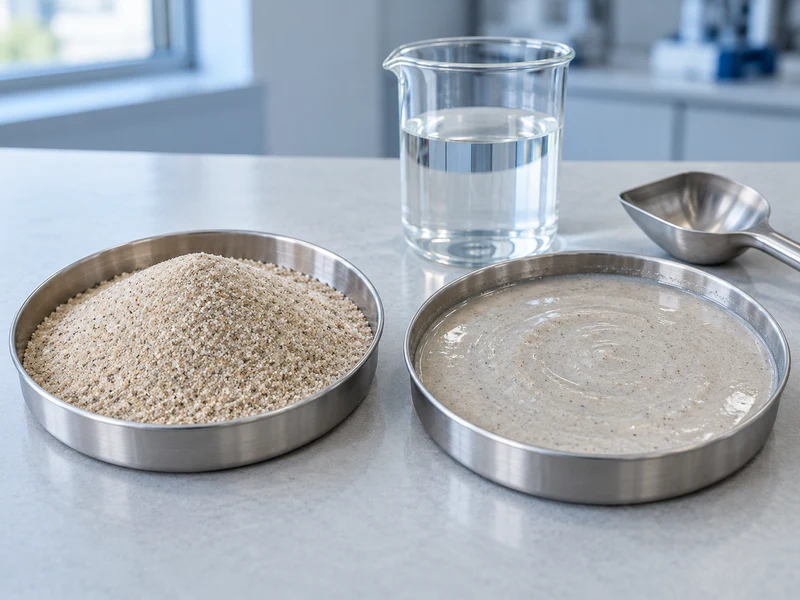
Work backward from the point where the prepared material enters batching. Specify whether the receiving system requires powder or slurry, the required fineness and the acceptable variation between deliveries. For slurry, add the solids concentration and temperature conditions used by the process designer.
A wet-ground product needs a defined route through transfer, storage, agitation and dosing. A dry-ground product needs controlled discharge, suitable storage and a reliable powder feed into the next stage. Treat these associated systems as part of the grinding choice.
Review the AAC ball mill configuration against this destination specification. A general product table may help identify a machine family, but it does not establish performance for an untested local material. Request a project-specific duty point and the conditions attached to it.
| Process Question | Wet Route | Dry Route |
| What leaves the preparation stage? | A slurry with controlled solids and particle size | A powder with controlled moisture and particle size |
| What storage must be provided? | Usable tank capacity and suitable agitation | Suitable silo or bin capacity and dependable discharge |
| Which handling losses need attention? | Settling, deposits and transfer interruptions | Dust, carryback, bridging and discharge interruptions |
| What must the recipe account for? | Water carried with the slurry | Moisture already present and water added later |
When Does Wet Grinding Fit the Plant?
When Slurry Preparation Is Already Required
Wet grinding is a strong candidate when the plant intends to batch silica as slurry and can maintain its condition between milling and use. It reduces the need to handle a separate dry ground product before slurry preparation. That advantage depends on reliable downstream storage and transfer, not merely the presence of a tank.
Check the full range of operating conditions, including the lowest planned production rate. A tank and agitator selected around a single full-load condition may behave differently when inventory falls. The usable storage range should be consistent with suspension requirements and the dosing system’s needs.
When the Water Balance Remains Controllable
Account for water arriving with the sand, water deliberately added to milling and any approved recycled process water. The batching team needs to know how much water enters with each quantity of slurry. A stable slurry-volume reading is not a substitute for knowing its solids content.
For an illustrative mass balance, 10 tonnes of dry solids at 60% solids by mass correspond to about 16.67 tonnes of slurry. The total water in that slurry is about 6.67 tonnes before considering how the water is supplied. The percentages here serve only to demonstrate the calculation; the process designer must specify the concentration for the actual plant.
If the incoming sand already contains water, that amount belongs in the balance rather than being added again. The same discipline applies to approved recovered water. Confirm its suitability, temperature and variability before treating it as a dependable process input.
When Is a Dry Route Worth Considering?
A dry route deserves consideration where the next process stage requires powder, where a dry material is supplied and stored effectively, or where wet preparation would create an unacceptable process constraint. It may also fit a plant with established powder handling that can meet the required consistency. These conditions should be demonstrated rather than assumed from the absence of slurry equipment.
Examine incoming moisture across seasons. A dry-grinding proposal that works with a laboratory-dried sample may need additional preparation for material delivered after rain. Ask whether drying is required and include that equipment, energy use and control burden in the comparison.
Dust control belongs in the base scope of the proposed dry system. Review enclosure, collection points, transfer arrangements and cleaning access with the responsible specialists. A low equipment price that omits required dust handling does not represent the complete route.
Powder storage also needs to be tested against material behavior. Determine whether the product can discharge consistently and whether segregation, compaction or moisture ingress changes its handling. Reliable grinding output is of limited value if batching regularly waits for a blocked outlet.
Which Measurements Make the Comparison Fair?
Compare both routes at the same material input, accepted fineness and required production rate. State whether the capacity is dry-solids throughput, slurry mass flow or another quantity. Different measurement bases can make two apparently similar offers impossible to compare.
Use the relationship between grinding fineness and slurry stability to frame the quality discussion. A smaller particle size is not an unlimited benefit if it raises cost or changes process behavior without improving the required product. The agreed endpoint must support the recipe and finished-block requirements.
- Record the test material source, moisture and particle-size distribution.
- Define the accepted product fineness and the method used to measure it.
- Report throughput on a clearly stated dry-solids basis where routes are compared.
- Measure energy across the agreed system boundary, including necessary auxiliaries.
- Record water addition, storage behavior and interruptions during the trial.
- Identify which observations were measured and which remain design estimates.
Request representative trials when the local feed differs materially from the supplier’s reference experience. Brief trials leave two important questions open: performance with feed received in other seasons, and the condition of wear parts after extended operation. Record the remaining uncertainty instead of converting every trial result into a guarantee.
How Should Whole-System Cost Be Compared?
Include preparation, grinding, conveying or pumping, storage, dust handling, instrumentation and maintenance access. Add operating costs using the expected production schedule and actual local service conditions. Keep optional equipment separate from items required to meet the quoted performance.
Downtime consequences also differ between routes. A wet system may depend on adequate usable slurry inventory during a mill stop, while a dry system may depend on powder stock and dependable silo discharge. Calculate how long each arrangement can support batching under its credible interruption scenarios.
Do not assume that a smaller number of machines means a simpler operating system. A compact wet route may demand closer water-balance control; a familiar dry route may require more attention to dust and powder flow. The better choice is the one the plant can operate consistently with its available skills and services.
What Should Be Written Into the Final Decision?
Document the selected route for each material, the tested feed envelope and the required product condition. Attach the material balance, equipment boundary and acceptance method. This gives procurement and operations the same basis for reviewing later changes.
The raw-material preparation equipment scope should then follow that decision. Confirm the interfaces with storage and batching before ordering the mill. A sound selection connects local material behavior to dependable batch supply, with the tradeoffs visible before the plant is built.