
Starting an AAC block business offers strong potential in the building materials market. AAC is lightweight, energy-efficient, fire-resistant, and widely used in construction.
Success requires more than machines. Investors need market research, factory planning, raw material analysis, equipment selection, quality control, sales channels, and cost control.
This guide covers key steps, including market analysis, equipment configuration, production process, investment planning, and operation tips.
Understand the AAC Block Market
Before starting an AAC block business, investors should first study local construction demand. AAC blocks are commonly used for wall construction, partition walls, high-rise buildings, commercial projects, schools, hospitals, hotels, and industrial buildings.
In many regions, AAC blocks are gradually replacing clay bricks and traditional concrete blocks because they support faster construction and better thermal insulation. However, market demand differs by country and region. Some markets already understand AAC blocks well, while others still need customer education.
Key Market Research Points
| Research Item | What to Check | Why It Matters |
| Local construction growth | Housing, commercial buildings, and infrastructure | Determines long-term demand |
| Existing competitors | AAC block factories, brick suppliers, concrete block plants | Helps set pricing and positioning |
| Customer acceptance | Contractors, developers, distributors | Affects sales difficulty |
| Local building standards | Block size, strength grade, fire rating | Determines product specification |
| Transport distance | Delivery radius and logistics cost | Impacts profit margin |
| Raw material availability | Fly ash, sand, cement, lime, gypsum | Affects production cost |
A good AAC block business should be built in a market with steady construction demand, stable raw material supply, and reasonable competition.
Choose the Right Business Positioning
Different investors may choose different AAC block business models. Some focus on low-cost standard blocks for mass construction, while others target premium blocks or AAC panels for higher-end projects.
Common AAC Business Models
| Business Model | Main Products | Suitable Buyer Type |
| Standard AAC block factory | Common wall blocks | Start-up and regional producers |
| Large AAC production plant | Blocks in multiple sizes | Large building material suppliers |
| AAC block and panel plant | Blocks, panels, reinforced products | Advanced manufacturers |
| Local distributor + small plant | Common local block sizes | Small regional investors |
| Customized AAC supplier | Special sizes or project-based blocks | Contractors and real estate projects |
For a new investor, starting with standard AAC blocks is often more practical. Once the market becomes stable, the business can expand into AAC panels, special block sizes, or higher automation.
Prepare a Feasibility Study
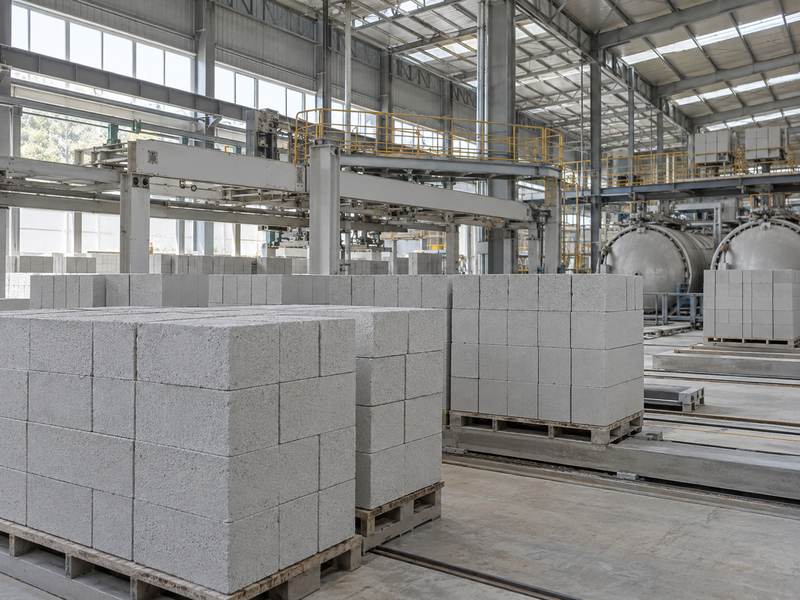
A feasibility study helps investors understand whether the AAC block business can be profitable. It should include investment cost, land requirement, production capacity, raw material cost, labor cost, energy consumption, selling price, and expected payback period.
Feasibility Study Checklist
| Section | Key Questions |
| Market demand | Who will buy the AAC blocks? How much can they buy monthly? |
| Product specification | What block sizes and density grades are needed locally? |
| Raw materials | Are fly ash or sand available at a stable cost? |
| Investment budget | How much capital is available for land, machines, and operations? |
| Production capacity | What daily or annual output is suitable? |
| Sales price | What is the market price per cubic meter or per block? |
| Operating cost | What are the costs of cement, lime, steam, power, and labor? |
| Profit estimate | What is the expected margin after all expenses? |
Investors should avoid choosing equipment only based on the lowest machine price. A low-cost but unstable production line may increase waste, downtime, and maintenance cost.
Select a Suitable Plant Capacity
AAC block production lines are usually planned by daily capacity or annual capacity. The right capacity depends on market demand, investment budget, land area, labor availability, and sales ability.
AAC Block Plant Capacity Reference
| Plant Scale | Daily Capacity | Suitable For | Main Features |
| Small plant | 50–100 m³/day | Start-up investors | Lower investment, simple operation |
| Medium plant | 150–300 m³/day | Regional suppliers | Balanced cost and output |
| Large plant | 500–1,000 m³/day | Large building material companies | Higher automation and stronger supply ability |
| Customized plant | Based on demand | Special projects | Flexible layout and product planning |
For many new investors, a medium AAC block plant is a practical choice. It can meet regional market demand without requiring an extremely high initial investment.
Choose Raw Materials
AAC blocks are usually made from silica materials, cement, lime, gypsum, aluminum powder, and water. The main silica source can be fly ash or sand.
Fly Ash AAC vs Sand AAC
| Item | Fly Ash AAC | Sand AAC |
| Main silica material | Fly ash | Sand |
| Common source | Power plants | Local sand resources |
| Grinding requirement | Usually lower than sand | Usually needs ball mill grinding |
| Color | Often gray | Often white or light gray |
| Cost advantage | Good where fly ash is cheap | Good where sand is easy to obtain |
| Suitable region | Areas near thermal power plants | Areas with stable sand supply |
Raw material testing is very important before confirming the production formula. Different raw materials have different chemical compositions, fineness, moisture levels, and activity. A professional AAC block machine manufacturer can help evaluate a suitable process configuration based on local materials.
Buy AAC Block Making Machines
The core of the business is the AAC block production line. A complete AAC block plant includes multiple equipment sections, not just one machine.
Main AAC Block Production Equipment
| Production Section | Main Equipment | Function |
| Raw material preparation | Ball mill, crusher, slurry tank, cement silo, lime silo | Prepares raw materials |
| Batching and mixing | Weighing system, mixer, pouring system | Controls formula and slurry quality |
| Moulding and pre-curing | Mould, ferry car, pre-curing room | Forms AAC green cake |
| Cutting section | Vertical cutting machine, horizontal cutting machine, cross-cutting machine | Cuts green cake into blocks |
| Autoclaving section | Autoclave, boiler, curing trolley | Steam curing for final strength |
| Finished handling | Separator, packing machine, conveyor | Separates, stacks, and packs finished blocks |
| Control system | PLC cabinet, sensors, operation panel | Improves automation and process stability |
When choosing equipment, investors should consider machine quality, automation level, cutting accuracy, installation support, spare parts supply, and after-sales service.
Plan the Factory Layout
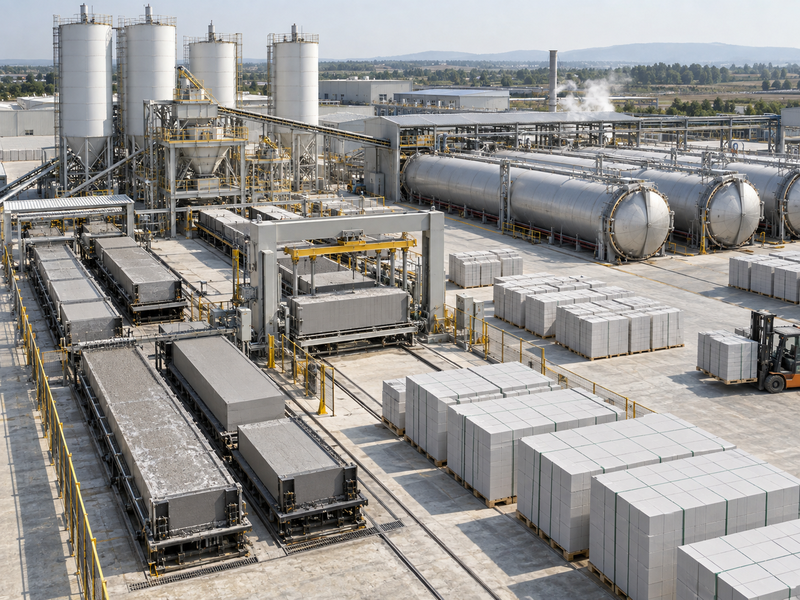
Factory layout affects production efficiency, material flow, labor use, and future expansion. A good AAC plant layout should allow smooth movement from raw material preparation to finished product storage.
Main Areas in an AAC Block Plant
| Factory Area | Purpose |
| Raw material storage | Stores fly ash, sand, cement, lime, gypsum, and aluminum powder |
| Grinding and slurry area | Prepares silica slurry |
| Batching and pouring area | Mixes and pours slurry into moulds |
| Pre-curing area | Allows green cake to reach cutting strength |
| Cutting area | Cuts AAC cake into required dimensions |
| Autoclave area | Steam cures blocks under high pressure |
| Finished product area | Separates, stacks, packs, and stores blocks |
| Maintenance area | Stores spare parts and tools |
| Office and lab | Quality testing and management |
The layout should also consider forklift movement, raw material truck access, finished product loading, drainage, safety distance, and equipment maintenance space.
Understand the AAC Block Production Process
The AAC block production process is systematic. Every stage affects the final quality.
First, fly ash or sand is prepared into a slurry. Cement, lime, gypsum, aluminum powder, and water are all weighed using this formula. The slurry is mixed and poured into moulds. The slurry expands as a result of the reaction between alkaline materials and aluminum powder, which produces air bubbles.
The green cake is robust enough to cut after pre-curing. The cutting machine cuts it into the required block sizes. After being cut, the blocks are placed in autoclaves to undergo high-pressure steam curing. The blocks are separated, packed, and shipped after autoclaving.
AAC Block Production Flow
| Step | Process | Key Control Point |
| 1 | Raw material preparation | Fineness, moisture, chemical composition |
| 2 | Batching | Accurate weighing |
| 3 | Mixing and pouring | Slurry temperature and uniformity |
| 4 | Pre-curing | Green cake strength and expansion height |
| 5 | Cutting | Size accuracy and smooth edges |
| 6 | Autoclaving | Steam pressure, temperature, curing time |
| 7 | Separating | Avoid block damage |
| 8 | Packing and storage | Stable stacking and delivery |
Estimate Investment and Operating Costs
The total investment includes land, factory building, equipment, installation, utilities, raw materials, labor, and working capital. Operating cost mainly includes raw materials, energy, labor, maintenance, packaging, and logistics.
Main Cost Items
| Cost Category | Examples | Notes |
| Fixed investment | Land, workshop, equipment, foundation | One-time major cost |
| Utility systems | Power, water, steam, boiler system | Must match plant capacity |
| Raw materials | Cement, lime, fly ash/sand, gypsum, aluminum powder | Main production cost |
| Labor | Operators, technicians, maintenance staff | Depends on automation level |
| Energy | Electricity, fuel, steam, water | Affects cost per cubic meter |
| Maintenance | Cutting wires, motors, valves, bearings | Needed for stable operation |
| Logistics | Forklift, pallets, delivery trucks | Important for sales radius |
| Working capital | Initial material stock and daily operation | Helps avoid cash flow pressure |
A higher automation level may increase initial investment but can reduce labor cost and improve production consistency.
Build a Quality Control System
Quality control is essential for customer trust. AAC blocks must meet requirements for density, compressive strength, size tolerance, surface quality, moisture, and appearance.
AAC Block Quality Control Points
| Quality Item | Why It Matters |
| Density | Affects weight, strength, and insulation |
| Compressive strength | Determines structural suitability |
| Dimensional accuracy | Improves wall flatness and reduces mortar use |
| Surface quality | Affects customer acceptance |
| Edge condition | Reduces breakage during transport |
| Autoclave curing quality | Ensures stable strength |
| Moisture control | Helps storage and delivery |
Investors should prepare basic testing equipment and train workers to inspect each production batch. Consistent quality helps build long-term cooperation with contractors and distributors.
Develop Sales Channels
Sales are just as important as production. Before the plant starts full operation, investors should already build relationships with buyers.
Common AAC Block Customers
| Customer Type | Buying Focus |
| Construction contractors | Stable supply, block quality, and delivery speed |
| Real estate developers | Project price, reliability, and technical support |
| Building material distributors | Margin, inventory, product consistency |
| Government projects | Standards, certification, supply capacity |
| Retail building material stores | Packaging, availability, and price competitiveness |
Useful sales methods include local construction visits, distributor cooperation, sample testing, project case promotion, technical seminars, online marketing, and cooperation with architects or contractors.
Choose a Reliable AAC Block Machine Manufacturer
A professional AAC block machine manufacturer can support the project from planning to production. The supplier should provide equipment design, plant layout, installation guidance, operator training, formula support, and after-sales service.
Runding AAC can provide complete AAC block machine and production line solutions for start-up, medium, and large AAC block plants. For investors, working with a complete solution supplier can reduce equipment matching problems, improve commissioning efficiency, and support more stable production after the plant starts running.
Supplier Selection Checklist
| Factor | What to Check |
| Experience | Has the supplier completed AAC plant projects before? |
| Complete line ability | Can it provide full production line equipment? |
| Customization | Can it be designed based on capacity and raw materials? |
| Cutting accuracy | Does the cutting machine meet size tolerance needs? |
| Installation support | Can the supplier guide installation and commissioning? |
| Spare parts | Are key spare parts available quickly? |
| Training | Can operators be trained for daily production? |
| After-sales service | Is technical support available after delivery? |
Common Mistakes to Avoid
Many AAC block business problems come from poor planning, not from market demand.
Common Mistakes
| Mistake | Possible Result |
| Choosing machines only by price | Higher downtime and poor product quality |
| Ignoring raw material testing | Unstable formula and weak blocks |
| Overestimating market demand | Excess inventory and cash pressure |
| Poor factory layout | Low efficiency and difficult maintenance |
| Lack of skilled operators | Production instability |
| Weak quality control | Customer complaints and returns |
| No sales plan before production | Slow market entry |
Careful planning can reduce risk and help the business become profitable faster.
Starting an AAC block business can be profitable with proper market research, raw material analysis, capacity planning, equipment selection, factory layout, and quality control.
A successful AAC block factory needs reliable equipment, stable technology, skilled operators, and strong sales channels. Runding AAC can help investors design a suitable production line, reduce risks, and improve efficiency.
With rising demand for lightweight, energy-saving wall materials, AAC block production offers good potential for building material investors.