
Reliable AAC slurry storage depends on keeping the prepared suspension consistent through its full holding and transfer period. Check representative samples, the agitator’s actual operating condition, and the outlet sequence together before changing the recipe. A turning shaft or a moving liquid surface alone does not establish that the material sent to batching is uniform.
This guide follows a hypothetical production investigation from the storage tank to the receiving station. The example is illustrative, while the inspection sequence can be adapted to the tank, slurry, and quality procedures used at a real plant.
The Starting Clue: A Stable Tank Level, an Unstable Feed
Imagine that a plant reports alternating thick and thin slurry at batching, although the tank level appears normal. The first task is to establish whether the variation already exists in the stored material or develops during withdrawal and transfer. Increasing mixing speed immediately would obscure that distinction.
Write down when the variation occurs: after a delivery, near the end of a drawdown, after a weekend stop, or during an otherwise steady run. Match those observations to the tank identity and transfer destination. The pattern determines which comparison will be most informative.
Before the investigation starts, separate three questions that are often combined under the word consistency:
- Is the slurry composition changing between incoming batches?
- Is stored material becoming uneven within the tank?
- Is the transfer system delivering material intermittently or drawing from an unrepresentative location?
These questions can have different answers at the same plant. A pump adjustment cannot correct an unidentified incoming material change, and a new agitator cannot establish whether the sampling method is reliable. Preserve the distinction until measurements support a specific explanation.
Trace the Material Before Adjusting the Equipment
At the Tank Inlet: Establish What Arrived
Record the incoming slurry reference, preparation time, quantity, and the quality checks required by the process specification. Note any approved dilution or blending operation as a separate event. Otherwise, a change introduced before storage may later be mistaken for a tank problem.
Use the same test method when comparing incoming batches. If density is one of the controlled properties, keep the sampling and measurement procedure consistent and record the applicable temperature condition. Treat a density reading as one piece of evidence, not a complete description of particle distribution or flow behavior.
The discussion of raw material fineness and AAC performance explains why material preparation belongs in this investigation. A storage study should retain that upstream reference while focusing on what changes during the holding period. Avoid redesigning the grinding process from one unusual tank sample.
Inside the Storage Stage: Compare Like With Like
Use the plant’s engineered sampling points and an approved method to compare the material over time and, where provided, at different locations. Record the liquid level, agitator status, and time since the last addition beside each result. Differences are difficult to interpret when those conditions are missing.
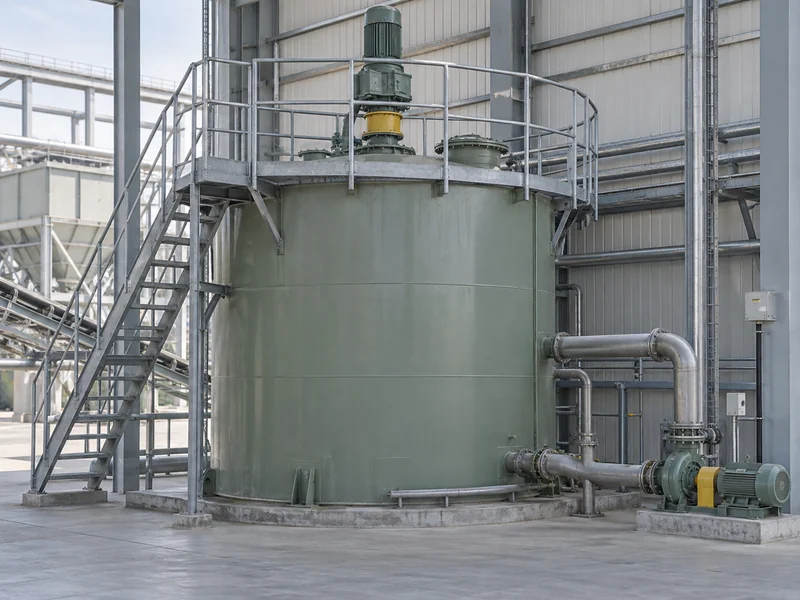
Runding describes its slurry storage agitator as providing slow stirring to help prevent prepared slurry from settling. Selection still requires the actual slurry properties, working volume, vessel geometry, and operating schedule. The listed tank volume does not establish the usable range for every application.
Review whether the installed arrangement matches the approved drawing and whether the drive, shaft, and mixing components are in their specified condition. Perform intrusive inspection only after the required isolation and access controls. An observation made from outside a protected area should never be converted into an improvised tank-entry task.
At the Outlet: Observe a Complete Withdrawal
Compare samples or process readings across the beginning, middle, and end of a representative transfer where the approved sampling arrangement allows it. A single sample collected at the easiest moment can miss a repeating change during drawdown. Keep transfer rate and destination records with the results.
The AAC slurry pump is part of this material path rather than an isolated component. Review its permitted operating conditions alongside tank level, inlet arrangement, and the receiving process. A visibly fluctuating delivery does not identify which of those interfaces caused it.
If tank samples remain comparable but the outlet changes, investigate the transfer path and measurement location before blaming storage. If both change together, extend the comparison back toward the tank inlet. This sequence limits unnecessary adjustments and gives maintenance a more precise inspection request.
Use the Symptom to Choose the Next Comparison
| Observed Pattern | Next Comparison | Interpretation Limit |
| Variation follows a new slurry delivery | Compare incoming records with the preceding accepted batch | Timing alone does not prove a material defect |
| Outlet changes as the tank empties | Compare level, samples, and withdrawal conditions | One outlet sample cannot map the whole tank |
| Variation appears after a long stop | Compare holding history and the approved restart sequence | A longer mixing period needs process validation |
| Tank results are stable but delivery pulses | Inspect transfer conditions and instrument behavior | Pulsation does not automatically mean pump damage |
| Results disagree between operators | Repeat the sampling and measurement method together | Resolve measurement differences before tuning machinery |
Use the table to select an investigation, not to declare a cause. A useful finding includes the observation, the comparison performed, and what that comparison ruled in or left uncertain. Keep an accepted production period as a reference whenever practical.
What the Sample Bench Can and Cannot Tell You
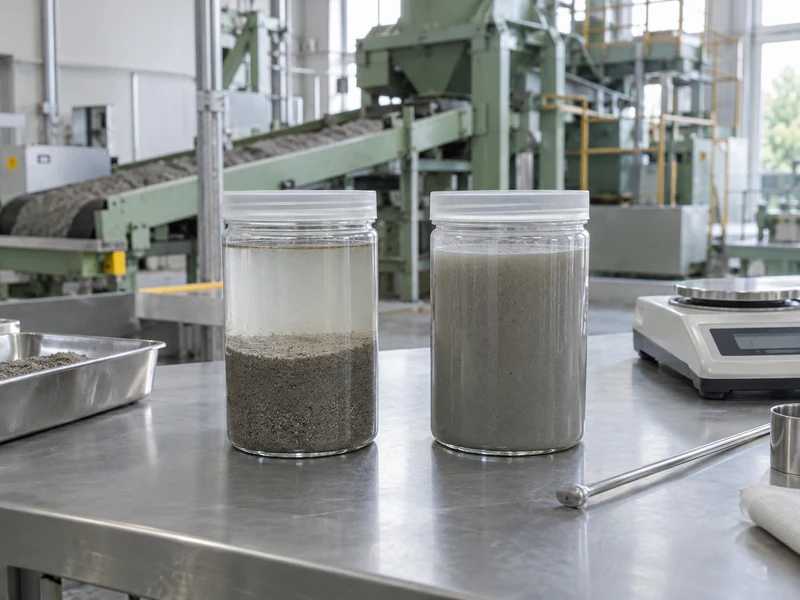
A jar that develops a visible sediment layer demonstrates behavior under that jar’s test conditions. It does not reproduce the circulation, withdrawal, temperature history, or geometry of a production tank. Use such observations to support a controlled comparison, not to calculate an agitator setting by eye.
Likewise, a uniform-looking sample may still need the checks specified for production release. Record test results against the plant’s acceptance criteria and retain the sample identity. The most valuable result is one that another shift can reproduce using the same method.
The related article on grinding fineness and slurry stability provides context for interpreting changes in the suspension. Keep the storage investigation separate from a laboratory formulation trial. Both may be needed, but their questions and comparison conditions should remain clear.
Plan for Holding Time and Restart
A tank that performs well during continuous production may behave differently during extended holding. Review the expected weekend, maintenance, and interruption scenarios with the equipment and process teams. Establish permitted holding and restart conditions through the plant’s validated procedure.
- Identify the material remaining in the tank and its recorded history.
- Confirm equipment readiness and any maintenance release before starting.
- Apply the approved agitation and transfer sequence.
- Check the specified slurry properties before releasing material to batching.
- Record whether the first transfer differs from subsequent production.
Do not assume that adding water makes held slurry acceptable, or that a longer run automatically restores its original condition. Any recovery action needs a defined purpose and a check of the result. Material outside its release criteria should remain identified while the responsible team decides its disposition.
Maintenance on the tank drive or connected equipment must address unexpected movement and stored energy. OSHA’s hazardous energy control guidance provides a reference for that principle; the installation’s own procedure must address its actual energy sources and applicable requirements. Keep sampling access and maintenance access distinct.
Turn the Investigation Into a Useful Operating Record
Bring together tank identity, incoming batch, level history, agitator condition, withdrawal sequence, and the relevant sample results. Review one suspected cause at a time with production and maintenance. Document the authorized correction before comparing the next run with the baseline.
When the evidence points toward the transfer equipment, the guide to AAC slurry pump troubleshooting can support the next inspection. When the evidence points upstream, retain the storage records so that the material team can distinguish arrival conditions from later changes. Passing the investigation onward should preserve its evidence.
For a new tank purchase, turn the same records into a supplier brief: slurry characteristics, required buffer volume, normal drawdown, longest expected holding period, and available sampling access. Ask how the proposed arrangement will be demonstrated with representative material. Consistent feed is an outcome to verify across an operating sequence, not a feature established by tank size alone.